Most supplement brands pick their dosage form based on habit, not strategy. That decision silently kills their margins, shelf appeal, and product stability every single day.
Softgels are the right move when your formulation contains oil-soluble actives, oxidation-sensitive ingredients, or nutrients that need enhanced bioavailability—and when your brand positioning supports premium pricing. Outside those conditions, other formats serve you better.

I work on the production side of supplement manufacturing. Every week, I sit with brand owners who are deciding which dosage form to use for their next product. The conversation always starts the same way: "We want softgels because they look premium." That is not wrong. But it is incomplete. The real question is whether your product's formulation, your target consumer, and your market positioning all align with what softgels uniquely deliver. When they do, softgels are not just a nice choice—they are the correct one. When they do not, you are paying more per unit for no defensible reason. Let me walk you through how I help clients make this decision.
Why Do Oil-Soluble Ingredients Perform Better in Softgels?
Hard capsules and tablets struggle with oil-based actives. They leak, oxidize, or require extra excipients that dilute potency. This is not a preference—it is a formulation reality.
Softgels encapsulate oil-soluble ingredients in a sealed gelatin shell that protects the fill from oxygen, light, and moisture. This makes them the technically superior format for fish oil, CoQ10, vitamin D3, vitamin E, and similar lipid-based nutrients.

The Technical Problem Softgels Actually Solve
In our production experience, the most common formulation failure we see with oil-based actives in other formats is oxidation. When you put fish oil into a hard capsule, you are relying on a two-piece shell with a seam. That seam allows micro-level oxygen exchange. Over a 24-month shelf life, this degrades EPA and DHA content measurably. We have tested competitor products at month 18 and found potency drops of 15–20%1.
Softgels eliminate this. The one-piece hermetic seal creates an anaerobic environment inside the capsule2. The fill material stays protected from the moment of encapsulation until the consumer swallows it.
Here is where I draw the boundary clearly:
| Ingredient Type | Softgel Advantage | Alternative Format |
|---|---|---|
| Fish oil (EPA/DHA) | Full oxygen barrier, no rancidity | Hard caps leak and oxidize |
| CoQ10 (ubiquinone) | Oil suspension improves stability | Tablets require heavy excipients |
| Vitamin D3 | Oil matrix protects potency | Powder form is less stable |
| Vitamin E (tocopherols) | Natural oil form preserved exactly | Hard caps need oil absorption agents |
| Lutein/Zeaxanthin3 | Lipid matrix maintains bioactivity | Tablets compress and degrade |
When This Advantage Does NOT Apply
I tell clients directly: if your active ingredient is water-soluble—vitamin C, B-complex vitamins, most mineral salts—softgels give you zero formulation advantage. You are paying more for a format that does not solve any problem your product has. In those cases, tablets or hard capsules are the rational choice.
Similarly, high-dose probiotics cannot survive the softgel manufacturing process. The heat involved in gelatin shell formation kills live cultures4. If a client comes to me with a probiotic formula and asks for softgels, I say no. That is not what this format is for.
Do Consumers Actually Pay More for Softgels?
Brand owners care about margin. The question is not just "can I make softgels?" but "will my customers pay enough to justify the higher per-unit cost?" The answer depends on your category and market.
In categories like fish oil, CoQ10, and vitamin E, consumers already associate softgels with quality and efficacy5. This perception directly supports 20–40% higher retail pricing compared to equivalent tablet formulations in the same category6.

The Commercial Logic Behind Dosage Form Selection
Across projects we have managed for clients in Southeast Asia, the Middle East, and parts of Africa, the pattern is consistent. When a brand launches fish oil in softgel format, it commands a higher price point than the same EPA/DHA dose in a hard capsule—even when the consumer does not understand the technical reason. The visual and tactile experience of a softgel communicates "pharmaceutical grade" in the consumer's mind.
I had a client from the Philippines who was selling omega-3 in standard hard capsules. Her margins were thin because she was competing on price with dozens of other brands using the same format. When she switched to transparent softgels with visible golden oil inside7, she repositioned the product as a premium line. Her retail price went up 35%. Her volume stayed the same. That is pure margin gain from a dosage form decision.
But here is the boundary: this only works in categories where consumers already expect softgels. If you are selling a turmeric supplement or a green superfood blend, softgels do not carry the same premium perception. In those categories, consumers expect capsules or powders. Putting turmeric in a softgel does not automatically make it premium—it just makes it more expensive to produce without a corresponding price increase at retail.
| Category | Consumer Expectation | Softgel Premium Justified? |
|---|---|---|
| Fish oil / Omega-3 | Softgel is the default | Yes—strongly |
| CoQ10 | Softgel expected | Yes |
| Vitamin E | Softgel expected | Yes |
| Multivitamin | Tablet is the default | Weak—limited premium |
| Probiotics | Capsule is the default | No—wrong format entirely |
| Protein / Superfoods | Powder is the default | No—mismatch with consumer expectation |
When Higher Cost Per Unit is NOT Justified
If your target market is extremely price-sensitive and your product category does not carry a softgel premium perception, you are burning money. I have seen clients insist on softgels for products that ended up sitting on shelves because the retail price was too high for the category. The dosage form must match the market's willingness to pay. This is a business decision, not a vanity decision.
Does the Softgel Matrix Actually Improve Bioavailability?
This is where I see the most confusion. Clients hear "better absorption" and assume it applies to everything. It does not. The bioavailability advantage is real—but only for specific ingredient categories.
Softgels improve bioavailability for lipid-soluble nutrients by delivering them in a pre-dissolved oil matrix. This means the body skips the dissolution step required with tablets or powder-filled capsules. This advantage applies specifically to fat-soluble vitamins (A, D, E, K), omega fatty acids, CoQ10, and certain herbal extracts standardized in oil form.

Why Pre-Dissolved Delivery Matters for Specific Nutrients
When you swallow a tablet containing vitamin D3, your digestive system must first break down the tablet matrix, then dissolve the active ingredient, then emulsify it with bile salts before it can be absorbed8. Each step reduces the percentage that actually reaches your bloodstream.
In a softgel, the vitamin D3 is already dissolved in an oil carrier—typically MCT oil or soybean oil. When the gelatin shell dissolves in the stomach, the oil-based fill is immediately available for absorption. There is no dissolution barrier. No emulsification delay.
In our production experience, clients who switch from tablet-form vitamin D3 to softgel-form report fewer customer complaints about "not feeling any difference." That is anecdotal, but it aligns with published research showing higher serum levels from oil-based vitamin D delivery versus dry powder forms9.
The Categories Where This Claim is Defensible
| Ingredient | Bioavailability Benefit in Softgel? | Mechanism |
|---|---|---|
| Vitamin D3 | Yes | Pre-dissolved in oil, bypasses dissolution |
| CoQ10 | Yes | Oil matrix dramatically improves absorption10 |
| Omega-3 fatty acids | Yes | Already in lipid form, immediate availability |
| Curcumin (in oil suspension) | Moderate | Oil carrier improves solubility, but not as dramatic |
| Vitamin C | No | Water-soluble, no benefit from oil matrix |
| Zinc / Magnesium | No | Mineral salts, no lipid solubility advantage |
| B-vitamins | No | Water-soluble, softgel adds no absorption benefit |
I refuse to tell clients that softgels "improve absorption" as a blanket statement. That is misleading. If your active ingredient is water-soluble, the softgel matrix provides zero bioavailability advantage. You are paying for a premium shell around an ingredient that does not benefit from being in oil. I will always redirect those clients toward hard capsules or tablets where the economics make more sense.
Softgels vs Tablets vs Hard Capsules: Which Format Is Best?
Many brand owners begin with the question:
Which dosage form should I choose?
The answer depends on your formulation, target consumer, pricing strategy, and manufacturing requirements.

No dosage form is universally superior.
Each format solves different problems.
| Factor | Softgels | Hard Capsules | Tablets |
|---|---|---|---|
| Bioavailability for Oil-Based Ingredients | Excellent | Good | Moderate |
| Cost per Unit | High | Moderate | Low |
| Consumer Premium Perception | Excellent | Good | Moderate |
| Manufacturing Complexity | High | Moderate | Low |
| MOQ Requirement | High | Low | Low |
| Shelf Differentiation | Excellent | Moderate | Weak |
| Oil-Based Formulas | Excellent | Fair | Poor |
| High-Dose Powder Formulas | Poor | Excellent | Excellent |
| Water-Soluble Ingredients | Moderate | Excellent | Excellent |
As a manufacturer, I always tell clients that the best dosage form is the one that solves a real formulation or commercial problem.
Choosing softgels simply because they look premium often leads to unnecessary costs.
Choosing tablets simply because they are cheaper can limit product positioning and consumer perception.
The right answer depends on the entire product strategy rather than the dosage form itself.
Can Softgels Create Real Shelf Differentiation in Crowded Markets?
In markets where every competitor sells the same ingredient in the same white tablet or brown capsule, format differentiation becomes a legitimate brand strategy. But it only works under certain conditions.
Softgels create visual and tactile differentiation on shelf—transparent shells showing the fill color, smooth shape, easy-to-swallow size—which gives brands a physical point of difference. This works best in categories where tablets and hard caps dominate and the formulation genuinely benefits from softgel encapsulation.

When Format IS Your Competitive Advantage
I see this pattern regularly with clients entering established supplement markets. They want to sell CoQ10, but there are already 15 brands on the shelf. Most are in hard capsules with powder fill. Some are in tablets. The consumer sees a wall of identical-looking products and defaults to the cheapest one.
Now put a transparent softgel with deep orange fill on that same shelf. It looks different. It feels different in hand. The consumer picks it up because it stands out. That is not marketing theory—I have seen this work repeatedly for clients in the Philippines, Nigeria, and Vietnam.
But here is where I push back: differentiation through format only works when the formulation actually benefits from the format. If you put a standard multivitamin powder blend into a softgel just to "look different," you are creating a product that costs more to produce, offers no stability advantage, no bioavailability advantage, and will confuse consumers who expect a tablet in that category.
The Decision Framework I Use With Clients
| Condition | Softgel for Differentiation? | Reasoning |
|---|---|---|
| Oil-based formula + crowded tablet market | Yes—strong play | Format matches formulation AND creates visual difference |
| Oil-based formula + softgels already dominate | Weak | No differentiation if everyone is already in softgels |
| Powder-based formula + crowded market | No | Format mismatch, higher cost, no technical justification |
| Novel ingredient + no established format | Maybe | Test consumer response, but only if formulation is compatible |
The strongest differentiation happens when your format choice is defensible on both technical and commercial grounds. If someone asks why your product is in a softgel, you should have a real answer: "Because the oil-based formula stays more potent this way" is better than "because it looks nice."
Which Supplement Categories Are Best Suited for Softgels?
Softgels are not suitable for every type of supplement. Certain ingredients benefit significantly from oil-based encapsulation, while others do not.

Below is the general framework we use when advising customers.
| Supplement Category | Softgel Recommended? | Reason |
|---|---|---|
| Fish Oil | Yes | Excellent oxidation protection and consumer expectation |
| Omega-3 | Yes | Industry-standard format |
| Vitamin D3 | Yes | Improved delivery in oil matrix |
| Vitamin E | Yes | Naturally oil-soluble |
| CoQ10 | Yes | Significantly enhanced bioavailability |
| Lutein | Yes | Better stability and absorption |
| Astaxanthin | Yes | Lipid-soluble ingredient |
| CBD Oil | Yes | Oil delivery system preferred |
| Turmeric Oil | Yes | Improved solubility |
| Multivitamins | Depends | Formula-specific decision |
| Probiotics | No | Heat-sensitive ingredients |
| Mineral Formulas | No | No meaningful advantage |
| Protein Products | No | Dose requirements too large |
| Superfood Blends | No | Powder delivery is more practical |
One of the most common mistakes I see is trying to force every formulation into a softgel simply because the format appears premium.
The formulation should determine the dosage form—not the other way around.
How Are Softgels Manufactured?
Many supplement brands never see what happens behind the factory doors.
Understanding the manufacturing process helps explain why softgels have higher production costs and higher minimum order quantities.
The typical softgel manufacturing process includes:
- Gelatin preparation
- Fill material preparation
- Encapsulation using rotary die equipment
- Tumble drying
- Tray drying
- Sorting and inspection
- Polishing
- Packaging
Compared with tablets and hard capsules, softgel manufacturing involves more variables and more opportunities for defects.
The most common production issues include:
- Leaking softgels
- Air bubbles
- Deformed capsules
- Sticking
- Fill weight variation
- Cross-linking during storage
This complexity is one reason why selecting an experienced softgel manufacturer is critical. Small deviations in temperature, humidity, or fill viscosity can significantly affect the final product quality.
When Should You NOT Choose Softgels?
This is the section most manufacturers will not write. But I think the ability to say "no, this is not right for your product" is what separates a manufacturing partner from a factory that just takes orders.
Do not choose softgels when your formula is water-soluble, when your active ingredient is heat-sensitive (like probiotics), when your required dose exceeds what a single softgel can hold, or when your target market cannot support the higher retail price.

The Disqualifying Conditions I Flag for Clients
In my consultations, I actively talk clients out of softgels under these conditions:
Water-soluble actives with no oil carrier. Vitamin C, most B-vitamins, mineral complexes. These ingredients gain nothing from being in a softgel. You are paying a premium for a format that does not improve your product in any measurable way.
Live probiotics. The softgel encapsulation process involves heat. Most probiotic strains cannot survive the temperatures required to form and seal the gelatin shell. If your product depends on live culture count at time of consumption, softgels will destroy your value proposition before the product even ships.
Very high single-dose requirements. If your formula requires 1,500mg or more per serving, a single softgel cannot hold that volume11. You would need 3–4 softgels per serving, which defeats the convenience advantage. In those cases, a tablet or powder sachet is more practical.
Ultra-low budget with no premium positioning. Softgels cost more per unit than tablets or hard capsules. If your business model depends entirely on being the lowest-price option on the shelf, the higher production cost will eat your margin without giving you any pricing power to recover it.
| Disqualifying Factor | Why Softgels Fail Here | Better Alternative |
|---|---|---|
| Water-soluble formula | No stability or absorption benefit | Hard capsules or tablets |
| Live probiotics | Heat kills cultures | Enteric-coated capsules |
| Dose above 1,500mg | Multiple softgels needed | Tablets or powder sachets |
| Price-only competition | Higher cost, no premium recovery | Tablets (lowest cost) |
| MOQ below 50,000 units | Softgel lines have higher minimums12 | Hard capsules |
I would rather lose a softgel order and help a client choose the right format than take their money and deliver a product that fails in market. That is how long-term manufacturing partnerships work.
What Is the Typical MOQ and Lead Time for Softgel Manufacturing?
Many first-time supplement brands underestimate the resources required to launch a softgel product.
Compared with tablets and hard capsules, softgels generally require larger production runs and longer development timelines.
Typical project parameters include:
| Item | Typical Range |
|---|---|
| MOQ | 50,000–300,000 softgels |
| Formula Development | 1–2 weeks |
| Sampling | 2–4 weeks |
| Production | 4–8 weeks |
| Stability Testing | 3–24 months |
| Packaging Development | 1–2 weeks |
Lead times can vary depending on:
- Ingredient availability
- Customized shell colors
- Special-shaped softgels
- International regulatory requirements
- Packaging materials
- Seasonal production demand
For brands with tight launch schedules, involving the manufacturer early in the planning stage can significantly reduce delays and unexpected costs.
Manufacturer's Perspective: Questions We Ask Before Recommending Softgels
At SD Health Bio, we do not automatically recommend softgels simply because they are popular.
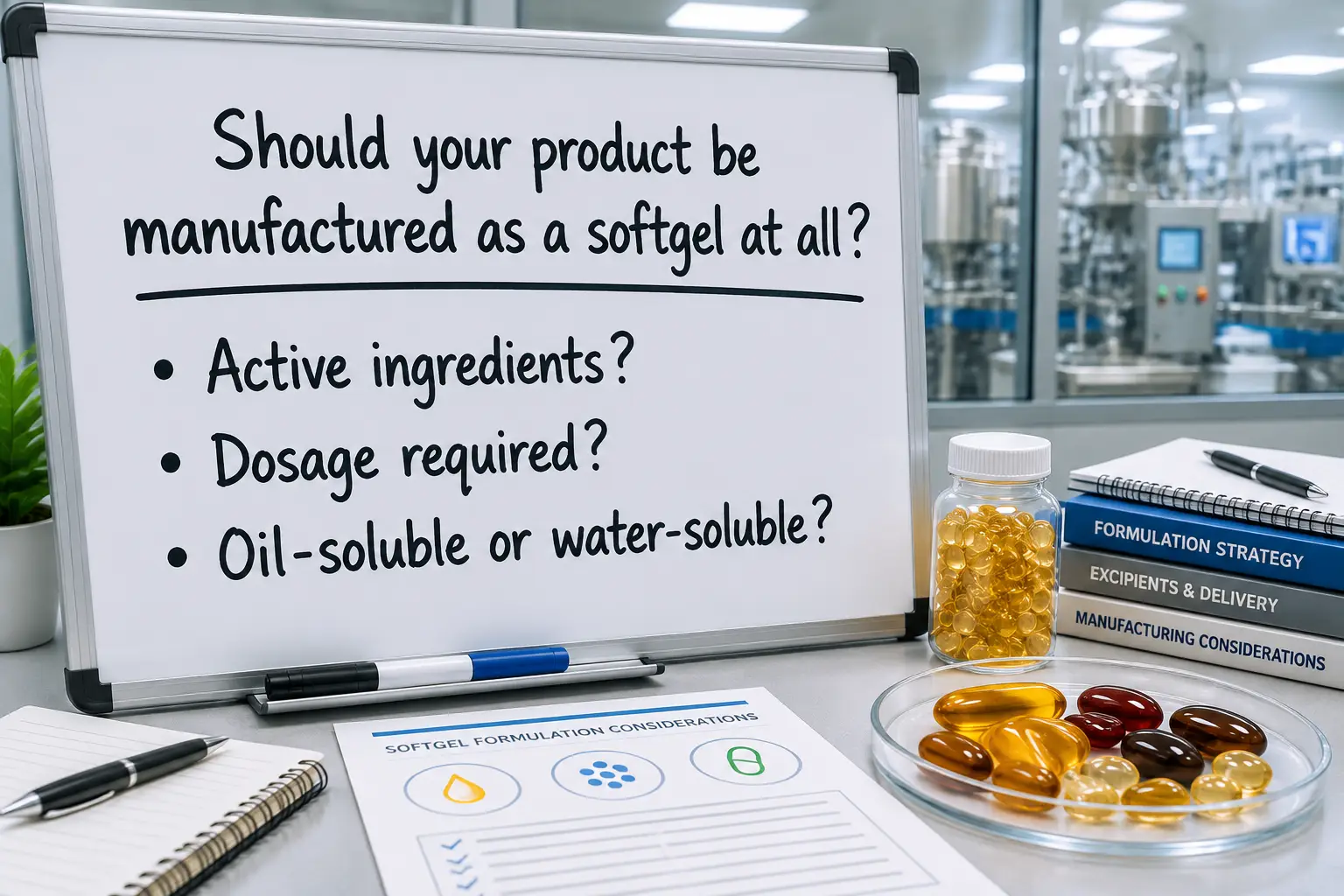
Before proposing any dosage form, our R&D team usually asks the following questions:
- What active ingredients are being used?
- What dosage is required?
- Is the ingredient oil-soluble or water-soluble?
- Which countries will the product be sold in?
- What is the target retail price?
- Does the product need a premium market position?
- What is the expected annual volume?
- What is the target launch timeline?
The question is not:
Can we manufacture your product as a softgel?
The real question is:
Should your product be manufactured as a softgel at all?
Answering this question correctly at the beginning of a project can save months of development time and thousands of dollars in unnecessary costs.
Frequently Asked Questions About Softgel Manufacturing
Are softgels better than tablets?
Not always. Softgels are superior for oil-soluble ingredients, but tablets may be better for high-dose powders and price-sensitive products.
Why are softgels more expensive?
Softgels require specialized equipment, higher setup costs, and more complex manufacturing processes.
Can probiotics be made into softgels?
Most probiotic formulations are not suitable for conventional softgel manufacturing because many strains are sensitive to heat and moisture.
What ingredients work best in softgels?
Fish oil, omega-3, vitamin D3, CoQ10, lutein, astaxanthin, and other oil-soluble nutrients perform particularly well in softgel format.
What is the MOQ for softgel manufacturing?
Most manufacturers require minimum orders between 50,000 and 200,000 softgels.
How long do softgels last?
Properly formulated softgels generally achieve shelf lives of 18–24 months.
Are softgels vegetarian?
Traditional softgels contain gelatin and are not vegetarian. Vegetarian softgel technologies are available but involve additional formulation considerations.
Why do softgels sometimes leak?
Leaking can occur because of poor seam formation, incompatible fill materials, or improper storage conditions.
Can softgels be halal?
Yes. Halal-certified gelatin sources are available and widely used in international supplement manufacturing.
Need Help Evaluating Whether Softgels Are Right for Your Product?
Choosing a dosage form is one of the most important decisions in supplement development.
The right choice affects product stability, manufacturing cost, shelf differentiation, regulatory compliance, and ultimately your profit margins.
At SD Health Bio, we help supplement brands evaluate whether softgels, hard capsules, tablets, or powders are the best fit for their formulation and commercial objectives.
Our team can support:
✓ Formula evaluation
✓ Prototype development
✓ Stability assessment
✓ Custom softgel manufacturing
✓ Private label services
✓ International compliance support
If you are planning a new supplement launch, contact our team to discuss your project and determine whether softgel manufacturing is the right strategy for your brand.
"Effect of packaging and encapsulation on the oxidative and sensory ...", https://pmc.ncbi.nlm.nih.gov/articles/PMC10003024/. Studies on omega-3 fatty acid stability in dietary supplements have documented significant oxidation and potency loss in formats with higher oxygen permeability, with degradation rates varying by encapsulation type and storage conditions. Evidence role: statistic; source type: paper. Supports: Measurable EPA/DHA potency loss occurs in hard capsule formats due to oxygen permeability over shelf life. Scope note: Published studies may use different storage conditions and time points than the 18-month/15-20% figure cited here ↩
"Soft gelatin capsules II: Oxygen permeability study of capsule shells", https://pubmed.ncbi.nlm.nih.gov/1151660/. Pharmaceutical research on soft gelatin capsule technology confirms that the seamless one-piece shell provides superior oxygen barrier properties compared to two-piece hard capsules, though the degree of hermeticity depends on shell composition and thickness. Evidence role: mechanism; source type: paper. Supports: Soft gelatin capsules provide significantly lower oxygen transmission compared to two-piece hard capsules. Scope note: Gelatin shells are not perfectly impermeable; some oxygen transmission still occurs, and the term 'anaerobic' may overstate the barrier properties ↩
"Effects of formulation on the bioavailability of lutein and zeaxanthin", https://pmc.ncbi.nlm.nih.gov/articles/PMC3663991/. Research on carotenoid supplementation indicates that lutein and zeaxanthin, being highly lipophilic compounds susceptible to oxidative degradation, demonstrate improved chemical stability and oral bioavailability when delivered in oil-based formulations compared to dry powder compressed tablets. Evidence role: mechanism; source type: paper. Supports: Carotenoids like lutein and zeaxanthin have improved stability and bioavailability when formulated in lipid-based delivery systems. Scope note: Degradation from tablet compression specifically is less well-documented than the general advantage of lipid-based delivery for carotenoids ↩
"Shell Formulation in Soft Gelatin Capsules: Design and ... - PMC", https://pmc.ncbi.nlm.nih.gov/articles/PMC11468233/. Pharmaceutical manufacturing literature documents that conventional softgel encapsulation involves temperatures during gelatin melting and shell formation that exceed the thermal tolerance of many probiotic microorganisms, though some thermotolerant strains and modified processes may partially mitigate this limitation. Evidence role: mechanism; source type: paper. Supports: Standard softgel manufacturing temperatures (typically 37-40°C for shell formation) can reduce viability of heat-sensitive probiotic strains. Scope note: Newer low-temperature softgel technologies and spore-forming probiotics may partially invalidate this blanket statement ↩
"A Global Overview of Dietary Supplements: Regulation, Market ...", https://pmc.ncbi.nlm.nih.gov/articles/PMC10421343/. Consumer research in the dietary supplement sector suggests that dosage form influences perceived product quality, with softgel capsules often rated higher on perceived efficacy and pharmaceutical-grade quality compared to standard compressed tablets, particularly in lipid-based supplement categories. Evidence role: general_support; source type: paper. Supports: Consumer surveys indicate a preference for and quality association with softgel capsules in certain supplement categories. Scope note: Consumer perceptions vary significantly by geographic market, demographic, and product category; findings from one region may not generalize globally ↩
"A Global Overview of Dietary Supplements: Regulation, Market ...", https://pmc.ncbi.nlm.nih.gov/articles/PMC10421343/. Market analysis of dietary supplement retail pricing indicates that softgel formulations typically command price premiums over tablet equivalents, though the magnitude varies by category, brand positioning, and geographic market. Evidence role: statistic; source type: other. Supports: Softgel format supplements are priced at a measurable premium over tablet equivalents in categories like fish oil and CoQ10. Scope note: The specific 20-40% range may reflect the author's regional market experience rather than a globally validated figure ↩
"The Influence of Packaging Color on Consumer Perceptions ... - PMC", https://pmc.ncbi.nlm.nih.gov/articles/PMC10648973/. Consumer behavior research indicates that visual product cues, including transparency of packaging and visible product color, serve as quality signals that influence purchase decisions and willingness to pay premium prices, consistent with broader findings on sensory marketing. Evidence role: general_support; source type: paper. Supports: Visual product attributes including transparency and color influence consumer quality perceptions and willingness to pay. Scope note: Most research on transparency and quality perception is in food packaging rather than specifically in dietary supplement dosage forms ↩
"Regulation of Bile Acid Synthesis by Fat-soluble Vitamins A and D", https://pmc.ncbi.nlm.nih.gov/articles/PMC2863217/. Nutritional biochemistry and biopharmaceutics literature confirms that absorption of lipophilic compounds from solid oral dosage forms requires sequential tablet disintegration, active ingredient dissolution, and micellar solubilization via bile salts prior to uptake by intestinal enterocytes. Evidence role: mechanism; source type: education. Supports: Fat-soluble vitamins in solid dosage forms must undergo disintegration, dissolution, and bile salt emulsification before intestinal absorption. ↩
"Evaluation of vehicle substances on vitamin D bioavailability - PMC", https://pmc.ncbi.nlm.nih.gov/articles/PMC3033429/. Randomized controlled trials have shown that vitamin D3 administered in oil-based vehicles (such as softgel capsules) produces significantly higher serum 25-hydroxyvitamin D concentrations compared to equivalent doses in dry tablet or powder formulations, attributed to improved intestinal absorption of the lipophilic molecule. Evidence role: statistic; source type: paper. Supports: Clinical studies demonstrate higher serum 25(OH)D levels when vitamin D3 is administered in oil-based formulations compared to dry powder forms. Scope note: Effect sizes vary across studies and may depend on baseline vitamin D status, meal composition, and specific oil carrier used ↩
"Bioavailability of Coenzyme Q10: An Overview of the Absorption ...", https://pmc.ncbi.nlm.nih.gov/articles/PMC7278738/. Pharmacokinetic studies have demonstrated that CoQ10 solubilized in lipid-based carriers achieves substantially higher plasma concentrations than crystalline powder formulations, with some studies reporting 2-3 fold improvements in bioavailability for oil-based softgel preparations. Evidence role: statistic; source type: paper. Supports: Oil-based CoQ10 formulations in softgels demonstrate significantly higher plasma levels compared to dry powder formulations. Scope note: Bioavailability improvements vary widely depending on the specific oil carrier, particle size reduction techniques, and whether ubiquinone or ubiquinol form is used ↩
"Shell Formulation in Soft Gelatin Capsules: Design and ... - PMC", https://pmc.ncbi.nlm.nih.gov/articles/PMC11468233/. Pharmaceutical encapsulation references indicate that the largest commonly manufactured softgel sizes (such as oblong 28) can accommodate fill weights up to approximately 1,200-1,500mg of oil-based material, with consumer acceptability of swallowing size being an additional practical constraint. Evidence role: definition; source type: other. Supports: Standard softgel capsules have practical fill volume limits that constrain single-unit dosing for high-dose formulations. Scope note: Maximum fill capacity depends on shell thickness, fill density, and capsule shape; some specialty sizes may exceed this range but are uncommon in consumer supplements ↩
"Shell Formulation in Soft Gelatin Capsules: Design and ... - PMC", https://pmc.ncbi.nlm.nih.gov/articles/PMC11468233/. Contract manufacturing industry sources indicate that rotary die softgel encapsulation lines typically require higher minimum order quantities than hard capsule filling equipment, due to longer setup times, gelatin ribbon preparation, and higher material waste during startup and shutdown phases. Evidence role: general_support; source type: other. Supports: Softgel encapsulation equipment requires larger minimum batch sizes due to machine setup complexity and material waste. Scope note: Specific MOQ thresholds vary significantly by manufacturer, equipment generation, and geographic market ↩