Tablet supplement manufacturers can look similar on Google, but the wrong choice can create delays, failed samples, weak documentation, or costly product registration problems. I have seen buyers compare only price, then discover late that tablet hardness, coating, packaging, or export files were not ready. A practical shortlist helps reduce that risk.
The top 10 global tablet supplement manufacturers are best viewed as a procurement reference, not an official market ranking. Buyers should compare suppliers by tablet capability, OEM/ODM flexibility, quality systems, testing support, export documentation, MOQ, lead time, communication speed, and fit for the target market before requesting samples or quotes.
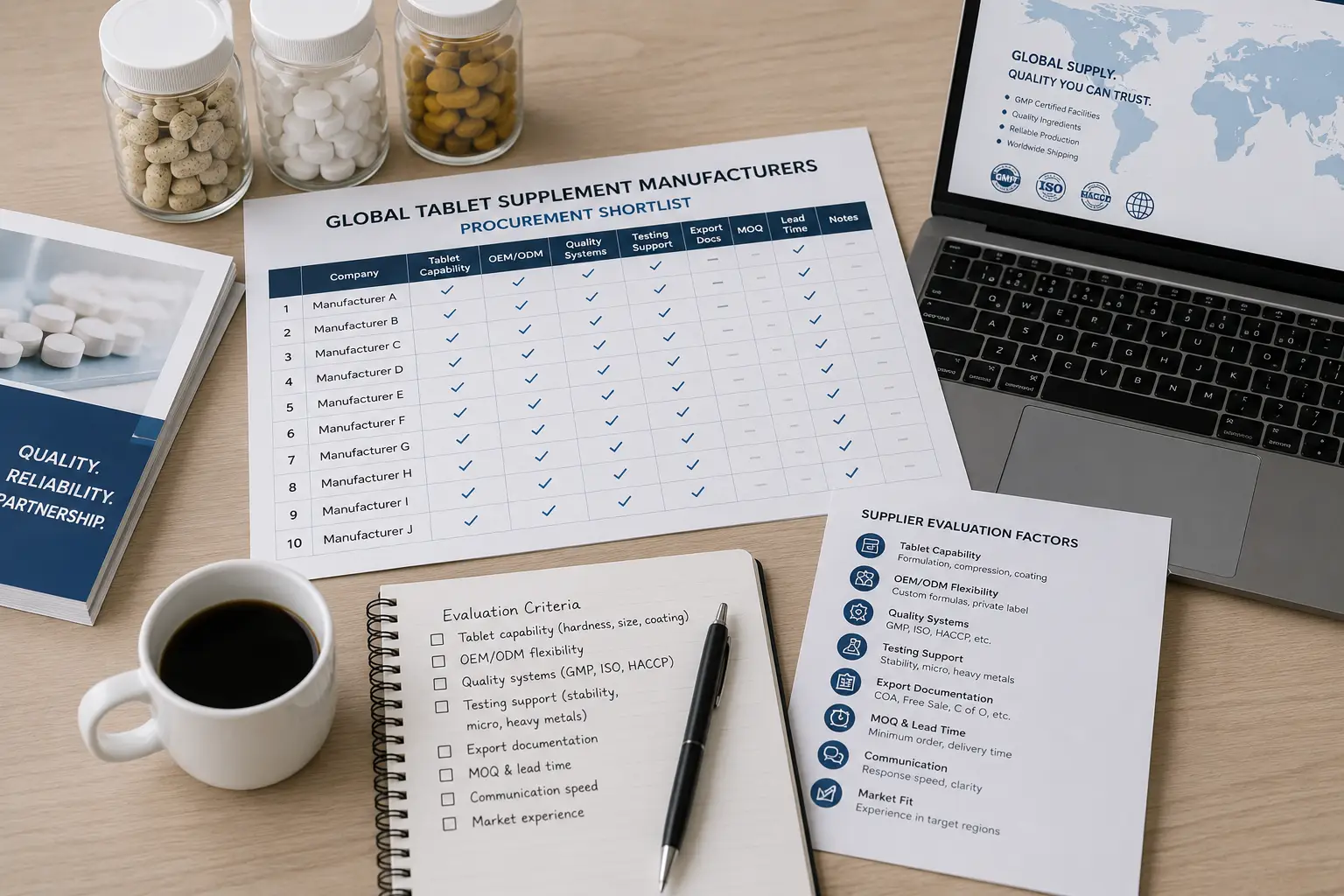
I use ranked lists as a starting point, not as a final answer. The real value comes from asking better questions before you pay for samples, packaging design, registration documents, or bulk production.
How Should Buyers Use This Top 10 Global Tablet Supplement Manufacturers List?
A top 10 list can save time, but it can also create false confidence. I often see buyers assume that the largest or most famous company must be the best supplier. That is not always true when MOQ, formula complexity, speed, and documentation needs are different.
The best way to use this list is as a supplier-screening tool. I recommend that buyers shortlist three to five tablet supplement manufacturers, compare their real capabilities, ask for product-specific documents, test sample quality, and confirm export support before choosing one partner.

This list is not an official global ranking
I want to be clear. This article is an editorial procurement reference based on buyer-relevant criteria, such as public visibility, international service capability, dosage-form coverage, OEM/ODM fit, documentation support, and suitability for supplement brands. It is not an official revenue ranking, capacity ranking, or market-share report.
That distinction matters because different buyers need different suppliers.
A large multinational brand may care most about:
- Multi-country compliance support
- Large-volume production
- Long-term quality agreements
- Advanced technical validation
- Multi-site supply stability
A small or mid-sized importer may care more about:
- Reasonable MOQ
- Fast response time
- Flexible packaging
- Help with formula documents
- Clear export coordination
- Practical pricing
In my own OEM/ODM experience, many overseas buyers do not fail because they choose a “bad” factory. They fail because they choose a factory that does not match their product stage.
What I would check before contacting any supplier
Before I send a serious inquiry, I like to prepare a simple product brief. This reduces back-and-forth communication and helps the supplier give a useful answer.
| Buyer Question | Why It Matters |
|---|---|
| What active ingredients are in the tablet? | Some formulas are hard to compress or need special processing.1 |
| What is the target tablet weight? | Tablet size affects swallowability, tooling, and packaging.2 |
| Does the tablet need coating? | Coating affects appearance, taste masking, stability, and cost.3 |
| Which country will receive the product? | Registration and labeling needs vary by market.4 |
| What packaging is required? | Bottles, blister packs, sachets, and cartons need different planning. |
| What documents are needed? | COA, MSDS, formula, flow chart, specifications, and testing reports may be required. |
| What is the first order quantity? | MOQ affects supplier fit and final unit cost. |
> My simple rule is this: I do not treat a ranking as proof. I treat it as a reason to ask better procurement questions.
Which Top 10 Global Tablet Supplement Manufacturers Are Worth Shortlisting?
Choosing from global tablet supplement manufacturers becomes easier when I separate “famous company” from “fit for my project.” A supplier can be strong in large-scale production but less suitable for a pilot order. Another supplier can be flexible but may need more technical review.
The following top 10 list includes publicly visible supplement and nutraceutical contract manufacturing companies that buyers often evaluate for tablets or broader solid-dose products. Buyers should verify each company’s current capabilities, certifications, lead times, and documentation support before making a final decision.

Top 10 global tablet supplement manufacturers for buyer reference
| Rank | Manufacturer | Region / Market Visibility | Best-Fit Buyer Type | Buyer Notes |
|---|---|---|---|---|
| 1 | Catalent | Global | Large brands, regulated-market projects | Strong public visibility in advanced dosage forms and contract development. Buyers should verify current nutraceutical tablet service fit. |
| 2 | Aenova Group | Europe / Global | Brands needing pharmaceutical-style systems | Often considered by buyers seeking structured production and quality processes. MOQ and project suitability should be checked early. |
| 3 | Sirio Pharma | China / Europe / US visibility | International supplement brands | Known in nutraceutical contract manufacturing. Buyers should confirm tablet format, packaging, and market-specific documents. |
| 4 | Vitaquest International | United States | US-focused supplement brands | Often shortlisted for dietary supplement contract manufacturing. Buyers should confirm tablet coating, testing, and private label support. |
| 5 | Robinson Pharma | United States | Brands needing multiple supplement formats | Publicly visible in capsules, tablets, softgels, and related formats. Buyers should check MOQ and lead time by project. |
| 6 | Lief Labs | United States | Emerging and growth-stage brands | Often considered for flexible supplement development. Buyers should clarify tablet tooling, flavor, coating, and documentation scope. |
| 7 | Makers Nutrition | United States | Private label and startup brands | Commonly visible in private label supplement searches. Buyers should verify direct manufacturing model and tablet-specific capabilities. |
| 8 | Supplement Factory | United Kingdom | UK and EU-focused brands | Often considered by European buyers. Buyers should confirm compliance documents for the target market. |
| 9 | NutraScience Labs | United States | Brands needing guided private label support | Useful for buyers seeking project management support. Buyers should verify production route, MOQ, and documentation details. |
| 10 | Shandong Health Biotech | China / Export markets | Importers, distributors, OEM/ODM brands | Suitable for buyers needing custom tablets, packaging, export coordination, and responsive OEM/ODM support. |
Why I include Shandong Health Biotech
I include Shandong Health Biotech in this list because our work focuses on dietary supplement OEM/ODM manufacturing for overseas buyers. We support tablets, capsules, softgels, gummies, powders, oral liquids, and custom packaging projects. Our typical customers include brand owners, importers, distributors, and purchasing managers who need both production and export support.
However, I do not want this list to sound like an advertisement. Shandong Health Biotech is not the right answer for every buyer. Some large pharmaceutical-style programs may require a different type of CDMO. Some very small test projects may not meet factory MOQ. The right match depends on the formula, quantity, country, timeline, and documentation needs.
How I would shortlist from this table
I would not contact all 10 suppliers at once. That usually creates confusion. Instead, I would choose based on project type:
- Large established brand: Start with multinational or highly structured manufacturers.
- Mid-sized importer: Compare manufacturers with OEM/ODM flexibility and export experience.
- Startup supplement brand: Ask first about MOQ, sample cost, packaging options, and response speed.
- Complex formula buyer: Focus on R&D support, tablet feasibility, and testing.
- Registration-heavy market buyer: Prioritize documentation cooperation, not just unit price.
This approach helps buyers avoid one of the most common mistakes: choosing the “highest ranked” company without checking whether that company actually wants or fits the project.
How Do Tablet Supplement Manufacturers Compare On OEM/ODM Fit?
Many tablet supplement manufacturers say they offer OEM or ODM service, but the meaning can vary a lot. One supplier may only produce an existing formula. Another may help with formulation, flavor, coating, packaging, label support, export documents, and sample improvement.
OEM/ODM fit should be judged by how well the manufacturer supports your real launch process. I recommend comparing formula development, sample speed, tablet testing, packaging choices, MOQ, document support, and communication quality before you compare final unit price.
OEM vs ODM in tablet supplements
Buyers often use OEM and ODM interchangeably, but I separate them in a practical way.
| Service Type | What It Usually Means | Best For |
|---|---|---|
| OEM | Buyer provides formula, brand, packaging direction, and specifications | Experienced brands with technical knowledge |
| ODM | Manufacturer helps develop or adjust the formula and product concept | Newer brands or importers without technical teams |
| Private Label | Buyer uses an existing or semi-standard product with custom branding | Fast launch and lower development complexity |
| Full Custom | Formula, tablet size, coating, flavor, packaging, and documents are customized | Differentiated products and long-term brand building |
For tablets, OEM/ODM support is not only about mixing ingredients and compressing tablets. It also includes decisions that affect the final product experience.
Tablet-specific questions I ask![Tablet Manufacturing]
When I review a tablet project, I like to ask questions that connect technical details with business risk.
-
Can the formula compress well?
Some herbal powders, high-oil ingredients, or large-dose minerals are difficult to form into stable tablets.5 -
Will the tablet disintegrate properly?
A tablet that is too hard may look good but break down slowly.6 -
Does the product need film coating?
Coating can improve appearance, reduce odor, mask taste, and protect sensitive ingredients. -
Will the tablet fit the packaging?
Tablet size affects bottle count, blister design, carton size, and shipping volume. -
Can the supplier support documents?
Importers may need COA, MSDS, ingredient specifications, production flow charts, formula documents, and test reports.
Why communication matters more than many buyers expect
I have seen buyers focus heavily on price and ignore communication quality. That is risky. Tablet projects require quick clarification. If a supplier takes five days to answer a basic technical question before payment, the communication may become worse after deposit.
For buyers like importers and distributors in the Philippines, Southeast Asia, the Middle East, or Europe, supplier responsiveness can affect product registration and launch timing. If the local authority or distributor asks for a revised document, the supplier must be willing to cooperate.
I recommend checking communication during the quotation stage:
- Does the supplier ask intelligent questions?
- Does the supplier explain limits clearly?
- Does the supplier provide document samples when possible?
- Does the supplier answer technical questions in simple language?
- Does the supplier understand export packaging and shipping needs?
A good OEM/ODM partner should not only manufacture tablets. The partner should help you reduce uncertainty before mass production.
What Quality Questions Should You Ask Tablet Supplement Manufacturers?
Quality can sound abstract until a real problem appears. A tablet may crack, smell strange, discolor, fail weight checks, disintegrate slowly, or arrive with incomplete documents. At that point, the cheapest supplier becomes expensive very quickly.
Buyers should ask tablet supplement manufacturers about raw material verification, in-process controls, finished product testing, tablet hardness, friability, disintegration, coating quality, microbiology, heavy metals, stability planning, and document availability before confirming an order.7

Key tablet quality checkpoints
I like to divide tablet quality into three stages: before production, during production, and after production.
| Stage | What To Check | Buyer Risk If Ignored |
|---|---|---|
| Before production | Raw material identity, formula feasibility, excipient selection | Formula may not compress or may fail registration review |
| During production | Tablet weight, hardness, thickness, appearance, friability | Tablets may chip, break, or vary too much |
| After production | Assay, microbiology, heavy metals, disintegration, COA | Product may fail customer, customs, or authority checks |
Technical terms translated into buyer language
Many purchasing managers are not technical specialists. That is normal. I prefer to translate tablet terms into business meaning.
-
Hardness:
This measures how strong the tablet is. If hardness is too low, tablets may break. If it is too high, disintegration may become slow. -
Friability:
This checks whether tablets chip or lose powder during handling. High friability can create dusty bottles and customer complaints.8 -
Disintegration:
This measures how fast the tablet breaks apart under test conditions.9 Buyers should check target requirements for their market and product type. -
Coating uniformity:
This affects appearance, taste masking, odor control, and brand perception. -
Weight variation:
This affects consistency and may influence active ingredient delivery.
Certificates are not the same as registration readiness
One common mistake is treating certificates as a complete solution. A factory certificate can show that a supplier follows certain quality systems. However, product registration may require product-specific files.10
Depending on the market, buyers may need:
- Certificate of Analysis
- Product specification
- Formula or ingredient composition
- Manufacturing flow chart
- MSDS or SDS
- Allergen statement
- GMO statement
- Heavy metal test report
- Microbiology test report
- Stability information
- Label review support
- Packaging specification
The exact list depends on the destination country and product category. I always suggest confirming requirements with a local regulatory consultant or importer before production. The manufacturer can support documentation, but the buyer must understand the target market’s rules.
Why third-party testing can protect both sides
Third-party testing is useful when the buyer needs stronger confidence or market documentation.11 It can cover identity, potency, microbiology, heavy metals, and other quality parameters. It also reduces arguments because both sides can refer to an independent report.
For important launches, I would consider third-party testing at these points:
- Raw material stage for high-risk or high-value ingredients
- Pilot batch stage for formula confirmation
- Finished product stage before shipment
- Market complaint stage if a quality dispute appears
A serious supplier should be open to reasonable testing requests. At the same time, buyers should understand that extra testing adds cost and time.
How Should You Choose The Best Tablet Supplement Manufacturer For Your Market?
The best tablet supplement manufacturer is not always the largest factory or the lowest quote. I have seen buyers lose months because they selected a supplier that could produce tablets but could not support documents, packaging, revisions, or export details.
You should choose a tablet supplement manufacturer by matching supplier capability to your product stage, target country, order volume, formulation difficulty, packaging plan, quality expectations, and communication needs. A good match should reduce launch risk, not only reduce unit cost.

Match the supplier to your product stage
A buyer’s stage changes the best supplier profile.
| Product Stage | Best Supplier Fit | Main Priority |
|---|---|---|
| Idea stage | ODM manufacturer with formulation support | Feasibility and concept development |
| Sample stage | Flexible OEM/ODM supplier | Fast revision and clear sample feedback |
| Registration stage | Documentation-friendly manufacturer | COA, formula files, specs, and test reports |
| Launch stage | Reliable production partner | Lead time, packaging, and export coordination |
| Growth stage | Scalable manufacturer | Capacity, cost control, and repeat consistency |
If I were launching a new tablet supplement, I would not start with unit price. I would start with feasibility. A low price does not help if the tablet is too large to swallow, too bitter without coating, or difficult to register.
Compare total landed risk, not only unit price
Unit price matters. I understand that many buyers must protect margin. However, the lowest tablet price may hide other costs.
Hidden costs can include:
- Failed samples
- Extra coating revisions
- Packaging redesign
- Missing documents
- Delayed registration
- Re-testing
- Higher freight volume
- Customs issues
- Product complaints
- Lost selling season
For example, a small difference in tablet price may not matter if the supplier helps you launch 45 days faster. In seasonal categories such as immune support, weight management, or beauty supplements, timing can be more valuable than a tiny unit-cost saving.
My practical supplier scorecard
I like using a weighted scorecard instead of emotional judgment. Buyers can adjust the weight based on their market.
| Evaluation Item | Suggested Weight |
|---|---|
| Tablet manufacturing capability | 20% |
| Quality control and testing support | 20% |
| Documentation and registration support | 15% |
| OEM/ODM formulation flexibility | 15% |
| MOQ and commercial fit | 10% |
| Packaging capability | 10% |
| Communication efficiency | 10% |
This scorecard helps prevent a common purchasing trap: overvaluing price and undervaluing execution.
Red flags I would not ignore
Some warning signs appear early. I would be cautious if a supplier:
- Gives a quote without asking about formula details
- Refuses to discuss tablet feasibility
- Cannot explain testing options
- Says every document is “no problem” but provides no examples
- Pushes for deposit before technical confirmation
- Avoids questions about lead time
- Changes answers often
- Cannot explain packaging limits
- Does not understand export requirements
A professional manufacturer does not need to know everything immediately. However, the supplier should know what must be checked before production.
Frequently Asked Questions
Are the top-ranked tablet supplement manufacturers always the best choice?
No. The highest-ranked company is not automatically the best fit. I recommend matching the manufacturer to your product stage, MOQ, formula complexity, target market, documentation needs, and communication expectations. A mid-sized OEM/ODM partner may fit some importers better than a very large factory.
What documents should I ask a tablet supplement manufacturer for?
I usually ask about COA, product specification, formula details, ingredient documents, MSDS or SDS, production flow chart, microbiology testing, heavy metal testing, packaging specifications, and export documents. The exact document list depends on the target country and local registration requirements.
How do I know if my tablet formula is feasible?
You should ask the manufacturer to review active ingredients, dosage, tablet weight, excipients, coating needs, and target tablet size. A sample trial is often necessary. Some formulas look simple on paper but are hard to compress, coat, or disintegrate properly.
Is China a good place to source tablet supplement manufacturers?
China can be a strong sourcing option for buyers who need competitive pricing, OEM/ODM flexibility, packaging customization, and export support. However, buyers should still verify quality systems, testing options, documentation cooperation, communication efficiency, and market compliance before placing an order.
Should I choose tablets, capsules, gummies, or powders?
The best format depends on the formula, dosage, consumer preference, price target, and market positioning. Tablets can be cost-efficient and stable, but they require good compression and disintegration control. Gummies may be easier to consume but often have more sugar, flavor, and stability challenges.
Conclusion
Tablet supplement manufacturers should be compared with a procurement mindset, not a ranking mindset. A useful shortlist helps you check tablet capability, OEM/ODM flexibility, quality control, testing, packaging, MOQ, lead time, documentation, and export support. I recommend contacting several suppliers, requesting samples, and scoring each one against your real market needs. If you need custom tablet supplement manufacturing with formulation, packaging, documentation, and export coordination support, you can contact Shandong Health Biotech to discuss your next OEM/ODM project.
"Investigation of the Compressibility Characteristics of Paracetamol ...", https://pmc.ncbi.nlm.nih.gov/articles/PMC7336030/. Pharmaceutics literature on tablet compaction shows that powder flow, compressibility, moisture, and excipient selection determine whether a formulation can be compressed into acceptable tablets. Evidence role: mechanism; source type: paper. Supports: Powder properties such as particle size, flowability, moisture, oil content, and compressibility influence whether a blend can be made into robust tablets.. Scope note: The support is mechanistic and general; a specific supplement formula still requires formulation review or trial batches. ↩
"Impact of Tablet Size and Shape on the Swallowability in Older Adults", https://pmc.ncbi.nlm.nih.gov/articles/PMC10145850/. Studies of oral solid dosage acceptability report that tablet size and shape influence swallowability, providing support for considering tablet dimensions during product design. Evidence role: general_support; source type: paper. Supports: Research on oral dosage forms indicates that tablet size and shape affect swallowability and acceptability, while manufacturing references connect dimensions to tooling and packaging constraints.. Scope note: This directly supports swallowability; tooling and packaging implications are contextual and may need a manufacturing reference for direct confirmation. ↩
"Pharmaceutical Coating and Its Different Approaches, a Review", https://pmc.ncbi.nlm.nih.gov/articles/PMC9415771/. Reviews of pharmaceutical tablet coating describe film coating as a process used for appearance, taste or odor masking, and protection of the dosage form, while also adding formulation and processing requirements. Evidence role: mechanism; source type: paper. Supports: Film coating is used to improve appearance, mask taste or odor, protect ingredients, and add process complexity and cost.. Scope note: The source would support the technical functions of coating; cost impact depends on supplier process, batch size, and coating material. ↩
"Dietary Supplement Labeling Guide", https://www.fda.gov/food/dietary-supplements-guidance-documents-regulatory-information/dietary-supplement-labeling-guide. Regulatory guidance from national authorities shows that dietary supplement labeling, notification, and market-entry requirements are jurisdiction-specific, supporting the need to check requirements by target market. Evidence role: general_support; source type: government. Supports: Regulatory agencies publish different rules for supplement labeling, notification, permitted claims, and market access in different jurisdictions.. Scope note: This supports the claim at a regulatory-framework level; it does not identify the requirements for every country or product category. ↩
"Development Strategies for Herbal Products Reducing the Influence ...", https://pmc.ncbi.nlm.nih.gov/articles/PMC3834931/. Tablet formulation research shows that active-ingredient properties, including poor flow, low compressibility, oil content, and high dose load, can make robust tablet formation more difficult. Evidence role: mechanism; source type: paper. Supports: Certain botanical, oily, or high-dose mineral ingredients can affect flow, compressibility, binding, tablet hardness, and friability.. Scope note: The evidence is formulation-mechanism support; difficulty varies by ingredient grade, excipient system, and manufacturing process. ↩
"Effects of hardness on the disintegration time and ...", https://pubmed.ncbi.nlm.nih.gov/241790/. Studies of tablet compaction and disintegration report that increased hardness or compaction force can reduce tablet porosity and delay disintegration under test conditions. Evidence role: mechanism; source type: paper. Supports: Higher compaction force or tablet hardness can reduce porosity and slow water penetration, which may increase disintegration time.. Scope note: The relationship is formulation-dependent; some disintegrants and excipient systems can offset the effect of higher hardness. ↩
"21 CFR Part 111 -- Current Good Manufacturing Practice in ...", https://www.ecfr.gov/current/title-21/chapter-I/subchapter-B/part-111. FDA dietary supplement current good manufacturing practice regulations require manufacturers to establish specifications and controls for components, production, packaging, labeling, and finished products, supporting buyer review of quality systems and testing plans. Evidence role: expert_consensus; source type: government. Supports: Dietary supplement cGMP rules and pharmacopeial standards require specifications, component controls, production records, and testing relevant to identity, quality, and tablet performance.. Scope note: The regulation establishes quality-system expectations; it does not prescribe the exact checklist for every tablet supplement project. ↩
"What Is Tablet Friability Testing and Why Does It Matter?", https://drugmachines.com/blogs/news/tablet-friability-testing-guide. Pharmacopeial descriptions of tablet friability define the test as an assessment of tablet resistance to abrasion and mechanical stress, supporting the link between high friability and powder loss during handling. Evidence role: definition; source type: institution. Supports: Friability testing evaluates the tendency of tablets to chip, crumble, or lose mass under mechanical stress.. Scope note: The source supports the physical mechanism; customer complaints are a plausible commercial consequence rather than a direct pharmacopeial endpoint. ↩
"A Review of Disintegration Mechanisms and Measurement ...", https://pmc.ncbi.nlm.nih.gov/articles/PMC5382187/. Pharmacopeial disintegration methods describe standardized conditions for determining whether tablets break apart within a specified time, supporting this definition of disintegration testing. Evidence role: definition; source type: institution. Supports: Pharmacopeial disintegration tests define apparatus and conditions for measuring whether tablets disintegrate within a specified time.. ↩
"Dietary Supplements Guidance Documents & Regulatory Information", https://www.fda.gov/food/guidance-documents-regulatory-information-topic-food-and-dietary-supplements/dietary-supplements-guidance-documents-regulatory-information. Government registration guidance for health or food supplements commonly requires product-specific dossier elements, such as composition, specifications, labels, and analytical documents, supporting the distinction between factory certification and registration readiness. Evidence role: general_support; source type: government. Supports: Registration or notification systems commonly request product-specific information such as formula, specifications, labels, certificates of analysis, and test reports.. Scope note: Requirements differ by jurisdiction and product category, so a cited example supports the principle rather than a universal document list. ↩
"Dietary Supplements: What You Need to Know - Consumer", https://ods.od.nih.gov/factsheets/WYNTK-Consumer/. Public health guidance on dietary supplements notes that third-party testing can provide independent assessment of selected quality attributes, supporting its use as additional market documentation and buyer assurance. Evidence role: general_support; source type: government. Supports: Independent testing or certification can help evaluate supplement quality attributes such as identity, purity, potency, and contaminants.. Scope note: Third-party testing reduces uncertainty for tested attributes only; it does not guarantee overall regulatory approval or performance of every batch. ↩