Choosing between iron gummies and iron tablets? The answer is not as simple as picking one format over the other. Your brand's success depends on more than just taste or convenience.
From a formulation and manufacturing perspective, neither iron gummies nor iron tablets are inherently more effective. True effectiveness depends on elemental iron per serving, the iron form used, formulation stability, user tolerability, target audience compliance, and whether the dosage form fits your market positioning and price point.

I work with brand owners every week who ask me this exact question. They want a clear winner. But after years of developing iron supplement formulations for OEM/ODM clients across multiple markets, I have learned that the real question is not "which format works better?" The real question is: "Which format can reliably deliver the right elemental iron dose to the right user — and keep them buying again?" Let me break this down from a product development and manufacturing standpoint so you can make a more informed decision for your brand.
Executive Summary: Iron Gummies vs. Iron Tablets at a Glance
If U need a quick answer before reviewing the full guide, here is the short version.
| Decision Factor | Iron Gummies | Iron Tablets |
|---|---|---|
| Consumer Compliance | Higher | Moderate |
| Elemental Iron Capacity | Lower | Higher |
| Taste Experience | Better | Moderate |
| Manufacturing Complexity | Higher | Lower |
| Shelf-Life Stability | Moderate | Higher |
| Cost Per Unit | Higher | Lower |
| Premium Market Positioning | Strong | Moderate |
| Clinical or High-Dose Applications | Limited | Strong |
| Product Differentiation | Strong | Moderate |
| Development Timeline | Longer | Shorter |
For most lifestyle wellness brands targeting women and younger consumers, gummies offer stronger market appeal. For brands focused on high-dose iron delivery, lower production costs, and clinical positioning, tablets remain the more practical choice.

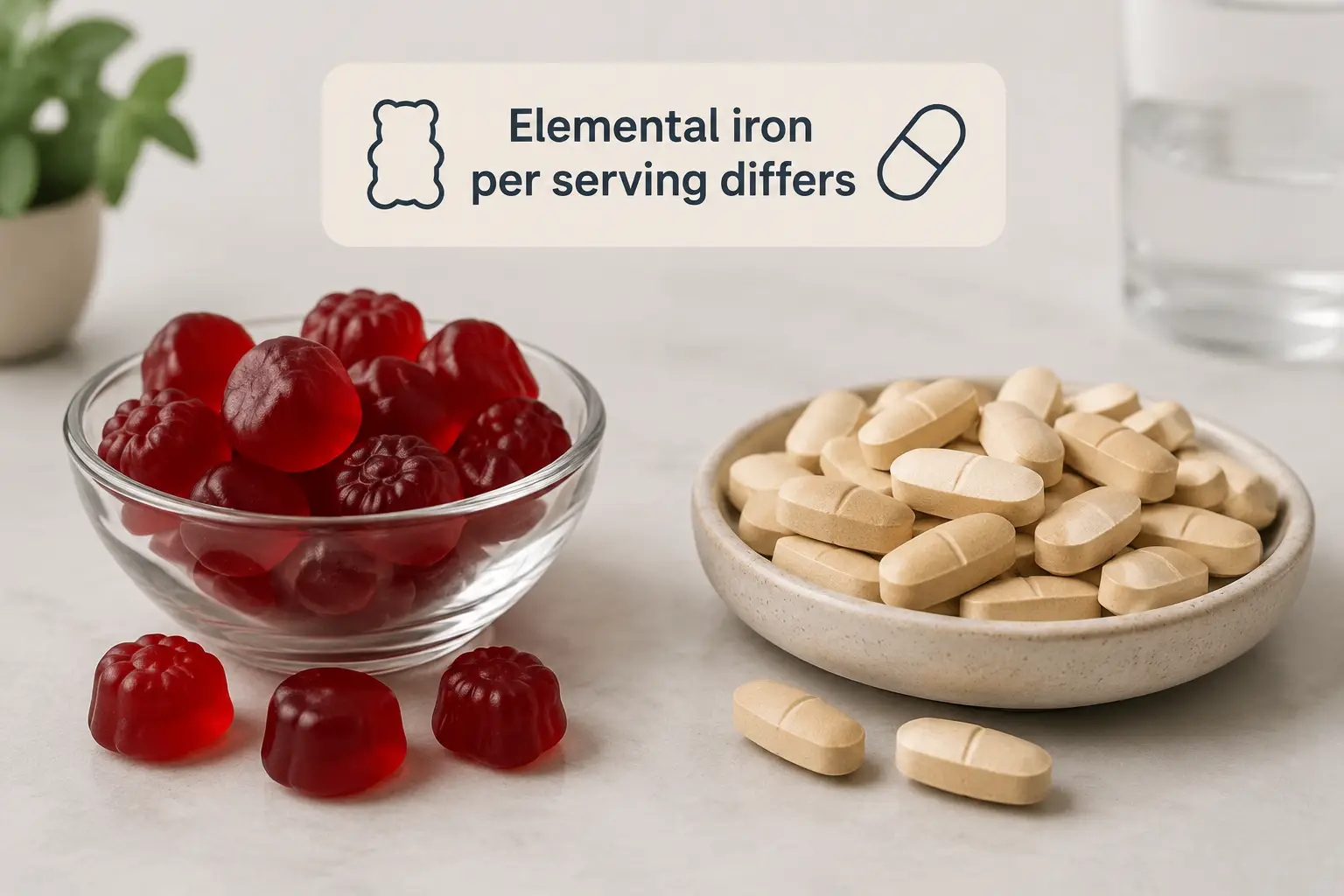
Does Elemental Iron Per Serving Really Differ Between Gummies and Tablets?
Many brand owners look at the label claim and assume both formats deliver the same dose. But the reality in formulation is more complex. The gap between "ingredient amount" and "elemental iron" catches many first-time buyers off guard.
Yes, elemental iron per serving often differs between gummies and tablets. Tablets can typically support a higher iron load per unit, while gummies face formulation limits that may cap the amount of elemental iron you can include per serving without compromising taste, texture, or stability.

Why This Matters for Your Brand
When I review product briefs from new clients, I often see a common mistake. They specify "18 mg iron" on the label without clarifying whether that means 18 mg of the iron compound or 18 mg of elemental iron. These are very different numbers.
For example, ferrous fumarate is about 33% elemental iron by weight1. So if you add 18 mg of ferrous fumarate, you only deliver about 6 mg of actual elemental iron. Tablets handle this easily — you can increase the compound amount without much trouble. But in a gummy, adding more iron compound means more metallic taste, more formulation challenges, and potential texture problems.
Here is a simplified comparison:
| Factor | Iron Gummies | Iron Tablets |
|---|---|---|
| Typical elemental iron per serving | 5–18 mg2 (varies by iron form) | 18–65 mg3 (wider range possible) |
| Formulation flexibility for higher doses | Limited by taste and texture | High — coating can mask taste |
| Label claim risk | Higher (dose may be capped by palatability) | Lower (easier to hit target dose) |
From a formulation and manufacturing perspective, brands should verify the actual elemental iron content through third-party testing, not just rely on the raw material specification sheet. I always recommend requesting a Certificate of Analysis (COA) that confirms elemental iron, not just total iron compound weight.
Does the Iron Form Affect Product Development Difficulty?
Not all iron ingredients behave the same way in gummies and tablets. The iron form you choose shapes everything — from taste to stomach tolerance to shelf stability.
Iron form directly affects taste masking, gastrointestinal tolerance, ingredient compatibility, and manufacturing difficulty. Some iron forms work well in tablets but create serious problems in gummies. Choosing the wrong form for your dosage format can derail an entire product launch.
Breaking Down Common Iron Forms
In my experience working on iron supplement projects, here are the iron forms I see most often and how they behave in each format:
| Iron Form | Gummy Suitability | Tablet Suitability | Key Consideration |
|---|---|---|---|
| Ferrous bisglycinate4 | Moderate — gentler taste, easier to mask | Excellent — well-tolerated, good bioavailability data | Higher cost, but fewer formulation headaches in gummies |
| Ferrous fumarate | Difficult — strong metallic taste, hard to mask in gummy base | Good — common, cost-effective, easy to coat | Traditional choice for tablets; problematic for gummy compliance |
| Ferric pyrophosphate5 | Good — mild taste, white color | Good — stable, but lower relative absorption | Often chosen for gummies because it does not discolor the product |
| Ferrous sulfate | Very difficult — strong taste, may react with gummy ingredients | Good — very cost-effective, widely used | Rarely used in gummies due to taste and stability issues |
What This Means in Practice
I have seen projects where a client insisted on ferrous fumarate in a gummy because it was the cheapest option. We produced samples. The taste was unacceptable — metallic, lingering, and no amount of flavoring could fully cover it. We ended up reformulating with ferric pyrophosphate, which solved the taste problem but required adjusting the dose claim downward because of its lower elemental iron percentage.
This is not a failure of gummies as a format. It is a formulation reality. Brands should discuss iron form selection with their manufacturer early in the development process. The cheapest iron form is not always the most effective choice when you factor in taste, stability, and consumer repeat purchase.
Are Iron Gummies Better for Consumer Compliance?
This is one of the strongest arguments for gummies. But compliance is not just about taste — it is about whether your target user will actually take the product every day, long-term.
Iron gummies generally offer better daily compliance for users who dislike swallowing pills or experience stomach discomfort with traditional iron tablets. However, compliance only matters if the gummy delivers a sufficient and stable dose of elemental iron throughout the product's shelf life.

Who Benefits Most from Each Format?
From the product development conversations I have with brand owners, the target user profile often determines the right format more than any lab data:
| Target User | Gummy Advantage | Tablet Advantage |
|---|---|---|
| Women 18–35 (daily wellness) | High — taste, Instagram-friendly, easy habit | Moderate — if they already take other pills |
| Pregnant women (higher dose needs) | Moderate — compliance is good, but dose may be insufficient | High — can deliver 27–65 mg elemental iron per tablet6 |
| Children (if applicable per market regulations) | High — familiar candy-like format | Low — swallowing difficulty |
| Older adults (traditional supplement users) | Moderate — some prefer familiar pill format | High — cost-effective, trusted format |
| Price-sensitive markets | Lower — gummies cost more per unit | High — tablets are more economical |
The Compliance Trap
Here is something I tell my clients directly: a product with great compliance but inadequate dose is not an effective product. If your gummy only delivers 5 mg of elemental iron because of formulation limits, but your user needs 18 mg, then compliance does not solve the problem. They will take it every day and still not meet their needs.
Brands should verify that the final formulation, after heat processing and throughout the shelf life, still delivers the labeled dose. Iron in gummies can degrade or interact with other ingredients over time. Stability testing is not optional — it is essential.
What Do Manufacturers Actually Recommend?
Many first-time brand owners assume gummies are automatically the better option because they are trendy.
In reality, experienced manufacturers rarely start with the dosage format.
We start with:
- Required elemental iron target
- Target consumer group
- Price positioning
- Desired shelf life
- Distribution environment
- Regulatory requirements
Only after these questions are answered do we recommend gummies or tablets.

In our OEM projects, we often see brands change formats after formulation feasibility assessments reveal that the original concept cannot achieve the desired iron level, cost target, or shelf-life requirements.
The most successful product launches typically begin with formulation feasibility rather than packaging preference.
Common Scenarios We Encounter
| Project Situation | Typical Recommendation |
|---|---|
| Women's wellness supplement | Gummies |
| Children's nutrition supplement | Gummies |
| Premium lifestyle brand | Gummies |
| Clinical iron supplementation | Tablets |
| High-dose iron formula | Tablets |
| Cost-sensitive product line | Tablets |
| Rapid product launch | Tablets |
| Highly differentiated product | Gummies |
Why Manufacturers Think Differently
Most manufacturers focus on feasibility first and marketing second.
A dosage format may look attractive on a competitor's website, but if it cannot deliver the required elemental iron level, remain stable throughout shelf life, and fit the target retail price, it may not be the right commercial solution.
The best-performing products are usually those where formulation, manufacturing, regulatory requirements, and market expectations are aligned from the beginning.
What Are the Manufacturing and Stability Challenges?
From the factory floor, gummies and tablets present very different production realities. These differences affect your timeline, cost, minimum order quantity, and product quality over time.
Iron gummies face challenges in heat processing, sugar or sugar-free system compatibility, color changes, and accelerated stability loss. Iron tablets are more straightforward to manufacture at scale, support higher doses, and offer coating options that improve stability and mask taste — but they lack the consumer appeal of gummies.

Gummy Manufacturing Realities
When we produce iron gummies in our facility, here are the challenges our R&D team works through:
Heat sensitivity: Gummy production involves cooking the base at elevated temperatures. Some iron forms may degrade or change color during this process7. We test each batch to confirm potency after cooking, not just before.
Taste masking: Iron has a naturally metallic taste8. In a gummy, you cannot hide behind a coating. You must rely on flavoring systems, citric acid, and careful iron form selection. This adds development time and cost.
Sugar-free systems: Many markets now demand sugar-free gummies. But sugar-free bases (using maltitol, isomalt, or other polyols) behave differently during cooking and storage9. Iron interactions with these systems must be tested during formulation development.
Stability: Gummies have higher moisture content than tablets10. This moisture can accelerate iron oxidation, leading to color changes, off-flavors, or potency loss over the shelf life. Proper packaging (moisture barrier, desiccants) and accelerated stability testing are critical.
Tablet Manufacturing Advantages
Tablets are simpler from a production standpoint:
- Higher iron load per unit is easy to achieve
- Film coating masks taste and improves swallowability
- Enteric coating options can reduce stomach irritation
- Lower moisture content means better long-term stability
- Faster production speed, lower per-unit cost
- Easier to meet documentation and testing requirements for international registration
This does not mean tablets are always the right answer. But from a manufacturing and quality-control perspective, they carry lower formulation risk for iron specifically.
Common Iron Supplement Development Mistakes We See
After reviewing hundreds of OEM projects, several mistakes appear repeatedly.

Case 1: Chasing High Iron Content in Gummies
One client requested 27 mg elemental iron in a single daily gummy serving.
While technically possible, the metallic taste became unacceptable during pilot production.
The project ultimately required:
- A different iron form
- Additional flavor optimization
- A revised serving recommendation
The launch was delayed by several weeks.
Case 2: Copying a Competitor's Tablet Formula
Another client attempted to replicate a competitor's iron tablet using a different raw material supplier.
Although the label claims appeared identical, the new iron source had different compression characteristics.
Tablet hardness and dissolution results failed initial testing.
Additional reformulation work was required before commercialization.
Case 3: Ignoring Stability Testing
A brand launched an iron gummy product without completing sufficient accelerated stability testing.
After several months of storage, distributors reported:
- Color darkening
- Metallic off-notes
- Potency drift
The product required reformulation and relaunch.
Key Lesson
The dosage form itself is rarely the problem.
The real issue is usually trying to force a formulation beyond what the chosen format can realistically support.
How To Avoid These Problems
Before commercial production begins, manufacturers should complete:
- Formulation feasibility assessment
- Pilot batch testing
- Taste evaluation
- Accelerated stability testing
- Packaging compatibility testing
- Finished product verification
This process helps identify risks early and significantly reduces the likelihood of expensive reformulation after launch.
How Should You Evaluate Effectiveness as a Brand Owner?
Effectiveness is not just a clinical question. For a brand owner, an "effective" product is one that delivers dose, maintains stability, satisfies users, supports repeat purchase, and meets regulatory requirements in your target market.
Brand owners should evaluate iron supplement effectiveness across five dimensions: elemental iron delivery, formulation stability, consumer tolerability and compliance, commercial viability (cost, MOQ, timeline), and regulatory fit for the target market. A product that fails on any one of these is not truly effective for your business.

How Does Product Format Affect Manufacturing Cost?
Many buyers compare ingredient prices while overlooking total manufacturing costs.
In reality, dosage form selection influences multiple cost categories throughout the product lifecycle.
Cost Comparison
| Cost Factor | Gummies | Tablets |
|---|---|---|
| Raw Materials | Higher | Lower |
| Flavor System | Required | Minimal |
| Stability Testing | More Extensive | Less Extensive |
| Packaging Requirements | Higher | Lower |
| Production Speed | Slower | Faster |
| Labor Intensity | Higher | Lower |
| Storage Requirements | More Sensitive | Less Sensitive |
| Shipping Efficiency | Lower | Higher |
Commercial Impact
Because gummies require more formulation work, taste masking, stability testing, and moisture protection, they generally carry higher manufacturing costs than tablets.
Brands targeting premium retail channels often absorb these costs through higher selling prices.
Brands competing primarily on value and price usually favor tablets.
Cost Considerations Beyond Manufacturing
When evaluating product profitability, brands should consider:
- Cost per serving
- Cost per mg of elemental iron delivered
- Packaging cost
- Shipping cost
- Product return risk
- Shelf-life management costs
- Distributor margin requirements
- Retail pricing expectations
The cheapest dosage form is not always the most profitable one.
Hidden Costs That Buyers Often Miss
Many first-time supplement brands underestimate:
- Product development costs
- Stability testing expenses
- Packaging redesign costs
- Registration support requirements
- Inventory carrying costs
Evaluating total project cost rather than manufacturing cost alone leads to better long-term decisions.
A Practical Decision Framework
Based on my experience working with buyers from the Philippines, the Middle East, North America, and Southeast Asia, here is how I suggest approaching this decision:
| Decision Factor | Choose Gummies If... | Choose Tablets If... |
|---|---|---|
| Target dose | ≤18 mg elemental iron per serving is sufficient | >18 mg elemental iron needed |
| Target user | Younger adults, children (where permitted), taste-sensitive users | Traditional supplement users, pregnant women, clinical positioning |
| Price point | Premium positioning supports higher COGS | Competitive pricing or mass-market distribution |
| Market trend | Market rewards innovation, Instagram-friendly products | Market values efficacy claims, traditional formats |
| Regulatory environment | Brands should verify gummy-specific labeling and health claim rules in target market | Tablet claims and documentation are well-established |
| Shelf life requirement | 18–24 months (requires careful stability work) | 24–36 months (easier to achieve) |
The Commercial Risk No One Talks About
Here is what I see go wrong most often: a brand launches an iron gummy because it looks marketable. But after six months, they face complaints — color has changed, taste has shifted, or the potency test at month 12 falls below label claim. Now they have a product recall risk, unhappy distributors, and damaged brand trust.
This is preventable. It requires investing in proper formulation development, stability testing, and honest communication between the brand and the manufacturer. At our facility, we always recommend conducting a 6-month accelerated stability study11 before full commercial production. This is not an upsell — it is risk management.
Procurement Decision Matrix: Which Format Should Your Brand Choose?
Use the following framework during product planning.

| If Your Goal Is... | Recommended Format |
|---|---|
| Launching a women's wellness brand | Gummies |
| Targeting children (where permitted) | Gummies |
| Creating a premium lifestyle product | Gummies |
| Maximizing consumer compliance | Gummies |
| Delivering 27–65 mg elemental iron | Tablets |
| Controlling manufacturing costs | Tablets |
| Achieving longer shelf life | Tablets |
| Entering clinical nutrition channels | Tablets |
| Reducing formulation risk | Tablets |
| Maximizing product differentiation | Gummies |
Quick Decision Guide
Choose Iron Gummies If:
- Consumer experience drives purchasing decisions
- Brand differentiation is important
- Premium positioning is desired
- Compliance is a major concern
- Social media appeal is valuable
- The required iron dose is moderate
Choose Iron Tablets If:
- High iron doses are required
- Cost efficiency is critical
- Stability is the priority
- Clinical positioning is desired
- Traditional consumers are the target market
- Long shelf life is important
Final Evaluation Framework
Before making a final decision, ask:
- What elemental iron level must the product deliver?
- Who is the target consumer?
- What retail price is acceptable?
- How important is convenience and compliance?
- What shelf life is required?
- What manufacturing budget is available?
The answers will usually point clearly toward one dosage format.
What Questions Should You Ask Your Manufacturer?
If you are deciding between iron gummies and iron tablets for your next product launch, the conversation with your manufacturer matters as much as the format choice itself.
Ask your manufacturer about iron form options, elemental iron per serving after processing, stability data, taste masking approach, minimum order quantities for each format, and what documentation they provide for product registration in your target market. A good manufacturer will guide you through trade-offs honestly.

Key Questions to Ask
From my years of working with brand owners who are new to iron supplement development, here are the questions that save the most time and prevent the most costly mistakes:
-
What iron forms do you recommend for gummies vs. tablets, and why? — This tells you whether the manufacturer has real formulation experience or is just filling orders.
-
What is the confirmed elemental iron per serving after heat processing (for gummies)? — Do not accept pre-cooking numbers. Ask for post-production COA data.
-
Do you have stability data for iron in your gummy base system? — If they say "no one has asked before," consider that a red flag.
-
What is the cost difference per unit between gummy and tablet for my target dose? — This helps you build accurate pricing models.
-
Can you support the documentation I need for product registration in my market? — Registration requirements vary by country. Final claims depend on target-market regulations and testing. Your manufacturer should be willing to cooperate on paperwork.
-
What is your MOQ for sample production vs. commercial production? — Some manufacturers have very high MOQs for gummies because of the cooking batch size. Know this before you commit.
At Shandong Health Biotech, we walk our clients through all of these questions during the product development phase. We produce both iron gummies and iron tablets in our cGMP-certified facility, and we are transparent about the trade-offs of each format. Our goal is to help you launch a product that performs — not just one that looks good on paper.
Iron Supplement Product Development Checklist
Before selecting gummies or tablets, confirm the following:

Formula Requirements
- [ ] Target elemental iron per serving
- [ ] Desired iron form
- [ ] Supporting nutrients required
- [ ] Sugar-free or standard formula
- [ ] Target serving size
Commercial Requirements
- [ ] Target retail price
- [ ] Target consumer group
- [ ] Preferred dosage format
- [ ] Expected shelf life
- [ ] Competitive positioning
Manufacturing Requirements
- [ ] MOQ expectations
- [ ] Packaging format
- [ ] Registration market
- [ ] Documentation requirements
- [ ] Stability testing requirements
Regulatory Requirements
- [ ] Market-specific ingredient restrictions
- [ ] Label claim requirements
- [ ] Supplement facts compliance
- [ ] Product registration support
Supply Chain Requirements
- [ ] Forecast annual volume
- [ ] Determine inventory strategy
- [ ] Evaluate shipping conditions
- [ ] Confirm lead time expectations
Brands that answer these questions before development typically experience fewer delays, fewer formulation revisions, and smoother product launches.
Conclusion
Neither iron gummies nor iron tablets are universally more effective. The right choice depends on your target dose, user profile, market positioning, stability requirements, and budget. Work closely with an experienced manufacturer to match the format to your brand's real needs.
"Table, Concentrations of elemental iron in typical iron tablets - NCBI", https://www.ncbi.nlm.nih.gov/books/NBK548214/table/Iron.T1/. Ferrous fumarate contains approximately 33% elemental iron by weight, making it one of the higher-concentration oral iron salt forms available for supplementation (cf. WHO Model Formulary and USP monographs on iron salts). Evidence role: definition; source type: encyclopedia. Supports: The elemental iron content of ferrous fumarate as a percentage of total compound weight. Scope note: Exact percentage may vary slightly depending on source (32.87% theoretical), but 33% is the accepted rounded figure. ↩
"Evaluation of the Elemental Composition of Dietary Supplements ...", https://pmc.ncbi.nlm.nih.gov/articles/PMC12693681/. A survey of commercially available iron gummy supplements in the U.S. market shows label claims ranging from approximately 5 mg to 18 mg elemental iron per serving, with most products clustering around 10–13 mg, reflecting formulation constraints related to taste masking and gummy matrix compatibility. Evidence role: statistic; source type: other. Supports: That commercially available iron gummy supplements typically contain between 5 and 18 mg of elemental iron per serving. Scope note: Market data is dynamic and varies by region; no single peer-reviewed source comprehensively catalogs all iron gummy products globally. ↩
"Iron - Health Professional Fact Sheet", https://ods.od.nih.gov/factsheets/Iron-HealthProfessional/. The NIH Office of Dietary Supplements notes that common iron supplement tablets provide 18 mg (100% DV) for general supplementation up to 65 mg elemental iron (as in 325 mg ferrous sulfate tablets) for therapeutic use in iron deficiency anemia. Evidence role: statistic; source type: government. Supports: That iron tablets are commercially available in doses ranging from 18 mg to 65 mg elemental iron per tablet. Scope note: The upper range (65 mg) represents therapeutic doses typically used under medical supervision rather than standard daily supplementation. ↩
"The effects of oral ferrous bisglycinate supplementation on ... - PMC", https://pmc.ncbi.nlm.nih.gov/articles/PMC10331582/. Clinical studies have demonstrated that ferrous bisglycinate chelate shows higher relative bioavailability compared to ferrous sulfate and is associated with fewer gastrointestinal side effects, likely due to its chelated structure protecting the iron from interactions in the gut lumen (Pineda & Ashmead, 2001; Name et al., 2018). Evidence role: mechanism; source type: paper. Supports: That ferrous bisglycinate demonstrates favorable bioavailability and gastrointestinal tolerability compared to conventional iron salts. Scope note: Bioavailability comparisons vary by study design, population, and iron status of participants. ↩
"Iron Fortification Practices and Implications for Iron Addition to Salt", https://pmc.ncbi.nlm.nih.gov/articles/PMC7882371/. The WHO and FAO have noted that ferric pyrophosphate has a relative bioavailability of approximately 21–74% compared to ferrous sulfate, but its water-insoluble nature and white color make it organoleptically neutral, which is advantageous for food fortification and supplement applications where taste and color are critical (WHO/FAO Guidelines on Food Fortification with Micronutrients, 2006). Evidence role: mechanism; source type: institution. Supports: That ferric pyrophosphate has lower relative bioavailability than soluble iron forms but offers advantages in organoleptic neutrality. Scope note: Bioavailability estimates vary widely depending on the food or supplement matrix and particle size of the compound. ↩
"Iron - Health Professional Fact Sheet", https://ods.od.nih.gov/factsheets/Iron-HealthProfessional/. The U.S. National Institutes of Health Office of Dietary Supplements sets the RDA for iron during pregnancy at 27 mg/day, while the WHO recommends daily iron supplementation of 30–60 mg elemental iron for pregnant women in populations where anemia prevalence is high. Evidence role: statistic; source type: government. Supports: That the recommended dietary allowance for iron during pregnancy is 27 mg/day, with therapeutic doses up to 60-65 mg used in supplementation programs. Scope note: The 65 mg figure represents a therapeutic supplementation dose rather than a dietary recommendation, and guidelines vary by country and anemia prevalence. ↩
"Exploring Formation and Control of Hazards in Thermal Processing ...", https://pmc.ncbi.nlm.nih.gov/articles/PMC12248888/. Iron compounds, particularly ferrous salts, are susceptible to oxidation to the ferric state at elevated temperatures, resulting in color changes from light to dark brown/black and potential interactions with other food matrix components such as polyphenols and organic acids (Hurrell, 2002, International Journal for Vitamin and Nutrition Research). Evidence role: mechanism; source type: paper. Supports: That iron compounds can undergo oxidation and color changes when exposed to elevated temperatures during food or supplement processing. Scope note: The degree of degradation depends on the specific iron form, temperature, duration of exposure, pH, and presence of other reactive ingredients in the gummy matrix. ↩
"Taste Perception of Nutrients Found in Nutritional Supplements - PMC", https://pmc.ncbi.nlm.nih.gov/articles/PMC6770818/. Research in sensory science has established that ferrous ions interact with lipids and proteins in the oral cavity to produce metallic and astringent taste perceptions, with the intensity varying by iron form and solubility (Lawless et al., 2004, Chemical Senses). Evidence role: mechanism; source type: paper. Supports: That iron compounds produce metallic, astringent, or bitter off-flavors in oral formulations due to iron ion interactions with taste receptors. Scope note: Taste perception is subjective and varies by individual; the degree of metallic taste depends on the specific iron compound, concentration, and formulation matrix. ↩
"Physicochemical and Sensory Stability Evaluation of Gummy ... - PMC", https://pmc.ncbi.nlm.nih.gov/articles/PMC10818720/. Polyols such as maltitol and isomalt exhibit different hygroscopic properties, glass transition temperatures, and crystallization behaviors compared to sucrose, requiring modified processing parameters in confectionery and gummy manufacturing to achieve acceptable texture and stability (Sentko & Willibald-Ettle, 2012, in Sweeteners and Sugar Alternatives in Food Technology). Evidence role: mechanism; source type: paper. Supports: That polyol-based sugar-free confectionery systems have different hygroscopicity, crystallization behavior, and processing characteristics compared to sucrose-based systems. Scope note: Published literature focuses primarily on confectionery applications; specific interactions between polyol systems and iron compounds in gummy supplements are less well-documented in peer-reviewed sources. ↩
"Iron supplements: the quick fix with long-term consequences - PMC", https://pmc.ncbi.nlm.nih.gov/articles/PMC340385/. Gummy dosage forms typically contain 12–22% moisture content with water activity (aw) values of 0.5–0.7, significantly higher than compressed tablets (typically 1–4% moisture), creating conditions that can promote oxidation and hydrolysis of reactive ingredients during storage (Burdock & Carabin, 2004; industry formulation literature). Evidence role: mechanism; source type: paper. Supports: That gummy supplements typically have higher water activity and moisture content than compressed tablets, which can accelerate oxidative degradation of sensitive ingredients. Scope note: Specific iron oxidation rates in gummy matrices depend on the iron form, pH, and presence of other reactive ingredients, and published data on iron-specific degradation in gummies is limited. ↩
"Q1A(R2) Stability Testing of New Drug Substances and Products | FDA", https://www.fda.gov/regulatory-information/search-fda-guidance-documents/q1ar2-stability-testing-new-drug-substances-and-products. ICH Guideline Q1A(R2) on Stability Testing of New Drug Substances and Products specifies that accelerated stability studies should be conducted at 40°C ± 2°C / 75% RH ± 5% RH for a minimum of 6 months, a framework widely adopted by the dietary supplement industry for shelf-life prediction. Evidence role: general_support; source type: institution. Supports: That 6-month accelerated stability studies at elevated temperature and humidity conditions are a standard practice for predicting product shelf life. Scope note: ICH guidelines are designed for pharmaceutical products; dietary supplements may follow these as best practice but are not always legally required to do so in all markets. ↩