Choosing the right capsule size is one of the most important decisions when developing a dietary supplement. A capsule size chart helps supplement brands compare capsule dimensions, fill capacity, swallowability, and dosage feasibility before production begins. The wrong capsule size can affect label claims, consumer experience, packaging costs, and even product compliance.
A capsule size chart shows the approximate volume and dimensions of capsule sizes ranging from 000 (largest) to 5 (smallest). However, actual fill weight depends on powder density, particle size, and flowability. Choosing the correct capsule size requires balancing dosage requirements, consumer preferences, manufacturing feasibility, and commercial goals.

I have worked with hundreds of brand owners and purchasing teams who come to us with a formula, a competitor sample, or just a product idea. The same question always comes up early: "Which capsule size should I use?" After years of OEM/ODM manufacturing, I can tell you the answer is never as simple as looking at a chart. Let me walk you through how to actually use capsule size information to make better product decisions.
What Does a Capsule Size Chart Actually Tell You?
Most people search for a capsule size chart expecting exact milligram capacities. But the chart alone can mislead you if you do not understand what it represents.
A standard capsule size chart provides the approximate volume (in milliliters) and outer dimensions (length and diameter) of each capsule size. It does not guarantee a specific fill weight because fill weight changes based on your powder's bulk density, granule form, and how well it flows during encapsulation1.

Here is a reference table showing standard gelatin capsule sizes, their approximate volume, and a typical fill weight range. I want to stress: the fill weight column is an estimate based on average powder densities. Your actual fill weight may be higher or lower.
Standard Capsule Size Reference
| Capsule Size | Approximate Volume (mL)2 | Typical Fill Weight Range (mg) | Outer Length (mm) | Outer Diameter (mm) |
|---|---|---|---|---|
| 000 | 1.37 | 800–1,100 | 26.1 | 9.9 |
| 00 | 0.91 | 500–750 | 23.3 | 8.5 |
| 0 | 0.68 | 400–600 | 21.7 | 7.6 |
| 1 | 0.50 | 300–450 | 19.4 | 6.9 |
| 2 | 0.37 | 200–350 | 18.0 | 6.4 |
| 3 | 0.30 | 150–275 | 15.9 | 5.8 |
| 4 | 0.21 | 100–200 | 14.3 | 5.3 |
| 5 | 0.13 | 60–130 | 11.1 | 4.9 |
Why the Range Exists
The fill weight range exists because different powders behave differently. A fine, dense mineral powder like calcium carbonate fills more milligrams into a size 0 capsule than a fluffy herbal extract with low bulk density.3 Two products using the same capsule size can have very different fill weights.
In our factory, we run trial fills before confirming any production order. One client came to us with a turmeric extract formula. They assumed size 00 would hold 700 mg based on a chart they found online. After trial filling, the actual capacity was closer to 520 mg because their extract was coarse and had poor flowability. We had to adjust the particle size and add a flow agent to reach their target.4 This is a common scenario.
So when you look at a capsule size chart, treat it as a planning tool. Use it to narrow down your options. But confirm real fill weight through trial production or by asking your manufacturer for a feasibility check with your specific powder.
What Is the Most Common Capsule Size for Supplements?
Many first-time supplement brands assume larger capsules are always better. In reality, the most common capsule size used in dietary supplements is not the largest size available.
Size 00 is generally considered the industry standard for many dietary supplement products because it offers a balance between fill capacity and consumer swallowability.

Why Size 00 Is So Popular
From an OEM manufacturing perspective, size 00 often provides enough room for vitamins, minerals, botanical extracts, and proprietary blends without becoming excessively large for consumers.
Common products frequently using size 00 include:
- Multivitamins
- Herbal supplements
- Immune support formulas
- Weight management products
- General wellness supplements
When Manufacturers Choose Other Sizes
While size 00 is common, it is not universal.
| Capsule Size | Common Application |
|---|---|
| 000 | High-dose powders |
| 00 | General supplements |
| 0 | Moderate-dose formulas |
| 1 | Smaller botanical products |
| 2 | Probiotics and specialty formulas |
| 3–5 | Pediatric or veterinary applications |
The correct size depends on formulation requirements rather than industry habits alone.
How Do You Choose the Right Capsule Size for Your Formula?
The real question is not "which capsule is biggest" but "which size balances my dose, my consumer, and my product plan?"
To choose the right capsule size, start with your target dose per serving and the number of capsules your consumer will accept per day. Then check if your powder's density allows that dose to fit. This makes capsule size a product design decision, not just a manufacturing detail.

Step-by-Step Decision Framework
Here is how I guide our OEM clients through this decision:
Step 1: Define Your Target Dose Per Serving
Write down how many milligrams of active ingredients your formula requires per serving. Include all actives plus any necessary excipients (flow agents, fillers, lubricants). The total powder weight per serving is what matters, not just the active ingredient weight.
Step 2: Decide Maximum Capsules Per Serving
Ask yourself: will my target consumer take 1 capsule, 2 capsules, or 3 capsules per serving? This depends on your market. In my experience5:
| Target Consumer | Acceptable Capsules Per Serving | Notes |
|---|---|---|
| General wellness adults | 1–2 | Convenience matters |
| Fitness/sports users | 2–3 | Higher tolerance for multiple capsules |
| Elderly consumers | 1 | Fewer capsules, smaller sizes preferred |
| Children (if applicable) | 1 | Smallest possible size |
Step 3: Calculate Required Capsule Volume
Divide your total serving dose by the number of capsules per serving. Then compare that per-capsule dose against the fill weight range for each size. But remember: you need your powder's actual bulk density to know the real answer.
Step 4: Check Swallowability Against Your Market
A size 000 capsule holds the most, but it is also 26 mm long and nearly 10 mm wide. Many consumers find it uncomfortable.6 If your target market includes older adults or first-time supplement users, a size 0 or size 1 capsule may perform better commercially, even if it means two capsules per serving.
One of our clients in Southeast Asia initially requested size 00 for a multivitamin formula. After market research, they found their customers preferred smaller capsules. We reformulated with a denser premix and split the serving into two size 1 capsules. Their repeat purchase rate improved because consumers found the product easier to take daily.7
How Much Powder Fits in Each Capsule Size?
One of the most common questions I receive from supplement brands is:
"How many milligrams can fit inside a capsule?"
Unfortunately, there is no universal answer.
Capsules are measured by volume, not weight. The actual powder weight depends entirely on ingredient density and flow characteristics.

Estimated Powder Capacity by Capsule Size
| Capsule Size | Light Powder (mg) | Medium Density Powder (mg) | Heavy Powder (mg) |
|---|---|---|---|
| 000 | 700-900 | 900-1200 | 1200-1600 |
| 00 | 450-650 | 650-900 | 900-1200 |
| 0 | 350-500 | 500-700 | 700-900 |
| 1 | 250-400 | 400-600 | 600-750 |
| 2 | 180-300 | 300-450 | 450-600 |
Why Capacity Varies So Much
Several factors influence final fill weight:
- Ingredient density
- Particle size
- Moisture content
- Powder flowability
- Excipient usage
This is why manufacturers perform capsule fill trials before confirming commercial production.
Why Is Bigger Not Always Better for Capsule Supplements?
It seems logical: pick the biggest capsule, fit more powder, reduce the capsule count. But this shortcut creates real problems in practice.
Oversized capsules can reduce consumer compliance, hurt swallowability, increase choking complaints, lower repeat purchase rates8, and limit your market to experienced supplement users. The cost of a bigger capsule is not just physical—it is commercial.

The Hidden Costs of Oversized Capsules
I have seen brand owners request size 000 capsules to keep their formula to one capsule per serving. On paper, it makes sense. In practice, here is what often happens:
| Problem | Impact |
|---|---|
| Difficult to swallow | Consumer complaints, negative reviews |
| Low compliance | Users skip doses, stop purchasing |
| Limited market reach | Excludes elderly, children, sensitive users |
| Packaging challenges | Larger capsules need bigger bottles or blister packs |
| Higher capsule cost | Size 000 capsules cost more per unit than size 0 or 19 |
| Filling challenges | Large capsules can jam or misalign on some machines10 |
A Real Scenario
A client from the Middle East wanted to launch a joint health supplement with glucosamine, chondroitin, and MSM. The total formula was 1,200 mg per serving. They asked us to put everything in one capsule. Even size 000 could not reliably hold 1,200 mg of their powder blend because the density was moderate. We presented two options: either reformulate with a denser ingredient source, or use two size 00 capsules per serving. They chose two capsules. The product launched successfully, and their end consumers reported no issues with the two-capsule serving.
The lesson: do not force a formula into one capsule if the size creates consumer resistance. Two comfortable capsules are better than one that people avoid swallowing.
Capsule Size 00 vs Size 0: Which Should You Choose?
Many supplement projects eventually come down to one decision:
Should the product use size 00 or size 0 capsules?
These two sizes are among the most commonly used capsule formats in the dietary supplement industry.

Size 00 Advantages
- Higher fill capacity
- Lower capsule count per serving
- Suitable for higher-dose formulations
- Popular for sports nutrition and herbal products
Size 0 Advantages
- Easier to swallow
- Better consumer acceptance
- Suitable for premium positioning
- Often preferred for elderly consumers
My Practical Recommendation
If the formula comfortably fits into a size 0 capsule, I generally prefer size 0 because of the better consumer experience.
If achieving the desired dosage requires a larger capsule, size 00 often becomes the most practical compromise.
What Are the Risks of Choosing a Capsule That Is Too Small?
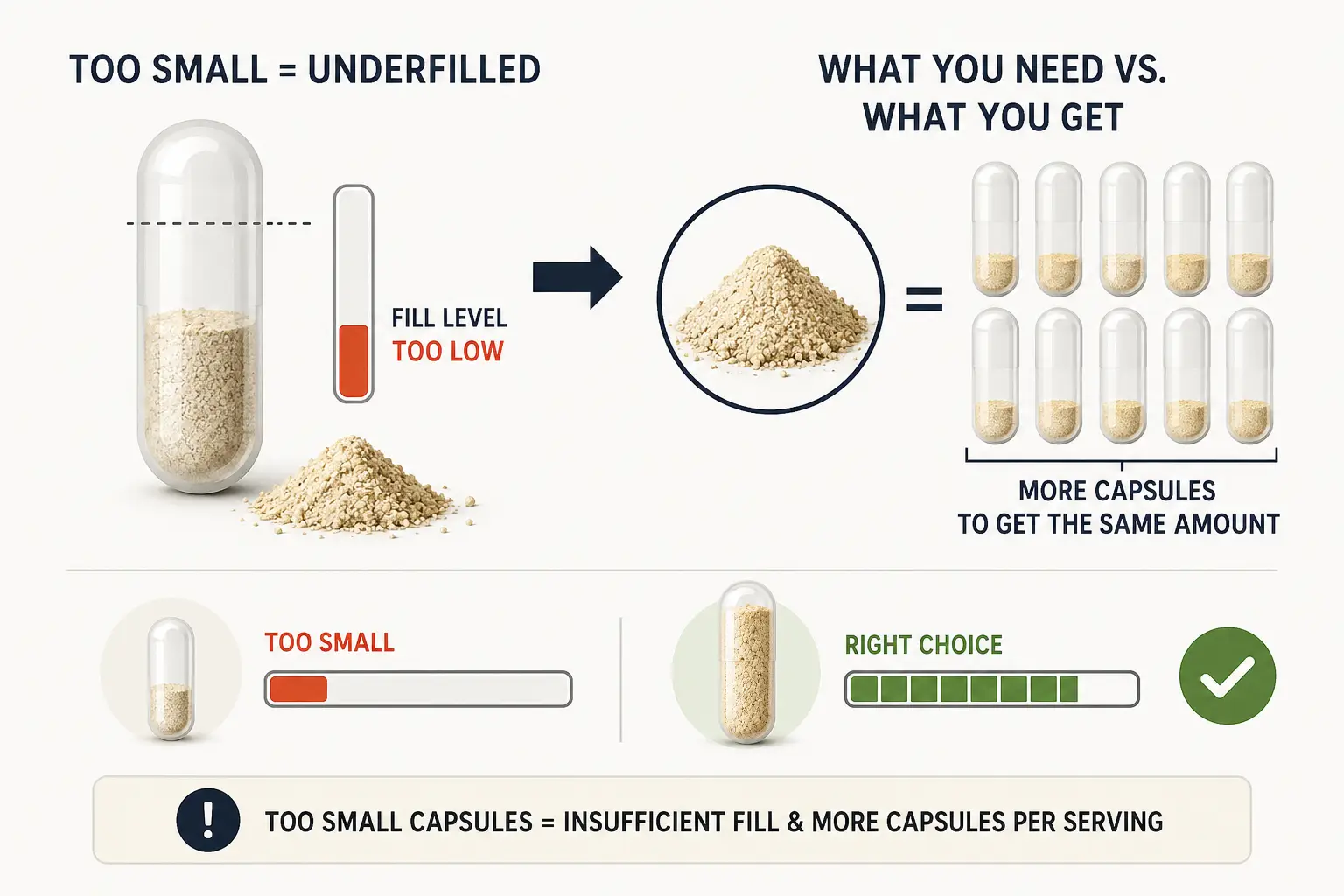
Going too small creates a different set of problems. If your capsule cannot hold enough powder, your entire product plan may need revision.
Undersized capsules can force you to increase capsules per serving, reduce active ingredient doses, add more filler, rewrite your label, change your packaging, and recalculate your cost per unit. These changes ripple through your entire project timeline and budget.
When Small Capsules Cause Problems
Some brand owners choose small capsules because they look elegant or because a competitor uses them. But they do not check whether their own formula fits. Here is what can go wrong:
Formula Does Not Fit
If your formula needs 500 mg per capsule and you choose size 2 (which typically holds 200–350 mg), you have a gap. You either need more capsules per serving or you need to cut ingredients.
Label and Regulatory Rework If you planned your label around "1 capsule per serving" but the formula requires 2 capsules, your supplement facts panel, suggested use, and sometimes your product name or marketing claims must change. This delays your launch.
Packaging Recalculation
More capsules per serving means more capsules per bottle. A 30-day supply at 1 capsule per day is 30 capsules. At 2 capsules per day, it becomes 60. Your bottle size, shipping weight, and unit cost all change.
Cost Assumptions Break
Your original quotation was based on a certain capsule count and bottle size. When capsule count doubles, your cost per bottle increases. Your retail price or margin must be adjusted.
How to Avoid This
Before finalizing your capsule size, send your formula to your manufacturer for a fill feasibility check. At our facility, we do this routinely for new OEM projects. We test the actual powder, measure its bulk density, run a small trial fill, and report back: "Your formula fits size 00 at 480 mg per capsule" or "Your formula needs size 0 with 2 capsules per serving." This simple step prevents expensive surprises later.
Should You Copy a Competitor's Capsule Size?
Many brand owners buy competitor products, open the capsules, and try to reverse-engineer the size and fill. This approach has limits.
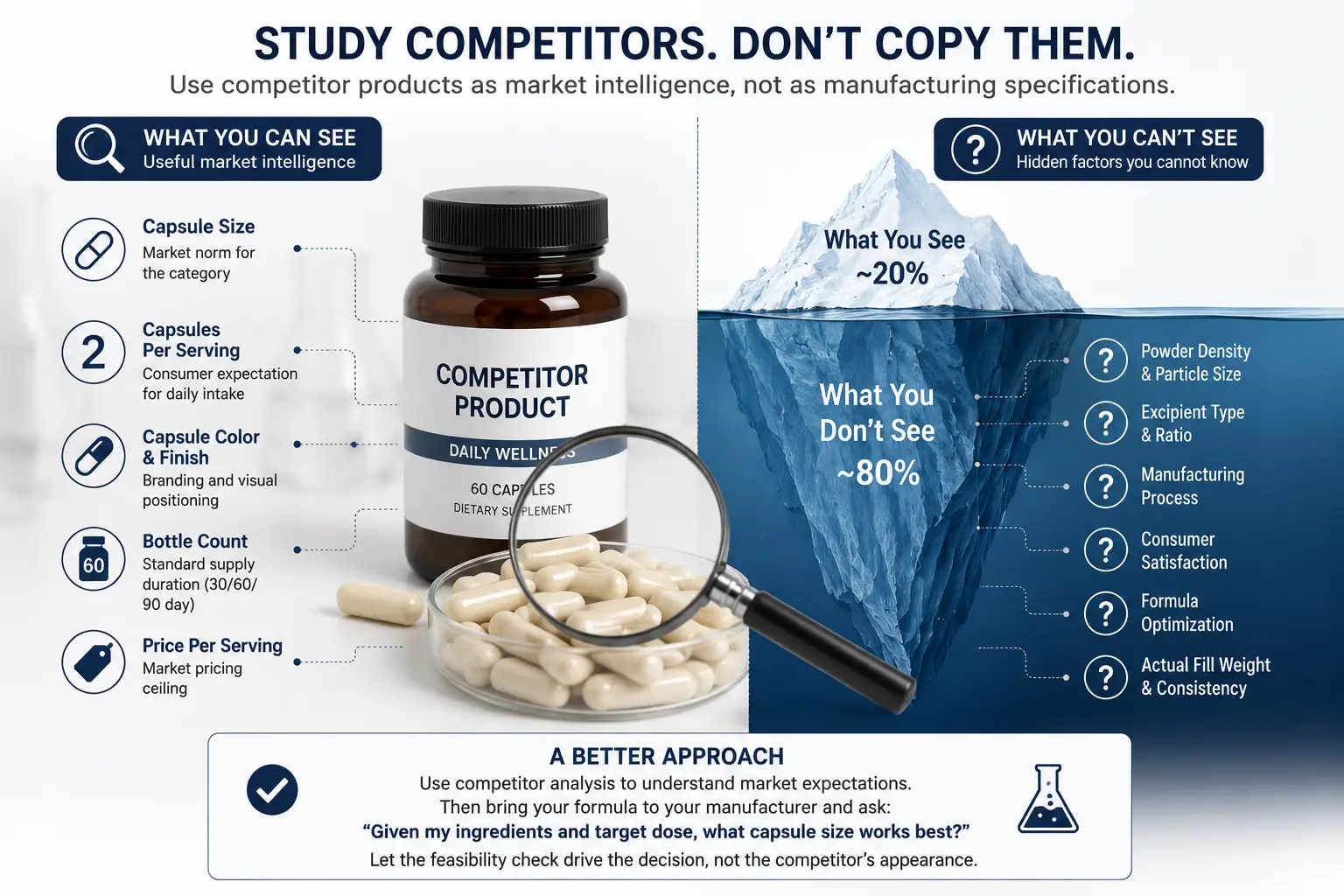
Copying a competitor's capsule size without checking your own formula density, target dose, excipient needs, and consumer profile is risky. Their powder, their supplier, their dose strategy, and their target market may differ from yours. Use competitor products as market intelligence, not as manufacturing specifications.
What You Can Learn From Competitors
Studying competitor capsule products is useful. You can observe:
| Observable Factor | What It Tells You |
|---|---|
| Capsule size (visual) | Market norm for the category |
| Capsules per serving | Consumer expectation for daily intake |
| Capsule color and finish | Branding and visual positioning |
| Bottle count | Standard supply duration (30, 60, 90 day) |
| Price per serving | Market pricing ceiling |
What You Cannot Learn From Competitors
You cannot know:
- Their exact powder density or particle size
- Which excipients they use and in what ratio
- Their manufacturer's specific filling process
- Whether their consumers are satisfied with the capsule size
- Whether their formula was optimized or compromised
A Better Approach
Use competitor analysis to understand market expectations. Then bring your own formula to your manufacturer and ask: "Given my ingredients and target dose, what capsule size works best?" Let the feasibility check drive the decision, not the competitor's appearance.
I had a client from Europe who wanted to match a popular brand's ashwagandha capsule. The competitor used size 0. My client's extract was from a different supplier with a different extraction ratio, resulting in a bulkier powder. Size 0 could not hold the same labeled dose. We moved to size 00 and adjusted the serving to 1 capsule. The product performed well because it delivered the right dose, even though it looked slightly different from the competitor.
How Does Capsule Size Affect Your Packaging and Label?
Capsule size decisions do not stay inside the capsule. They affect your entire product presentation, from bottle dimensions to label compliance.
Your capsule size determines capsules per serving, total capsule count per bottle, bottle dimensions, label layout, supplement facts panel content, and shipping weight. Changing capsule size late in development can force costly revisions across packaging, labeling, and logistics.

The Ripple Effect
Here is how capsule size connects to downstream decisions:
| Decision Area | How Capsule Size Affects It |
|---|---|
| Capsules per serving | Larger capsule = fewer per serving (usually) |
| Total count per bottle | Fewer per serving = smaller bottle possible |
| Bottle type and size | 60 capsules size 1 fits a smaller bottle than 60 capsules size 00 |
| Label space | Bottle size determines available label area |
| Supplement facts panel | Serving size statement changes with capsule count |
| Shipping dimensions | Bigger bottles = fewer units per carton |
| Unit cost | All of the above affect your landed cost |
Plan Capsule Size Early
I always recommend that our OEM clients finalize capsule size before designing packaging and labels. Too often, a brand owner designs beautiful packaging first, then discovers their formula requires a different capsule size that changes the bottle count. Now the packaging artwork, the die-cut dimensions, and the regulatory text all need revision.
The better workflow is: confirm formula → confirm capsule size and serving → confirm capsule count per bottle → select bottle → design label and packaging11. This sequence prevents rework and saves weeks of project time.
How Do Supplement Manufacturers Determine Capsule Size?
Many buyers assume manufacturers simply choose the largest capsule that can hold the formula.
In reality, capsule selection is a technical and commercial decision.
Professional supplement manufacturers evaluate formulation feasibility, consumer preferences, production efficiency, packaging requirements, and target market expectations before recommending a capsule size.

How We Evaluate Capsule Size During OEM Projects
At Shandong Health Biotech, capsule size evaluation typically involves several steps:
| Evaluation Area | Purpose |
|---|---|
| Formula Weight | Determine theoretical fill requirement |
| Bulk Density Testing | Calculate realistic fill capacity |
| Trial Encapsulation | Verify machine performance |
| Consumer Considerations | Assess swallowability |
| Packaging Review | Confirm bottle compatibility |
Why Trial Fills Matter
Many formulas look feasible on paper but behave differently during production.
A powder with poor flowability may require additional excipients or a larger capsule size than originally expected.
This is why experienced manufacturers perform feasibility testing before confirming commercial specifications.
Frequently Asked Questions
What is the most common capsule size for supplements?
Size 00 is generally considered the most commonly used capsule size for dietary supplements because it balances fill capacity and consumer comfort.
What capsule size holds 500 mg?
Many medium-density powders can fit approximately 500 mg into a size 0 capsule, although actual capacity depends on density and flowability.
What is the largest capsule size available?
Size 000 is the largest commonly used hard capsule size in dietary supplement manufacturing.
What capsule size is easiest to swallow?
Sizes 1 and 2 are generally easier to swallow than larger capsule sizes such as 00 or 000.
How much powder fits into a size 00 capsule?
A size 00 capsule can typically hold between 500 mg and 900 mg of powder, depending on ingredient density.
Are vegetarian capsules available in all sizes?
Most common capsule sizes, including 000 through 5, are available in both gelatin and vegetarian HPMC versions.
What capsule size is best for herbal supplements?
Size 00 and size 0 capsules are commonly used for herbal supplements because botanical extracts often require moderate fill volumes.
Can capsule size affect supplement costs?
Yes. Capsule size can influence capsule shell costs, packaging requirements, shipping costs, and manufacturing efficiency.
Conclusion
A capsule size chart gives you a starting point, but the right capsule size comes from matching your formula's density, your target dose, your consumer's comfort, and your commercial plan. Always confirm with a trial fill before committing to production.
"Predicting capsule fill weight from in-situ powder density ... - PMC", https://pmc.ncbi.nlm.nih.gov/articles/PMC6733302/. Aulton's Pharmaceutics: The Design and Manufacture of Medicines identifies bulk density, particle size distribution, and powder flow characteristics as the principal factors governing fill weight uniformity in hard capsule filling operations. Evidence role: mechanism; source type: paper. Supports: Bulk density, particle size/morphology, and flow properties are primary determinants of capsule fill weight. Scope note: Additional factors such as machine type, tamping force, and number of tamps also influence fill weight in practice. ↩
"[PDF] Size, Shape, and Other Physical Attributes of Generic Tablets ... - FDA", https://www.fda.gov/files/drugs/published/Size--Shape--and-Other-Physical-Attributes-of-Generic-Tablets-and-Capsules.pdf. Capsule shell manufacturers such as Lonza (formerly Capsugel) publish standard capsule body volumes consistent with these figures, with size 000 at approximately 1.37 mL and size 00 at approximately 0.91 mL (Lonza Capsugel product specifications). Evidence role: statistic; source type: other. Supports: Standard hard gelatin capsule volumes from size 000 (approximately 1.37 mL) to size 5 (approximately 0.13 mL). Scope note: Slight variations exist between manufacturers and between gelatin and HPMC capsule shells. ↩
"Calcium Carbonate | CaCO3 | CID 10112 - PubChem", https://pubchem.ncbi.nlm.nih.gov/compound/Calcium-Carbonate. The Handbook of Pharmaceutical Excipients reports calcium carbonate bulk density values ranging from approximately 0.6 to 1.2 g/mL depending on particle size and grade, substantially higher than typical herbal extract powders which often range from 0.2 to 0.5 g/mL. Evidence role: definition; source type: encyclopedia. Supports: Calcium carbonate has a relatively high bulk density (~0.6–1.2 g/mL depending on grade) compared to many botanical powders. Scope note: Exact density values vary by supplier, particle size distribution, and processing method. ↩
"Effects of powder flow properties on capsule filling weight uniformity", https://pubmed.ncbi.nlm.nih.gov/23902366/. Pharmaceutical research demonstrates that particle size reduction increases tapped density by improving packing efficiency, while glidants such as silicon dioxide reduce interparticle friction and improve flow into capsule bodies, collectively enabling higher fill weights per capsule (Podczeck & Jones, Pharmaceutical Capsules, 2nd ed.). Evidence role: mechanism; source type: paper. Supports: Reducing particle size increases bulk/tapped density, and flow agents (glidants) improve powder flow into capsule bodies, both contributing to higher fill weights. Scope note: Excessive particle size reduction can sometimes worsen flow due to increased cohesion; optimal results depend on the specific powder system. ↩
"Dietary Supplements: What You Need to Know - Consumer - NIH ODS", https://ods.od.nih.gov/factsheets/WYNTK-Consumer/. Survey data from the Council for Responsible Nutrition and published consumer preference studies indicate that most supplement users prefer one to two capsules per serving, with tolerance for higher counts primarily among sports nutrition consumers, while elderly populations show strong preference for single-unit servings. Evidence role: general_support; source type: paper. Supports: Consumer tolerance for multiple capsules per serving varies by demographic, with elderly and general consumers preferring fewer units. Scope note: Consumer preferences vary by region, product category, and cultural context; no single universal standard applies across all markets. ↩
"Impact of Tablet Size and Shape on the Swallowability in Older Adults", https://pmc.ncbi.nlm.nih.gov/articles/PMC10145850/. Research published in the International Journal of Pharmaceutics has demonstrated that capsule dimensions exceeding approximately 22 mm in length are associated with increased reports of swallowing difficulty, particularly among elderly patients and those with dysphagia (Fields et al., 2015). Evidence role: expert_consensus; source type: paper. Supports: Larger oral dosage forms are associated with greater swallowing difficulty and reduced patient compliance. Scope note: Most studies focus on patient pop ulations rather than general supplement consumers; results may not directly translate to healthy adult supplement users. ↩
"Medication adherence outcomes of 771 intervention trials - PMC - NIH", https://pmc.ncbi.nlm.nih.gov/articles/PMC5467216/. Studies in Therapeutic Advances in Drug Safety have shown that patients who report difficulty swallowing tablets or capsules are significantly more likely to discontinue therapy or switch products, suggesting a plausible mechanism by which smaller capsule sizes could improve repeat purchase behavior. Evidence role: general_support; source type: paper. Supports: Easier-to-swallow dosage forms are associated with improved adherence and continued product use. Scope note: The cited research addresses pharmaceutical adherence rather than supplement purchasing behavior specifically; the anecdotal case cannot be independently verified. ↩
"Patients' Preference for Pharmaceutical Dosage Forms - PMC", https://pmc.ncbi.nlm.nih.gov/articles/PMC10981379/. A systematic review in Patient Preference and Adherence found that larger pill or capsule size was consistently associated with reduced adherence and increased likelihood of discontinuation across multiple therapeutic categories. Evidence role: general_support; source type: paper. Supports: Dosage form size is a significant factor in medication/supplement adherence and patient preference. Scope note: Most adherence research is conducted in pharmaceutical rather than dietary supplement contexts; direct evidence on repeat purchase rates for supplements is limited. ↩
"Shell Formulation in Soft Gelatin Capsules: Design and ... - PMC", https://pmc.ncbi.nlm.nih.gov/articles/PMC11468233/. Industry pricing from capsule shell suppliers indicates that size 000 capsules typically cost 20–40% more per unit than size 0 or size 1 capsules, reflecting increased gelatin or HPMC material requirements and lower production speeds for larger shells. Evidence role: statistic; source type: other. Supports: Larger capsule sizes generally command higher per-unit prices due to greater material usage. Scope note: Pricing varies significantly by supplier, order volume, material type (gelatin vs. HPMC), and geographic market. ↩
"Capsule Filling Machine Bundle - Large (Size 00 and Size 000)", https://www.allincapsule.com/products/capsule-filling-machine-bundle-large?srsltid=AfmBOord9GzPSV6CtQhF4NUk2NwHFcAEnaa72YfWCswgGOhlD2pJkq8z. Equipment manufacturers such as Bosch and MG2 specify that size 000 capsules require dedicated change parts and may run at reduced speeds compared to standard sizes (0–2), with some bench-top and mid-range machines not supporting size 000 at all. Evidence role: mechanism; source type: other. Supports: Not all encapsulation machines are designed to handle size 000 capsules, and larger sizes may require specific tooling or slower operation. Scope note: Machine compatibility depends on specific equipment model and manufacturer; modern high-speed lines may handle all sizes with appropriate tooling. ↩
"Small Entity Compliance Guide: Current Good Manufacturing ... - FDA", https://www.fda.gov/regulatory-information/search-fda-guidance-documents/small-entity-compliance-guide-current-good-manufacturing-practice-manufacturing-packaging-labeling. The Natural Products Association and contract manufacturing industry guidelines recommend that formulation feasibility, including capsule size confirmation and trial fills, be completed prior to packaging specification and label design to avoid costly revisions and regulatory compliance issues. Evidence role: expert_consensus; source type: institution. Supports: Industry best practices recommend finalizing formulation and dosage form specifications before committing to packaging design. Scope note: Specific workflow sequences may vary by company and regulatory jurisdiction; no single universal standard exists. ↩