Launching a dietary supplement brand involves much more than choosing ingredients and designing attractive packaging. You need to develop a commercially viable formula, identify reliable raw material suppliers, select the right dosage form, coordinate production, approve packaging, and prepare the necessary quality documentation.
When these responsibilities are divided among multiple suppliers, communication becomes complicated. A packaging delay can disrupt manufacturing. An ingredient substitution can affect product specifications. Missing technical documents can create additional challenges during product registration or importation.
For private label brands, distributors, and purchasing managers, these problems create unnecessary costs and uncertainty. Turnkey supplement manufacturing offers a more coordinated approach by bringing product development, manufacturing, packaging, and quality support together under one manufacturing partner.
However, not every manufacturer defines turnkey services in the same way. Understanding what is included, what costs extra, and who remains responsible for market compliance is essential before committing to a supplier.
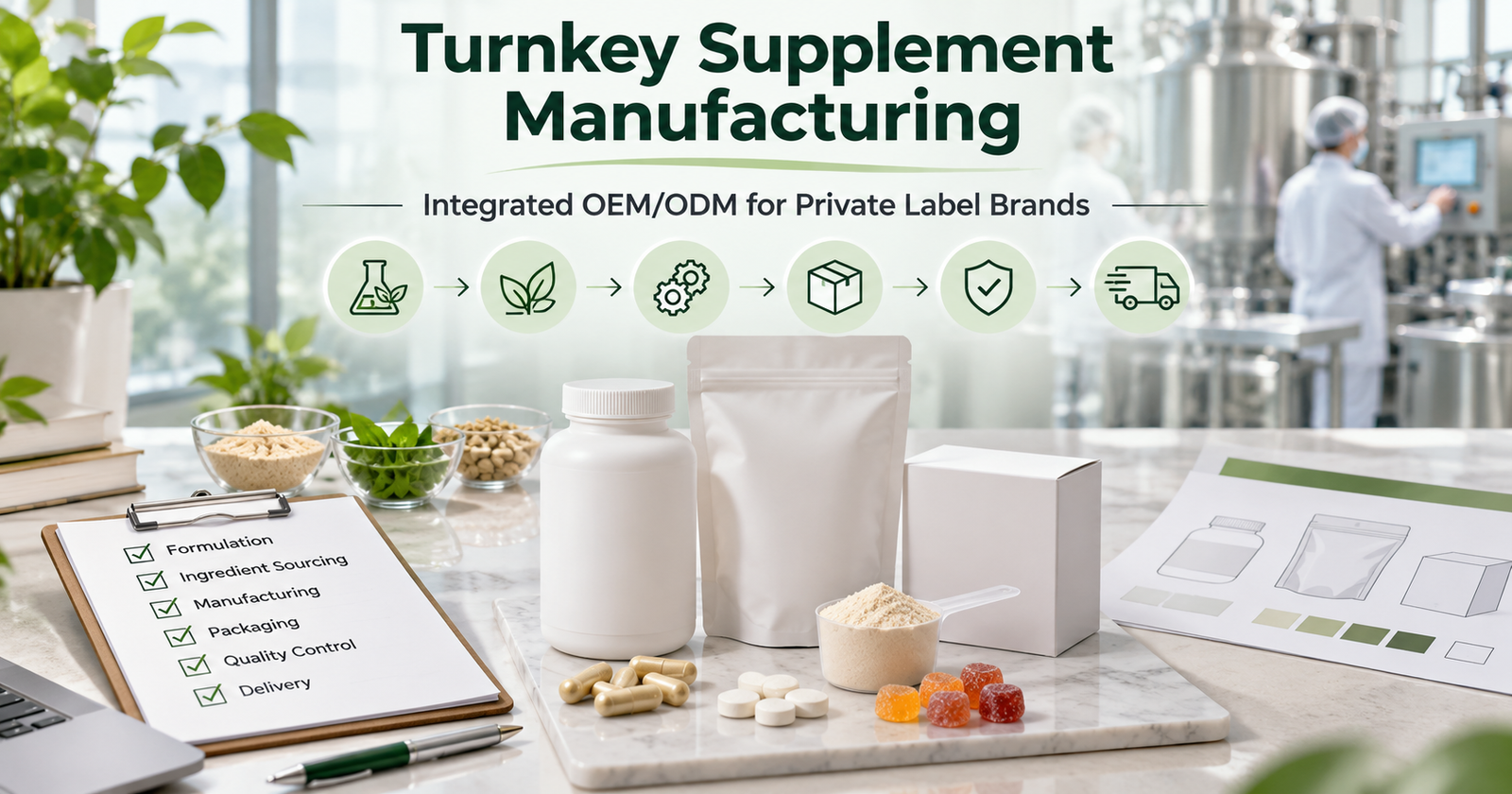
Turnkey supplement manufacturing is an integrated OEM/ODM service in which one manufacturing partner coordinates formulation, ingredient sourcing, production, packaging, quality control, and finished-product delivery. Instead of managing several independent suppliers, supplement brands work through a coordinated production process. The exact scope depends on the manufacturer and the agreed contract.
A turnkey manufacturer can help brands reduce supplier coordination, improve project visibility, and simplify product development. However, it does not automatically guarantee lower costs, shorter lead times, or regulatory approval. These outcomes depend on formula complexity, manufacturing capabilities, supplier coordination, and the destination market.
This guide explains how turnkey supplement manufacturing works, what buyers should expect from a manufacturer, and how to evaluate suppliers before placing a commercial order.
What Is Turnkey Supplement Manufacturing?
Turnkey supplement manufacturing describes a coordinated production model in which one manufacturing partner manages or organizes the major activities required to transform a supplement concept into finished, packaged products.
For a brand owner, this model can eliminate the need to establish separate relationships with formulation consultants, ingredient suppliers, manufacturing facilities, packaging companies, and testing laboratories.
Instead, the brand communicates with one primary manufacturing partner responsible for coordinating the agreed project scope.
For example, a purchasing manager preparing to launch magnesium glycinate capsules may need to arrange the formula, capsule shells, raw material qualification, encapsulation, bottles, labels, testing, and shipping documentation. A turnkey supplement manufacturer can coordinate these activities through a single project workflow.
This does not mean every process must occur inside one building. Some specialized activities, such as third-party laboratory testing or particular packaging operations, may be outsourced to qualified service providers.
The important distinction is that the manufacturer coordinates the work, defines responsibilities, and provides the buyer with a structured production process.
Turnkey supplement manufacturing combines product development, manufacturing, packaging, and agreed support services under one coordinated project. It is especially useful for brands that want finished products without independently managing every technical supplier.
How Is Turnkey Manufacturing Different From Private Label Manufacturing?
The terms turnkey manufacturing, private label manufacturing, OEM, and ODM are frequently used interchangeably. However, they describe different aspects of the manufacturing relationship.
| Manufacturing Model | Main Characteristics | Best Suited For |
|---|---|---|
| Turnkey Manufacturing | A coordinated service covering multiple production and support stages | Brands seeking simplified project management |
| Private Label Manufacturing | Existing or adaptable formulas sold under a customer's brand | Brands seeking a relatively straightforward launch |
| Custom Supplement Manufacturing | Products developed according to specific formula and technical requirements | Brands requiring differentiation |
| OEM Manufacturing | Products manufactured according to agreed customer specifications | Brands with defined product requirements |
| ODM Manufacturing | Manufacturer participates in product design and development | Brands requiring formulation and technical development support |
| Contract Manufacturing | Manufacturing services performed under a commercial agreement | Brands outsourcing production activities |
These models are not mutually exclusive.
A turnkey project can involve an existing private label formula, a custom OEM formulation, or a manufacturer-led ODM development process.
For example, a brand might choose an established vitamin C tablet formula, customize the bottle and label, and purchase finished products through a turnkey agreement.
Another brand might request a proprietary botanical capsule formula requiring feasibility testing, stability assessment, and customized packaging.
Both projects can use a turnkey arrangement, but their development requirements and costs will be different.
What Does a Turnkey Manufacturer Actually Take Responsibility For?
A professional turnkey supplement manufacturer should clearly distinguish between manufacturing responsibilities and commercial or regulatory responsibilities.
The manufacturer may coordinate:
- Formulation development and technical evaluation
- Ingredient sourcing and supplier qualification
- Manufacturing and in-process quality control
- Packaging and labeling execution
- Agreed laboratory testing
- Production records and quality documentation
- Export shipment preparation
The brand or importer may remain responsible for:
- Final product positioning and marketing claims
- Destination-market product registration or notification
- Import authorization and local regulatory compliance
- Trademark ownership and brand protection
- Local distribution and consumer marketing
These responsibilities should be documented before production begins.
The key benefit of turnkey manufacturing is coordinated execution, not the automatic transfer of every legal responsibility to the factory.
This distinction is particularly important for brands selling into the United States, European Union, and Southeast Asian markets.
What Services Are Included in Turnkey Supplement Manufacturing?
A comprehensive turnkey supplement manufacturing service should help buyers progress through the critical technical and commercial decisions required for product development.
The service generally begins with evaluating the product concept. The manufacturer reviews the proposed ingredients, dosage, serving size, target market, dosage form, and packaging expectations.
Once the formulation has been evaluated, the project moves toward ingredient sourcing, sample development, production planning, packaging preparation, and quality verification.
The advantage is not simply having several services available. It is ensuring those services work together.
For example, a formula may technically fit inside a capsule but require a larger capsule size than the brand originally planned. A gummy formula may contain ingredients that affect flavor, texture, or stability. A high-dose tablet may require adjustments to maintain acceptable hardness and disintegration.
These issues should be identified before the brand approves packaging artwork or places a commercial order.
Turnkey supplement manufacturing commonly includes formulation support, raw material sourcing, dosage-form production, packaging customization, quality control, and documentation assistance. The complete service scope should be confirmed in the quotation and manufacturing agreement.
1. Custom Formulation and Product Development
Formulation is one of the most important stages in supplement manufacturing.
A manufacturer should evaluate whether the selected active ingredients are suitable for the intended dosage form.
This evaluation may include:
- Active ingredient dosage and concentration
- Ingredient compatibility
- Bulk density and processing characteristics
- Flavor and taste considerations
- Moisture sensitivity
- Product stability
- Target serving size
- Manufacturing feasibility
For instance, a high-dose mineral formula may be more suitable for tablets or capsules than gummies, depending on the mineral form and required serving amount.
Brands developing products from scratch may benefit from an experienced supplement manufacturer that can assess formula feasibility before commercial production.
2. Ingredient Sourcing and Qualification
Ingredient sourcing involves more than locating the lowest-cost supplier.
A manufacturer should consider raw material identity, specification, quality, consistency, availability, and documentation.
Depending on the ingredient, relevant documents may include:
- Raw Material Specification
- Certificate of Analysis (COA)
- Allergen Statement
- Origin Information
- Microbiological Testing Results
- Heavy Metal Testing Results
- Relevant Product or Supplier Certifications
For botanical extracts, standardization and extraction methods can be particularly important.
A supplier offering a low price for an extract with different active-compound specifications may not be providing a commercially equivalent ingredient.
Brands should therefore compare materials using agreed technical specifications rather than ingredient names alone.
3. Supplement Manufacturing and Dosage Forms
Turnkey manufacturing can cover different supplement formats depending on the manufacturer's equipment and capabilities.
| Dosage Form | Common Applications | Key Manufacturing Considerations |
|---|---|---|
| Capsules | Vitamins, minerals, botanical extracts | Fill weight, powder flow, capsule size |
| Tablets | Multivitamins, minerals, chewable products | Compression, hardness, friability, disintegration |
| Gummies | Vitamins, beauty and wellness products | Taste, texture, moisture, active stability |
| Softgels | Oils and compatible liquid or semi-solid fills | Fill compatibility, shell stability, sealing |
| Powders | Protein, creatine, electrolyte blends | Blend uniformity, moisture control, flowability |
| Liquids | Liquid vitamins and botanical formulations | Solubility, preservation, microbial control |
Manufacturing requirements vary significantly across these categories.
For more detailed information, explore our:
- Capsule Manufacturing Services
- Tablet Supplement Manufacturing
- Gummy Supplement Manufacturing
- Softgel Manufacturing Services
- Powder Supplement Manufacturing
- Liquid Supplement Manufacturing
Selecting the right dosage form at an early stage can reduce reformulation, packaging changes, and production complications.
4. Private Label Packaging and Labeling
Packaging is an important part of a turnkey manufacturing project because it influences product protection, shipping efficiency, shelf presentation, and cost.
Common supplement packaging options include:
- PET and HDPE bottles
- Glass bottles
- Blister packaging
- Stand-up pouches
- Stick packs
- Sachets
- Cartons and display boxes
Packaging selection should consider compatibility with the formula and intended shelf life.
For example, moisture-sensitive products may require suitable barrier packaging and desiccants. Products containing oils may require careful packaging compatibility evaluation.
The manufacturer can assist with packaging specifications and label production, while the brand should approve the final artwork and verify destination-market labeling requirements.
5. Quality Control and Documentation
A turnkey project should define the quality checks performed at each stage.
Depending on the product, the agreed program may include raw material identity testing, in-process controls, finished-product specifications, and additional third-party testing.
Potential finished-product checks include:
- Appearance and physical characteristics
- Active ingredient content
- Microbiological limits
- Selected heavy metals
- Net content or fill weight
- Tablet or capsule performance characteristics
- Packaging integrity
Not every test is required or appropriate for every product. The final testing scope depends on the formula, specifications, applicable requirements, and customer agreement.
For US-market dietary supplements, FDA's dietary supplement cGMP framework under 21 CFR Part 111 addresses specifications and quality control during manufacturing, packaging, labeling, and holding operations.
Practical takeaway: Before approving a turnkey quotation, ask which services, tests, packaging components, and documents are included—and which require additional fees.
How Much Does Turnkey Supplement Manufacturing Cost?
One of the first questions purchasing managers ask is how much turnkey supplement manufacturing costs.
However, there is no reliable universal price per bottle, capsule, or gummy.
Two products with similar marketing descriptions may have substantially different manufacturing costs because they use different ingredient grades, active dosages, production processes, packaging materials, and testing requirements.
For example, a standard vitamin C tablet and a multi-ingredient botanical tablet may use the same packaging format but have different formulation and production costs.
Similarly, a ready-made private label capsule may require less development work than a new formulation involving uncommon ingredients or specialized processing requirements.
A complete quotation should therefore be based on defined product specifications rather than an estimated retail product category.
Turnkey supplement manufacturing cost depends primarily on formulation, ingredient quality, dosage form, MOQ, packaging, testing, development requirements, and logistics. Buyers should request an itemized quotation with clearly defined specifications and included services.
What Factors Affect Supplement Manufacturing Costs?
| Cost Factor | How It Influences the Quotation | What Buyers Should Confirm |
|---|---|---|
| Active Ingredients | Higher concentrations or specialized materials may increase raw material costs | Ingredient grade and amount per serving |
| Dosage Form | Equipment, processing stages, and production efficiency differ | Manufacturing method and technical feasibility |
| MOQ | Small batches may have higher unit costs | Minimum quantity per SKU |
| Formula Development | New formulas may require sampling and adjustments | Development and revision charges |
| Packaging | Custom bottles, printing, and cartons affect costs | Exact packaging specifications |
| Quality Testing | Third-party testing can add expense | Included and optional test items |
| Documentation | Additional market-specific requirements may require extra work | Available files and preparation costs |
| Shipping | Destination, volume, and delivery terms affect freight | EXW, FOB, or other agreed Incoterms |
How Does MOQ Affect Turnkey Manufacturing?
MOQ means Minimum Order Quantity.
Manufacturers establish MOQs based on production equipment, batch efficiency, raw material procurement, and packaging requirements.
Smaller quantities may increase unit costs because setup, cleaning, quality control, and documentation expenses must be distributed across fewer finished products.
For example, a production run of 1,000 bottles may have a different unit cost from a run of 5,000 bottles, even when the formulation and packaging are identical.
However, larger quantities also require more capital and inventory management.
Brands should evaluate MOQ in relation to forecast demand, cash flow, shelf life, and reorder planning.
A lower MOQ is not automatically the most economical option, and the lowest unit price is not automatically the best purchasing decision.
A useful comparison includes the landed cost per sellable unit, not only the factory's quoted price.
Should Brands Choose Ready-Made or Custom Formulas?
Ready-made formulas may reduce development work and simplify early product decisions.
Custom formulations provide opportunities for differentiation, but may involve additional sampling, ingredient procurement, and technical evaluation.
| Consideration | Ready-Made Formula | Custom Formula |
|---|---|---|
| Development Work | Usually lower | Usually higher |
| Product Differentiation | More limited | Greater potential |
| Sampling | May be relatively straightforward | May require multiple iterations |
| Manufacturing Feasibility | Often previously established | Must be assessed |
| Ingredient Flexibility | Limited to permitted changes | More formulation options |
| Launch Planning | Potentially simpler | More technical decisions |
For new brands with limited capital, an existing formula may provide a practical starting point.
For established businesses seeking a differentiated product, custom formulation may offer greater commercial value.
What Should a Turnkey Manufacturing Quotation Include?
A well-structured quotation should identify:
- Product name and dosage form
- Active ingredients and agreed dosage
- Unit weight or serving size
- Quantity per bottle or package
- Minimum order quantity
- Packaging materials and specifications
- Unit price and applicable currency
- Sample or development fees
- Testing and documentation scope
- Production lead time and shipping terms
Buyers should also clarify whether label printing, cartons, shipping, and third-party laboratory testing are included.
For example, a quotation of USD 3.00 per bottle cannot be compared fairly with a quotation of USD 3.30 if the two prices include different packaging or testing services.
A slightly higher unit price may be commercially preferable when the overall scope is more complete.
Practical takeaway: Ask for a specification-based quotation and compare the total cost of obtaining finished, saleable products.
How Long Does the Turnkey Supplement Manufacturing Process Take?
Production timelines are a major concern for supplement importers and private label brands.
Many businesses plan launches around seasonal demand, advertising campaigns, retail distribution schedules, or inventory replenishment.
However, manufacturing time is only one part of the project.
A new supplement must usually pass through product specification, formula evaluation, sampling, approval, material procurement, manufacturing, quality checks, packaging, and shipment preparation.
A delay at an early stage can affect every subsequent activity.
For example, if a brand changes the active ingredient dosage after approving a sample, the manufacturer may need to repeat feasibility checks and revise the product specification.
Similarly, customized bottle production or imported raw materials can affect the manufacturing schedule.
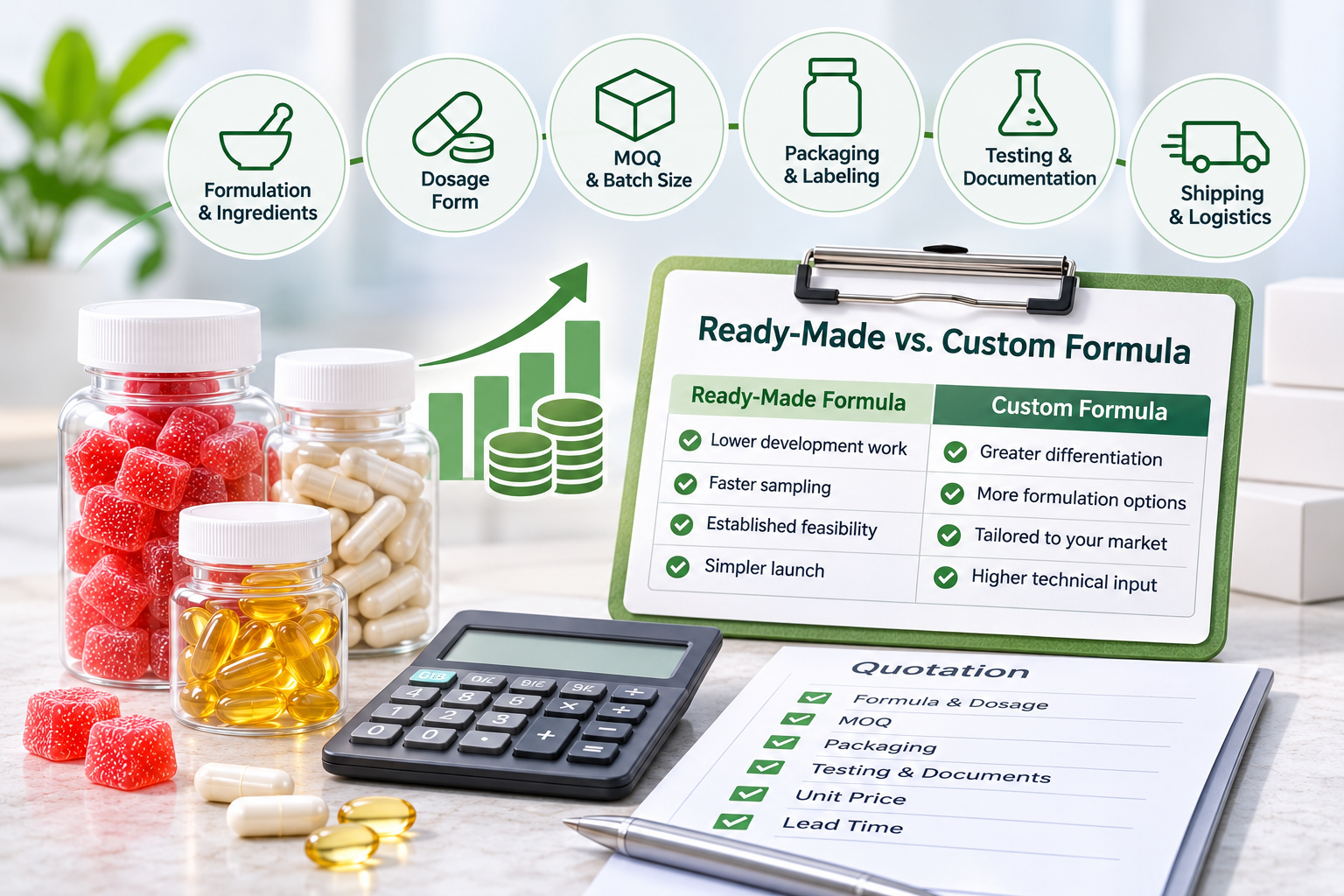
A turnkey supplement manufacturing project typically follows six major stages: requirement confirmation, formulation assessment, sample development, commercial approval, manufacturing and quality control, and final shipment preparation. Total lead time depends on product complexity, supplier availability, customer approvals, and testing requirements.
Stage 1: Product Requirements and Technical Evaluation
The first step is to define what the brand wants to manufacture.
A useful product brief should contain:
- Target product category
- Main active ingredients
- Desired dosage per serving
- Dosage form
- Target country
- Expected order quantity
- Packaging requirements
- Target price range
- Intended launch schedule
The more complete the initial brief, the easier it is for the manufacturer to evaluate feasibility.
Stage 2: Formula Development and Sampling
For custom supplements, the manufacturer may need to prepare samples for evaluation.
Sampling can involve:
- Ingredient compatibility assessment
- Flavor development
- Texture or mouthfeel adjustments
- Capsule or tablet size selection
- Active dosage verification
- Packaging suitability review
Sample approval should consider technical performance as well as appearance and taste.
A good-tasting gummy sample is not necessarily commercially ready if its active ingredients cannot remain within specification throughout the intended shelf life.
Stage 3: Commercial Specification Approval
Once the sample is accepted, the buyer and manufacturer should confirm the commercial product specification.
Important approval items may include:
- Final formula and permitted tolerances
- Ingredient specifications
- Packaging format
- Label artwork
- Finished-product quality specifications
- Agreed testing requirements
- Order quantity
- Commercial terms
These details should be documented before production.
Stage 4: Raw Material Procurement and Production Planning
After commercial confirmation, the manufacturer arranges materials and production scheduling.
Potential schedule dependencies include:
- Ingredient availability
- Custom packaging lead times
- Production-line capacity
- Required quality documentation
- Payment and commercial approvals
Uncommon ingredients or specialized packaging may require additional procurement time.
Stage 5: Manufacturing and Quality Verification
Commercial production follows the agreed manufacturing process.
The specific controls depend on the dosage form.
For capsules, important parameters may include blend uniformity, fill weight, and capsule integrity.
For tablets, they may include tablet weight, hardness, friability, and disintegration.
For gummies, controls may include weight consistency, texture, moisture, and ingredient stability.
After production, the required finished-product tests and documentation should be completed before release.
Stage 6: Packaging, Shipping, and Documentation
The final stage involves confirming that the products have been packaged and labeled according to the approved specifications.
The manufacturer and buyer should coordinate shipping documentation and agreed delivery terms.
Depending on the destination and shipping arrangement, documents may include:
- Commercial Invoice
- Packing List
- Certificate of Analysis
- Product Specification
- Certificate of Origin, when required
- Other agreed export or registration-support documents
The specific document requirements vary by country and product.
How Can Brands Avoid Production Delays?
The most effective approach is to reduce preventable changes after commercial approval.
Before confirming an order, buyers should check that the formula, packaging, artwork, documentation, and shipping details are all aligned.
| Potential Delay | Preventive Action |
|---|---|
| Late formula changes | Complete sample and formula approval before production |
| Packaging artwork revisions | Approve final dimensions and artwork early |
| Ingredient shortages | Confirm material availability before scheduling |
| Missing import documents | Identify destination requirements before ordering |
| Unexpected testing requests | Agree on testing scope before commercial production |
| Unclear communication | Assign responsible contacts and approval deadlines |
Practical takeaway: Request a project-specific production schedule with clear milestones instead of relying on a generic manufacturing lead-time estimate.
How Can Brands Choose a Reliable Turnkey Supplement Manufacturer?
Choosing a turnkey supplement manufacturer is a strategic sourcing decision.
The supplier will influence product quality, cost control, documentation, inventory availability, and ultimately the reputation of your brand.
A manufacturer offering an attractive quotation may still be unsuitable if its production equipment cannot handle your formula, its documentation is incomplete, or its communication process creates repeated delays.
Likewise, a manufacturer with an impressive product catalog may not necessarily have the expertise required for every dosage form.
Buyers should therefore evaluate potential partners using a combination of technical capability, quality systems, commercial transparency, communication, and export experience.
For international buyers, documentation support deserves particular attention. A product that is manufactured successfully may still encounter import or registration difficulties if the required technical files are missing.
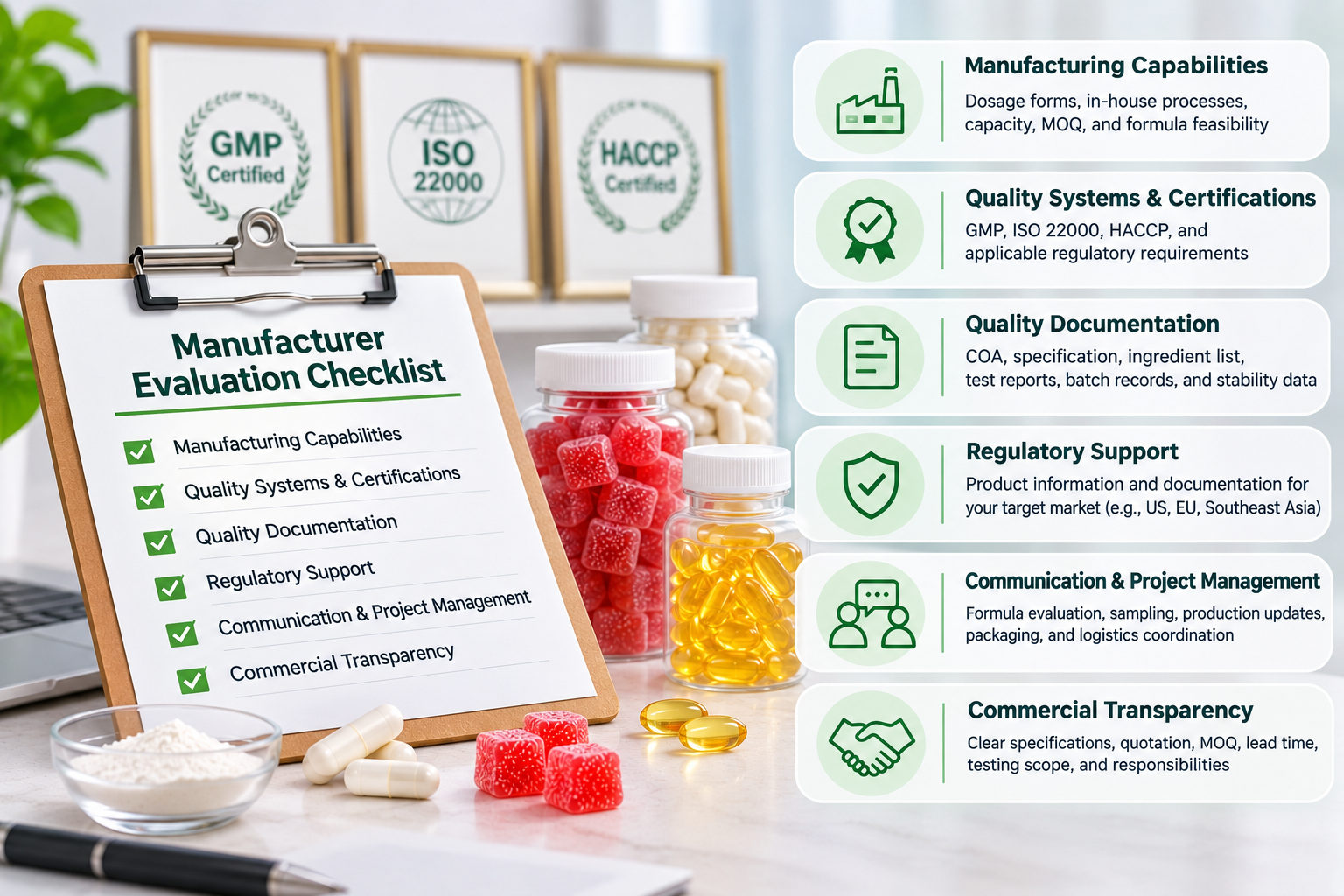
A reliable turnkey supplement manufacturer should demonstrate suitable production capabilities, verifiable quality systems, clear specifications, transparent quotations, responsive technical communication, and the ability to provide agreed manufacturing documentation.
1. Verify Manufacturing Capabilities
The first question is whether the manufacturer can produce the intended dosage form and formulation.
A supplement factory specializing in powder blending may not have the same equipment or expertise as a facility producing gummies or softgels.
Before placing an order, ask:
- Which dosage forms can the facility manufacture?
- Which processes are performed in-house?
- Which activities are outsourced?
- Can the manufacturer handle your ingredient concentrations?
- What are the production-line capacity and MOQ requirements?
- Can the manufacturer support repeat orders?
For companies planning several product categories, a supplier with multiple manufacturing capabilities may simplify procurement.
However, the buyer should still verify the supplier's actual equipment and project feasibility.
2. Review Quality Systems and Certifications
Manufacturers may operate under quality systems such as GMP, ISO 22000, or HACCP.
These systems cover different aspects of manufacturing and food safety management.
A certification should never be evaluated by its logo alone.
Buyers should review the issuing organization, validity period, facility name, certification scope, and applicability to the intended product.
For US-market dietary supplements, relevant manufacturing obligations are described in FDA's dietary supplement current Good Manufacturing Practice regulations under 21 CFR Part 111.
Read the FDA guidance on dietary supplement cGMP requirements.
A certificate does not automatically establish that every finished product is approved for sale in every destination market.
3. Evaluate Quality Documentation
Documentation is particularly important when sourcing supplements internationally.
Before ordering, ask the manufacturer which files can be provided.
| Document | Primary Purpose |
|---|---|
| Certificate of Analysis (COA) | Reports specified test results |
| Product Specification | Defines agreed product characteristics |
| Ingredient List | Identifies product composition |
| Raw Material Documentation | Supports ingredient qualification |
| Microbiological Test Report | Reports selected microbiological results |
| Heavy Metal Test Report | Reports selected elemental contaminant results |
| Batch Records | Support manufacturing traceability |
| Stability Information | Supports shelf-life assessment |
| Packaging Specification | Defines the approved packaging format |
The available documentation may differ by product and order.
For instance, a manufacturer may routinely provide a finished-product COA while charging separately for additional third-party heavy metal or microbiological testing.
Buyers should confirm this before commercial production.
4. Check Regulatory Support for Your Destination Market
Regulatory requirements vary between markets.
For the United States, dietary supplement labeling and claims should be assessed against applicable FDA requirements.
For example, certain structure/function claims require substantiation, a prescribed disclaimer, and notification to FDA within the applicable timeframe.
Review the FDA Dietary Supplement Labeling Guide.
For European markets, food supplements must comply with relevant EU rules and applicable national requirements. Nutrition and health claims are governed by Regulation (EC) No 1924/2006.
Review the European Commission's nutrition and health claims guidance.
For countries such as the Philippines, Indonesia, or other Southeast Asian markets, local registration, ingredient, labeling, and certification requirements may differ.
A manufacturer can assist with relevant product information and agreed documentation, but local importers and brand owners should verify applicable market requirements with qualified regulatory professionals.
5. Evaluate Communication and Project Management
Communication quality can be as important as technical capability.
A reliable supplier should be able to explain:
- Formula feasibility and limitations
- Pricing differences
- Required documentation
- Production milestones
- Sample approval procedures
- Quality testing arrangements
- Packaging options
- Export and logistics coordination
Be cautious when a supplier promises that every ingredient, dosage, and regulatory claim can be manufactured without technical evaluation.
Responsible manufacturing partners should be willing to explain limitations and propose workable alternatives.
6. Confirm Commercial Transparency
Before making a purchasing decision, request a written agreement covering:
- Approved formula and product specifications
- MOQ and order quantity
- Packaging requirements
- Included services and testing
- Price and payment terms
- Manufacturing schedule
- Quality acceptance criteria
- Shipping terms
- Responsibilities for changes and deviations
A transparent agreement helps prevent disagreements during production.
Practical takeaway: Evaluate a turnkey supplement manufacturer using a documented supplier checklist—not only the unit price or product catalog.
Is Turnkey Supplement Manufacturing Right for Your Brand?
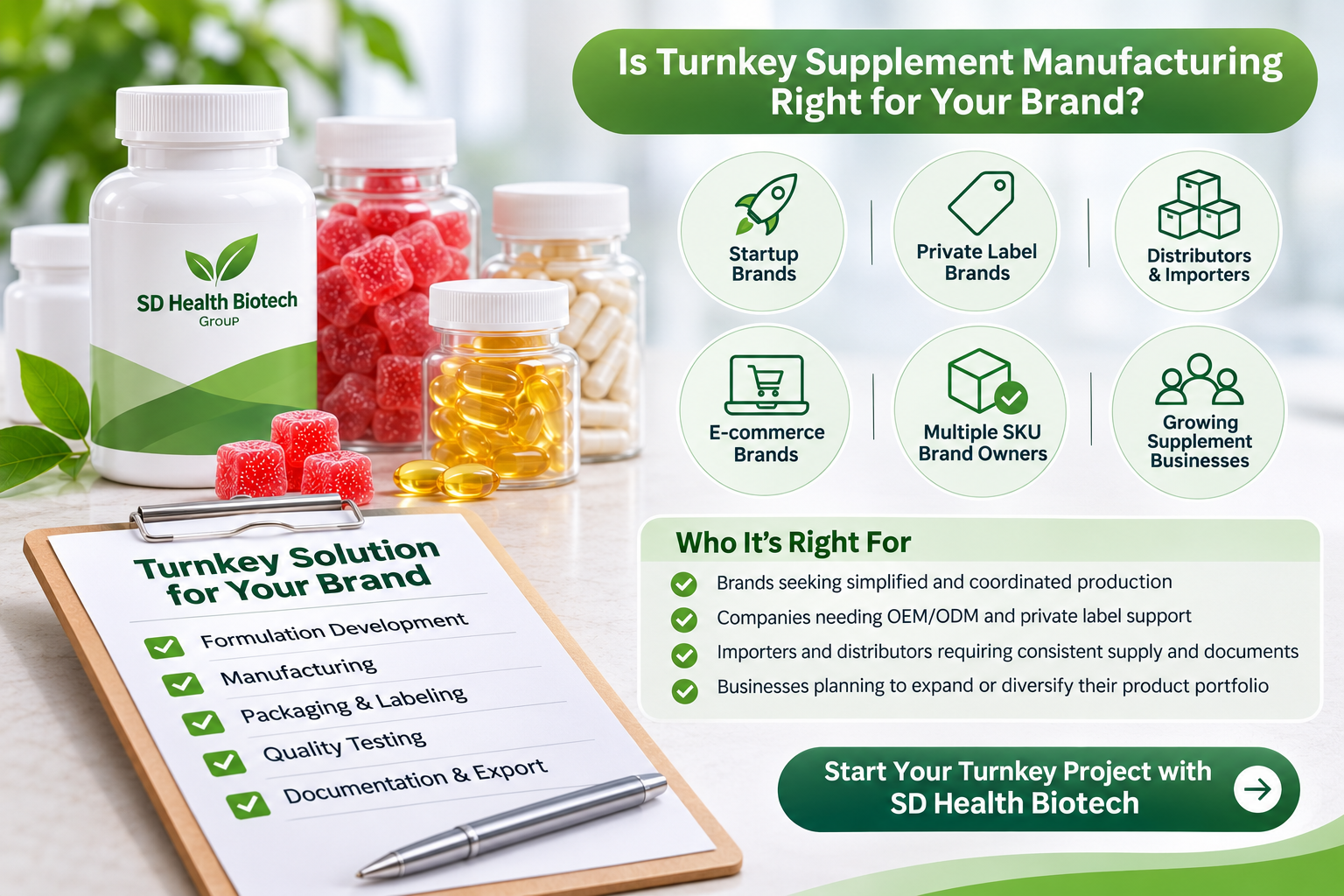
Turnkey supplement manufacturing can be an effective option for companies that want to develop or expand supplement products without managing every part of production independently.
However, the best manufacturing arrangement depends on the brand's resources, product requirements, commercial goals, and technical experience.
A startup supplement brand may prefer an existing formulation with customized packaging because it reduces the number of early technical decisions.
An established supplement brand may require proprietary ingredients, custom dosage levels, specialized packaging, and detailed quality documentation.
An importer or distributor may prioritize consistent supply, competitive landed costs, market-specific documentation, and predictable reordering.
Turnkey manufacturing can support all of these situations, but the service scope should be adapted to the buyer's needs.
Turnkey supplement manufacturing is particularly suitable for private label brands, growing supplement businesses, and importers that need coordinated manufacturing services. It is less suitable when a company requires complete direct control over every supplier or manufacturing step.
Which Types of Businesses Benefit Most?
| Business Type | Main Priority | Potential Turnkey Advantage |
|---|---|---|
| Startup Supplement Brands | Launching with limited technical resources | Simplified supplier coordination |
| Established Private Label Brands | Introducing differentiated products | Custom formulation and manufacturing support |
| Supplement Distributors | Reliable supply and documentation | Coordinated procurement and production |
| E-commerce Brands | Expanding product portfolios | Flexible product development options |
| International Importers | Quality, costs, and market documentation | Centralized manufacturing communication |
| Brand Owners With Multiple SKUs | Consistent supplier management | More coordinated product planning |
When Might Turnkey Manufacturing Be Less Suitable?
Turnkey manufacturing is not the ideal arrangement for every company.
For example, a brand with its own formulation laboratory, established ingredient supply contracts, and dedicated quality team may prefer to purchase manufacturing services separately.
Similarly, a company requiring strict supplier exclusivity or a specialized manufacturing technology may need a more customized sourcing structure.
Brands should compare the total operational cost and level of control offered by different models.
How Does SD Health Biotech Support Turnkey Supplement Projects?
SD Health Biotech provides OEM/ODM and private label supplement manufacturing services for international supplement brands, importers, and distributors.
Our manufacturing capabilities cover multiple dosage forms, including:
- Capsules
- Tablets
- Gummies
- Softgels
- Powders
- Liquid supplements
Depending on project requirements, we can support formulation development, ingredient sourcing, manufacturing, packaging customization, quality testing coordination, and export documentation.
For buyers considering a turnkey project, the first step is a technical and commercial evaluation.
We recommend providing the following information:
- Product name or concept
- Main active ingredients and dosage
- Preferred dosage form
- Quantity per bottle or package
- Estimated order quantity
- Target market
- Packaging preferences
- Required testing and documents
- Target price range, if available
This information helps our technical and commercial teams assess the proposed project and prepare a more relevant quotation.
For an overview of our capabilities, visit SD Health Biotech's supplement manufacturing services.
What Should You Ask Before Starting a Project?
Before choosing a turnkey manufacturer, consider these questions:
- Is your formula technically feasible?
- Does your target market allow the proposed ingredients and claims?
- Is your order quantity suitable for the manufacturing process?
- Are samples required before production?
- Is your packaging compatible with the formula?
- Which quality tests are included?
- What documentation will you need for importation?
- What are the commercial approval milestones?
- Does the quotation clearly define included services?
Answering these questions before placing an order can prevent avoidable delays and purchasing disputes.
Practical takeaway: Choose a turnkey manufacturing model when the benefit of coordinated technical and commercial execution outweighs the need to manage suppliers independently.
Frequently Asked Questions
What does turnkey supplement manufacturing mean?
Turnkey supplement manufacturing is a coordinated service model in which one manufacturing partner manages or organizes product development, sourcing, manufacturing, packaging, and agreed quality-support activities.
The manufacturer delivers products according to approved specifications, while the exact responsibilities depend on the commercial agreement.
Is turnkey supplement manufacturing the same as private label manufacturing?
Not exactly.
Private label manufacturing typically refers to products sold under a customer's brand, often using existing or adaptable formulations.
Turnkey manufacturing describes the broader coordination of services. A turnkey project can include private label products or fully customized formulas.
What is the minimum order quantity for turnkey supplements?
There is no universal MOQ.
Minimum quantities vary according to dosage form, equipment, formulation, ingredient sourcing, and packaging requirements.
Buyers should request a product-specific MOQ based on the final manufacturing specifications.
Is turnkey supplement manufacturing cheaper than managing multiple suppliers?
Not necessarily.
Turnkey manufacturing may reduce coordination costs and simplify procurement, but its total price depends on the services included.
Comparing itemized quotations and total landed costs is more reliable than comparing unit prices alone.
Can I customize ingredients and packaging?
Yes, subject to manufacturing feasibility and the manufacturer's capabilities.
Common customization options include active ingredient selection, dosage, dosage form, flavors, capsule types, bottle sizes, labels, and packaging materials.
Not every requested combination is technically feasible, so a formulation review is recommended.
How long does turnkey supplement manufacturing take?
Lead time varies based on formulation complexity, sampling, material availability, packaging production, quality testing, and customer approvals.
A ready-made formula with standard packaging may require less development work than a fully customized supplement.
Request a project-specific schedule before placing an order.
Does a turnkey supplement manufacturer provide a COA?
Many supplement manufacturers can provide a Certificate of Analysis for the agreed product specifications.
However, the test parameters, laboratory, additional third-party testing, and documentation charges should be confirmed in advance.
Can a Chinese turnkey supplement manufacturer support US or EU brands?
Yes, a Chinese manufacturer may supply products intended for these markets when the product and supply arrangement meet applicable requirements.
However, ingredient restrictions, labeling rules, product notifications, quality requirements, and import responsibilities must be evaluated for each destination market.
Manufacturing support does not automatically constitute regulatory approval.
Can turnkey manufacturers help with product registration documents?
Manufacturers may provide technical documentation such as ingredient lists, product specifications, COAs, and relevant testing reports.
The precise documentation scope depends on the product and manufacturing agreement.
The importer or brand owner should verify local registration requirements and arrange additional documents when necessary.
How do I get an accurate turnkey manufacturing quotation?
Prepare a product brief containing ingredients, dosage, dosage form, packaging, estimated order quantity, target market, and required documentation.
A clear product brief allows the manufacturer to assess technical feasibility and provide a more meaningful quotation.
Conclusion
Turnkey supplement manufacturing can simplify the process of developing and sourcing dietary supplements by coordinating formulation, ingredients, production, packaging, quality control, and agreed documentation through one manufacturing partner.
For private label brands, importers, and distributors, the main advantage is a more structured manufacturing workflow with clearer responsibilities and fewer independent supplier relationships.
However, a successful project depends on more than selecting a supplier offering comprehensive services.
Brands should confirm formula feasibility, understand the full quotation, evaluate quality systems, verify the documentation required for their target markets, and establish clear commercial specifications before production.
The right turnkey supplement manufacturer should offer practical technical guidance, transparent communication, and manufacturing capabilities suited to the product.
SD Health Biotech supports private label and custom supplement manufacturing projects across capsules, tablets, gummies, softgels, powders, and liquids.
If you are planning a new supplement product or expanding an existing product line, contact SD Health Biotech to discuss your formulation, packaging requirements, order quantity, and target market.
A well-defined project is the foundation of a more efficient and reliable manufacturing partnership.