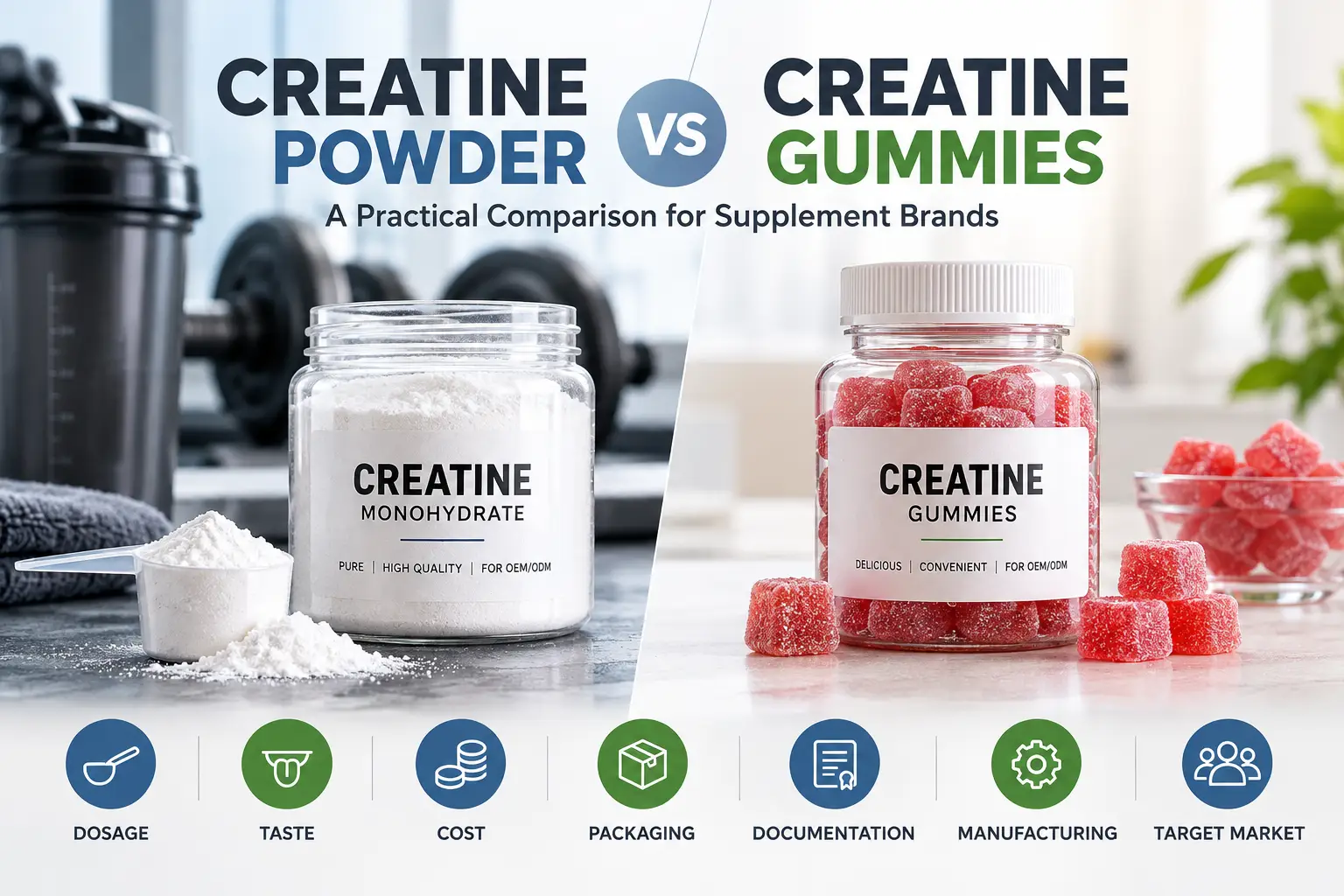
Creatine powders and gummies can look like two versions of the same supplement, but buyers quickly face a bigger problem: the format changes dosage, taste, cost, packaging, and documentation. If you treat this as a simple trend decision, you may choose a product that is difficult to manufacture, register, or sell profitably.
Creatine gummies vs powder is mainly a choice between dose efficiency and product differentiation. Creatine powder is usually better for delivering several grams of creatine at a lower cost with simpler formulation. Creatine gummies can offer greater convenience and consumer appeal, but brands need to consider active loading, serving size, flavor, texture, stability, MOQ, packaging, and target-market compliance requirements.

In OEM/ODM discussions, I usually see the same question appear early: “Which one is better?” My answer is usually: “Better for what market, what dose, what budget, and what registration path?” The details below can help buyers compare both formats more clearly.
What Are the Main Differences Between Creatine Gummies and Powder?
Creatine gummies and powder can use the same core active ingredient, but they create very different product-development requirements. Powder gives manufacturers more space for gram-level doses and usually keeps the formula relatively simple. Gummies need to balance creatine with the gummy base, flavor, sweeteners, acids, moisture, texture, and processing requirements.
For supplement brands, this means the format decision affects more than convenience. It can change your cost per serving, daily serving size, bottle count, MOQ, production lead time, packaging, stability plan, and registration documents.
Powder generally offers better dose efficiency and simpler manufacturing. Gummies usually offer stronger product differentiation and a more convenient consumer experience. Neither format is automatically better. The stronger option depends on the commercial goal of the product.
Creatine powder is usually easier to formulate at meaningful serving levels, with lower cost per gram of active ingredient. Creatine gummies can be more convenient and visually differentiated, but the format has less formula space. Buyers should compare dose feasibility, taste masking, stability, MOQ, packaging, and documentation before choosing.

Powder usually wins on dose efficiency
From a manufacturing and sourcing perspective, creatine powder has a clear advantage in dose efficiency. A scoop, sachet, or jar can deliver several grams of creatine without the size and texture limits of a gummy. A scoop, sachet, or jar can carry a higher amount of creatine with fewer formulation compromises. This matters because many commercial creatine products use serving sizes measured in grams, not milligrams.1
A powder formula may include:
- Creatine monohydrate or another creatine source
- Flavoring system, if flavored
- Sweetener or acidity regulator
- Anti-caking agent, depending on the formula
- Optional complementary ingredients, if allowed by the market
The formula is usually direct. The buyer can focus on raw material identity, particle size, taste, solubility expectations, packaging, and finished-product testing.
Gummies must balance active load with texture
Gummies are different. A gummy is not just a delivery container. It is also a food-like matrix.2 The formula needs room for:
- Gelling agents, such as pectin or gelatin systems
- Sweeteners or sugars
- Acids and flavor materials
- Color system
- Moisture control
- Active ingredient
- Processing aids, depending on the production method
This means the “available space” for creatine is more limited.3 If the target serving dose is high, the brand may need more gummies per serving. That affects consumer acceptance, bottle count, label design, shipping weight, and cost.
Which Format Better Matches Your Product Goal?
I have seen buyers approach creatine gummies because they look more attractive for online selling. That can be true in some channels. However, a nice format does not solve every commercial task.
| Buyer Goal | Powder May Fit Better When… | Gummies May Fit Better When… |
|---|---|---|
| Cost control | The buyer needs low cost per gram of creatine | The buyer accepts higher cost for format appeal |
| Higher serving dose | The formula needs several grams per serving | The buyer accepts multiple gummies per serving |
| Fast launch | Simple formula and packaging are preferred | The buyer has time for texture and taste trials |
| Differentiation | Flavor, blend, or packaging can still stand out | The dosage target is feasible in gummy form |
| Registration support | Documentation is straightforward for the market | Gummy ingredients also meet local rules |
What Should You Define Before Requesting a Quote?
Before comparing prices, you should first define the basic product plan. This helps the manufacturer evaluate feasibility and allows you to compare quotations using the same specifications.
A format choice becomes clearer when the buyer defines the target market, serving dose, packaging, and documentation requirements first.
Useful supplier questions include:
- What is the target country or sales channel?
- What creatine dose do you want per serving?
- Do you want unflavored powder, flavored powder, gummies, sachets, or bottles?
- What is your acceptable MOQ?
- Do you need third-party testing?
- Do you need export documents, formula documents, or product registration support?
- What is the retail price target?
- Do you need private label packaging or bulk supply for local repacking?
These questions help prevent a common mistake: choosing a trendy dosage form before confirming whether it can be produced, tested, shipped, and registered in the target market.
Which Creatine Format Offers Better Dose Efficiency?
Creatine dosage is one of the biggest differences between powder and gummies. Many creatine products use daily serving levels measured in grams rather than a few hundred milligrams. This makes dose efficiency especially important when choosing a delivery format.
Creatine powder can usually deliver several grams in one scoop or sachet. Gummies have less available formula space, so the amount of creatine per gummy directly affects how many pieces the consumer needs to take each day.
Creatine powder usually offers better dose efficiency because several grams can be delivered in one serving with fewer formulation limits. Creatine gummies can still provide a practical daily dose, but brands should compare the amount per gummy, the number of gummies per serving, and the cost per daily serving before selecting a formula.

Why Does Creatine Content Per Gummy Matter?
The amount of creatine per gummy determines how practical the final serving will be.
For example, a creatine gummy containing 1,500 mg of creatine monohydrate per gummy can provide:
- 2 gummies = 3 g creatine monohydrate
- 3 gummies = 4.5 g creatine monohydrate
This type of serving structure can be easier to position than a lower-dose gummy that requires consumers to take a large number of pieces each day.
Cost Per Serving Matters More Than Bottle Price
A lower bottle price does not always mean a lower cost per effective daily serving.
If one gummy formula contains less creatine per piece, consumers may need more gummies each day. This increases the number of gummies required per bottle and can affect packaging size, shipping weight, cost per serving, and consumer convenience.
Brands should therefore compare:
| Evaluation Point | Why It Matters |
|---|---|
| Creatine per gummy | Determines serving size |
| Gummies per day | Affects convenience |
| Gummies per bottle | Affects bottle count and cost |
| Creatine per daily serving | Allows meaningful formula comparison |
| Cost per daily serving | Gives a clearer commercial comparison |
How Do Cost, MOQ, and Lead Time Compare?
Creatine powder and gummies can have very different cost structures. A quoted bottle price does not tell the full story because the two formats may contain different amounts of creatine, different serving counts, and different packaging requirements.
Powder is usually simpler to produce and can offer a lower cost per gram of creatine. Gummies involve additional formulation, processing, texture control, flavor systems, and packaging considerations. These differences can also affect MOQ and production lead time.
When comparing creatine gummies vs powder, brands should compare cost per daily serving rather than bottle price alone. MOQ, formulation complexity, packaging, sampling requirements, and production lead time can also change the total cost of launching the product.
Buyers should compare effective creatine content, raw material verification, finished-product testing, serving size, MOQ, lead time, packaging format, certificates, payment terms, and export or registration document support. The best quote is not always the lowest quote. It is the quote that matches the product specification and market requirements.

Why Is Cost Per Daily Serving More Useful Than Unit Price?
A quotation only becomes meaningful when you know the active content per serving.
Two creatine gummy products may have a similar bottle price, but one may contain much less creatine per gummy. The consumer may therefore need more gummies each day.
The same issue applies to flavored powder. A lower-priced powder may contain more flavoring or other ingredients and less creatine per serving.
For this reason, buyers should compare the cost per useful daily serving, not only the cost per bottle.
The same issue appears in powder. A low price for a flavored powder may not mean the same thing as a low price for a high-creatine formula. The buyer should ask for a specification sheet that clearly states:
- Creatine source
- Creatine amount per serving
- Serving size
- Number of servings per bottle, pouch, or jar
- Other active ingredients
- Flavor and sweetener system
- Packaging materials
- Testing plan
A practical comparison table
| Evaluation Point | What to Check for Powder | What to Check for Gummies |
|---|---|---|
| Active content | Creatine grams per scoop or sachet | Creatine per gummy and per serving |
| Formula feasibility | Flow, flavor, solubility, caking control | Texture, moisture, taste masking, active load |
| Cost structure | Raw material, flavor, jar/pouch, scoop | Gummy base, flavor, processing, bottle count |
| MOQ | Often simpler for standard formulas | May depend more on production setup |
| Lead time | Usually shorter for simple formulas | May require more sampling and formulation work |
| Packaging | Jar, pouch, sachet, stick pack | Bottle, pouch, blister, individual wrap |
For gummies, texture and moisture control deserve extra attention. A gummy that is acceptable after production must also remain acceptable during storage and shipping. Tropical climates, long sea freight, and warehouse temperature variation can affect texture.4 This does not mean gummies are a bad choice. It means buyers should discuss packaging, desiccants, storage, and shelf-life expectations before confirming the order.
Because requirements vary by country and sales channel5, buyers should verify local rules with qualified regulatory professionals. A manufacturer can support documents, but it should not replace market-specific legal or regulatory review.
What Formulation and Stability Risks Matter for Creatine Gummies?
Creatine gummies can look simple to consumers, but they are not simple in production. If I describe them as “powder but better tasting,” I ignore the real formulation work behind the format. The main challenge is balancing dose, taste, texture, stability, and cost in a small chewable piece.
The main formulation challenges for creatine gummies are active loading, serving size, flavor masking, texture, moisture control, stability, and packaging. Higher creatine levels can make a gummy harder to formulate, so brands should confirm the target dose and serving size before finalizing flavor, shape, and packaging.

Serving Size Is the First Reality Check
A gummy has limited mass, so the target creatine dose must be evaluated before the final shape, flavor, or packaging is confirmed.
For example, a formula containing 1,500 mg of creatine monohydrate per gummy can provide 3 g in two gummies or 4.5 g in three gummies.
If the creatine content per gummy is much lower, the consumer may need more pieces per serving. That can increase bottle size, product cost, sweetness intake, and daily inconvenience.
Trying to push too much active material into one gummy can create other problems:
- Larger gummy size
- Grittier texture
- More difficult flavor masking
- Reduced chew quality
- Higher production cost
- Greater formulation complexity
Why Does Taste Masking Matter More in Gummies?
Consumers chew the entire gummy directly, so flavor, sweetness, acidity, and aftertaste have a major effect on the product experience.
A manufacturer may need to adjust:
- Flavor type
- Acid balance
- Sweetness level
- Aftertaste control
- Color
- Texture
- Chew time
For this reason, brands should evaluate physical samples rather than approve a creatine gummy only from the written formula.
How Does the Gummy Base Affect Product Positioning?
The choice between pectin and gelatin systems can influence texture, target consumer group, label positioning, and cost.6 Each market may also treat ingredients differently, so buyers should verify local rules and consumer preferences.
| Gummy System | Positioning Opportunity | Buyer Consideration |
|---|---|---|
| Pectin-based | Plant-based or vegan positioning may be possible | Texture and processing control require experience |
| Gelatin-based | Familiar chewy texture | Not suitable for vegan positioning |
| Sugar-based | Strong taste and texture flexibility | Sugar content may affect brand positioning |
| Sugar-free or reduced-sugar | Attractive for some sports nutrition products | Sweetener system and aftertaste require more attention |
Why Is Packaging Part of Creatine Gummy Stability?
For creatine gummies, packaging is part of product stability, not only branding.
Gummies can be affected by moisture, heat, and storage conditions. The packaging system should therefore help protect texture, appearance, and finished-product quality during shipping and shelf life.
- Bottle type and cap seal
- Desiccant use
- Induction sealing
- Count per bottle
- Shipping carton strength
- Storage temperature guidance
- Climate conditions in the target market
For importers in warm or humid countries, this discussion is important. A product that leaves the factory in good condition still needs to survive freight, customs, warehousing, and last-mile distribution.
MOQ and lead time may be higher
Creatine gummies may involve more production setup than powder. Molds, cooking systems, drying time, flavor trials, and packaging setup can affect MOQ and lead time.7 If a buyer is testing a new market, a high MOQ may create inventory pressure.
That is why I usually suggest matching gummy projects to a clear launch plan. Gummies can be a smart choice when the brand already understands its customers, sales channel, price point, and positioning. They may be less suitable when the buyer only wants the lowest-cost creatine product or needs a very fast pilot launch with minimal development work.
What Testing and Documents Should Buyers Check Before Ordering?
Testing and documentation can determine whether a creatine product is ready for import, registration, retail listing, or local repacking. A low quotation has limited value if the supplier cannot provide the documents or finished-product verification required by your market.
Creatine powders and gummies may need similar core quality tests, but gummies also require closer attention to moisture, texture, and finished-product stability.
Before ordering creatine products, buyers should confirm raw material identity, finished-product potency, microbiology, heavy metals, moisture where relevant, product specifications, COA availability, certificates, packaging specifications, and target-market documentation requirements.

What Testing Should Buyers Request?
Common quality checks may include:
- Raw material identity
- Creatine assay or potency
- Microbiology
- Heavy metals
- Moisture
- Appearance, odor, and taste
- Packaging integrity
For creatine gummies, finished-product creatine assay deserves particular attention. The amount of creatine added during production does not by itself confirm the amount present in the finished product throughout its shelf life.
Certificates Are Buyer Documents, Not Marketing Decorations
Before accepting certificates, check:
- Company name
- Facility address
- Certification scope
- Issuing body
- Validity period
- Whether the certification applies to the requested dosage form
Why Can Documentation Decide Which Supplier You Choose?
For importers and private-label brands, documentation support can be as important as price.
Depending on the target market, buyers may request:
- Ingredient list
- Formula specification
- Finished-product COA
- Raw material COA
- Manufacturing flow chart
- Free sale or export documents, where available
- Stability or shelf-life support
- Packaging specifications
- Label information
- Product registration documents
Requirements vary by country, so brands should confirm local regulatory requirements before production begins.
Which Creatine Format Fits Your Brand and Market Stage?
The best creatine format depends on what stage your brand has reached.
A new brand may prioritize low development risk, clear cost control, and a simple launch. An importer may care more about registration documents and bulk supply options. An established sports nutrition brand may accept more formulation work in exchange for stronger product differentiation.
New brands often find creatine powder easier for market testing because it offers simpler formulation and clearer dose economics. Established brands may consider creatine gummies when they have a defined target consumer, retail price, serving structure, and MOQ plan.
New brands often benefit from powder because it supports dose efficiency, simpler sourcing, and cost control. Importers may choose the format that best fits registration documents and local repacking plans. Established brands may consider gummies when they have a clear consumer segment, budget, and MOQ tolerance.

New Brands Testing Market Demand
A new brand usually needs to protect cash flow. The goal is often to test demand before locking money into complex packaging and higher MOQs. For this situation, powder may be a practical first step.
A new buyer may consider:
- Unflavored creatine powder in jars
- Flavored powder in pouches
- Stick packs or sachets for sampling
- Bulk powder for local repacking, if allowed
- Simple private label packaging
The advantage is speed and clarity. The buyer can test price, channel response, and repeat purchase behavior. The formula can remain focused. The documentation can also be more straightforward, depending on the market.
However, powder is not automatically easy. Buyers still need to verify raw material identity, heavy metals, microbiology, labeling rules, and import requirements. They should also check whether the packaging format fits local retail or online distribution.
Importers Focused on Registration and Documentation
Many importers care less about “cool format” and more about whether the product can be registered, imported, and released without trouble. In this case, supplier cooperation is critical.
I would suggest that import-focused buyers prepare a document checklist before asking for a final quote. The checklist may include:
- Target country
- Product category
- Ingredient restrictions
- Label format
- Required certificates
- COA requirements
- Shelf-life requirement
- Free sale or export documents, if applicable
- Testing standards
- Local language label needs
This approach saves time. It also helps the supplier answer correctly. Some buyers become frustrated because suppliers ask many questions. However, those questions are often needed to avoid producing a product that cannot pass registration review.
Established Sports Nutrition Brands
An established brand may already have powder products. For that buyer, gummies may support portfolio expansion or channel differentiation. A gummy can be useful when the brand wants a more convenient serving experience or a product that looks different from standard tubs and pouches.
But the brand should still confirm:
- Is the target creatine dose realistic?
- Will consumers accept the number of gummies per serving?
- Can the retail price cover higher production cost?
- Does the formula meet target-market ingredient rules?
- Can the packaging protect the product during shipping?
- Can the supplier provide repeatable taste and texture across batches?
A simple format decision framework
| Buyer Stage | Better Starting Point | Main Reason |
|---|---|---|
| New brand testing demand | Powder | Lower complexity and clearer dose-cost relationship |
| Price-sensitive distributor | Powder or bulk powder | Easier cost control and repacking flexibility |
| Importer with strict documents | Depends on local rules | Documentation and registration path decide |
| Established brand seeking differentiation | Gummies or flavored powder | More room for brand experience |
| Retail-ready premium launch | Gummies may fit | Only if dose, texture, packaging, and price work |
What Information Should You Send a Manufacturer?
A structured product brief helps manufacturers evaluate feasibility and allows buyers to compare quotations more accurately.
A useful inquiry can include:
“We plan to launch a creatine product in [country]. We want [powder/gummy] format, [target serving dose], [flavor], [packaging], [estimated order quantity], and [documents needed]. Please advise feasibility, MOQ, lead time, testing options, and price range.”
This kind of brief helps a manufacturer respond with useful information. It also helps the buyer compare suppliers fairly. Without the same specifications, every quote is based on different assumptions.
Frequently Asked Questions
Are creatine gummies better than creatine powder?
Creatine gummies are not automatically better than powder. Gummies may offer convenience and product differentiation, but powder is usually stronger for dose efficiency, cost control, and simple formulation. The better option depends on target dose, market rules, budget, MOQ, packaging, and consumer positioning.
How Much Creatine Should Be in Each Gummy?
The right amount depends on the intended daily serving and product positioning. Higher creatine content per gummy can reduce the number of gummies consumers need to take each day.
For example, a gummy containing 1,500 mg of creatine monohydrate provides 3 g in two gummies or 4.5 g in three gummies. Brands should evaluate the amount per gummy together with gummy size, texture, taste, bottle count, and cost per daily serving.
What should I ask a creatine supplement manufacturer before ordering?
I would ask about creatine source, dosage per serving, MOQ, lead time, packaging options, testing plan, certificates, raw material verification, finished-product COA, export documents, and registration support. I would also share the target country so the supplier can discuss market-specific document needs.
Why can creatine gummies cost more than powder?
Creatine gummies can cost more because the format requires a gummy base, flavor masking, texture control, drying or setting time, packaging protection, and more formulation trials. The active dose may also require multiple gummies per serving, which increases bottle count, weight, and total production cost.
Can I buy bulk creatine powder and repackage it locally?
Some buyers purchase bulk creatine powder for local repacking, but this depends on local laws, facility qualifications, labeling rules, and registration requirements.8 Buyers should verify target-market regulations and ensure the supplier provides suitable documents, testing results, and packaging or shipping specifications.
What quality tests are important for creatine powders and gummies?
Common tests may include raw material identity, potency, microbiology, heavy metals, moisture, and finished-product appearance. Gummies may also need closer attention to texture, moisture control, and packaging integrity. Buyers should confirm testing requirements based on their country, sales channel, and product claims.
Conclusion
Creatine powders and gummies should be evaluated as product-development and sourcing decisions, not just trend choices. Powder often supports efficient dosage, lower cost, and simpler production. Gummies can support convenience and differentiation, but they require careful work on taste, texture, stability, packaging, MOQ, and documentation. If you are comparing creatine powders and gummies for your market, prepare your target dose, country, packaging plan, testing needs, and document checklist first.
If you are developing a creatine product, Shandong Health Biotech can support creatine powder and creatine gummy projects with OEM/ODM manufacturing, private label packaging, sampling, finished-product testing, and export documentation support. Ready-stock creatine gummies containing 1,500 mg of creatine monohydrate per gummy are also available for brands that want to shorten product development time.
"International Society of Sports Nutrition position stand - PMC", https://pmc.ncbi.nlm.nih.gov/articles/PMC5469049/. The International Society of Sports Nutrition position stand describes common creatine supplementation protocols using gram-level daily intakes, including maintenance intakes of about 3–5 g/day, supporting the statement that creatine servings are generally gram-scale rather than milligram-scale. Evidence role: expert_consensus; source type: paper. Supports: Common creatine supplementation protocols and maintenance intakes are described in gram-level daily doses.. ↩
"Peanut skin bioactive extract on pectin and gelatin candies", https://pmc.ncbi.nlm.nih.gov/articles/PMC12701288/. Food-science literature describes gummies as hydrocolloid gel systems in which gelatin or pectin, sugars, acids, and water determine texture and stability, supporting the characterization of a gummy as an edible matrix rather than a simple carrier. Evidence role: mechanism; source type: paper. Supports: Gummy products rely on hydrocolloid gel matrices whose texture and stability depend on ingredients such as gelatin, pectin, sugars, acids, and water.. Scope note: This supports the formulation principle generally; it does not test creatine-containing gummies specifically. ↩
"Current Innovations in the Development of Functional Gummy ...", https://pmc.ncbi.nlm.nih.gov/articles/PMC10778822/. Reviews of functional gummy formulation note that gel structure, sweetener systems, acidity, water content, flavoring, and processing constraints affect how much active ingredient can be incorporated, providing contextual support for the claim that creatine loading space is limited in gummies. Evidence role: mechanism; source type: paper. Supports: Functional gummies must allocate formulation space to gelling agents, sweeteners, acids, water, flavors, and processing requirements, which can constrain active ingredient loading.. Scope note: The support is contextual unless the selected source reports creatine-specific loading data. ↩
"Correlation between physical and sensorial properties of ...", https://pmc.ncbi.nlm.nih.gov/articles/PMC8292526/. Food storage and confectionery stability studies show that temperature and humidity influence moisture migration and texture in gelled confectionery products, providing contextual support for the concern that tropical climates and variable shipping conditions can affect gummy texture. Evidence role: general_support; source type: paper. Supports: Temperature and humidity during storage and transport can affect the physical quality of gel confectionery products.. Scope note: The source would support the environmental mechanism generally, not necessarily the exact conditions of a specific freight route. ↩
"A Comparison of Current Regulatory Frameworks for ... - PMC", https://pmc.ncbi.nlm.nih.gov/articles/PMC8326690/. International and national regulatory guidance shows that food supplement classification, permitted ingredients, labeling, and import requirements are jurisdiction-specific, supporting the article’s statement that requirements vary by country and sales channel. Evidence role: general_support; source type: institution. Supports: Food supplement regulation, labeling, permitted ingredients, and import procedures vary by jurisdiction.. Scope note: The source would support regulatory variability in general; buyers still need market-specific legal review for a particular product. ↩
"Mass spectrometric sequencing of proteins silver-stained ...", https://pubmed.ncbi.nlm.nih.gov/8779443/. Food hydrocolloid literature explains that gelatin and pectin form gels through different mechanisms and produce different texture profiles; because gelatin is animal-derived while pectin is plant-derived, the choice of gelling system can also affect consumer suitability and label positioning. Evidence role: mechanism; source type: paper. Supports: Gelatin and pectin form gels through different mechanisms and can produce different textures; pectin can be used in plant-based formulations whereas gelatin is animal-derived.. Scope note: Cost effects vary by supplier and market conditions, so the source would mainly support texture and positioning rather than exact cost differences. ↩
"Hard Candy Production and Quality Parameters: A review - PMC", https://pmc.ncbi.nlm.nih.gov/articles/PMC11214042/. Educational and food-engineering descriptions of gummy manufacturing identify cooking, depositing or molding, setting or drying, and packaging as standard process stages, supporting the article’s statement that setup and processing steps can influence production timing and order planning. Evidence role: general_support; source type: education. Supports: Gummy manufacturing includes steps such as cooking, depositing or molding, setting or drying, flavor adjustment, and packaging, which can add process complexity.. Scope note: Such sources usually explain process complexity, not supplier-specific MOQ policies. ↩
"Small Entity Compliance Guide: Current Good ...", https://www.fda.gov/regulatory-information/search-fda-guidance-documents/small-entity-compliance-guide-current-good-manufacturing-practice-manufacturing-packaging-labeling. Government dietary supplement regulations treat manufacturing, packaging, labeling, and holding as regulated activities subject to quality and labeling controls, supporting the claim that local repackaging depends on applicable laws, facility qualifications, and label requirements. Evidence role: general_support; source type: government. Supports: Repackaging and labeling of dietary supplements can be regulated activities subject to manufacturing controls and labeling requirements.. Scope note: The exact obligations differ by country, so a jurisdiction-specific source is needed for any particular target market. ↩