Problem: Women’s health has long been under-served in the supplement world. Many brands offered generic formulas, lacking targeted solutions for fertility, menopause, skin, mood, or gut health.
Agitation: Today’s female consumer is informed, demanding, and ready to invest in solutions that actually speak to her life stage and unique biology. A generic multivitamin just doesn’t cut it anymore.
Solution: For private label branders, this means a major opening. By creating purpose-built women’s health supplements—formulated for life stages, gender-specific needs, and meaningful claims—you can ride the wave of skyrocketing demand and capture higher margin, loyal customers.
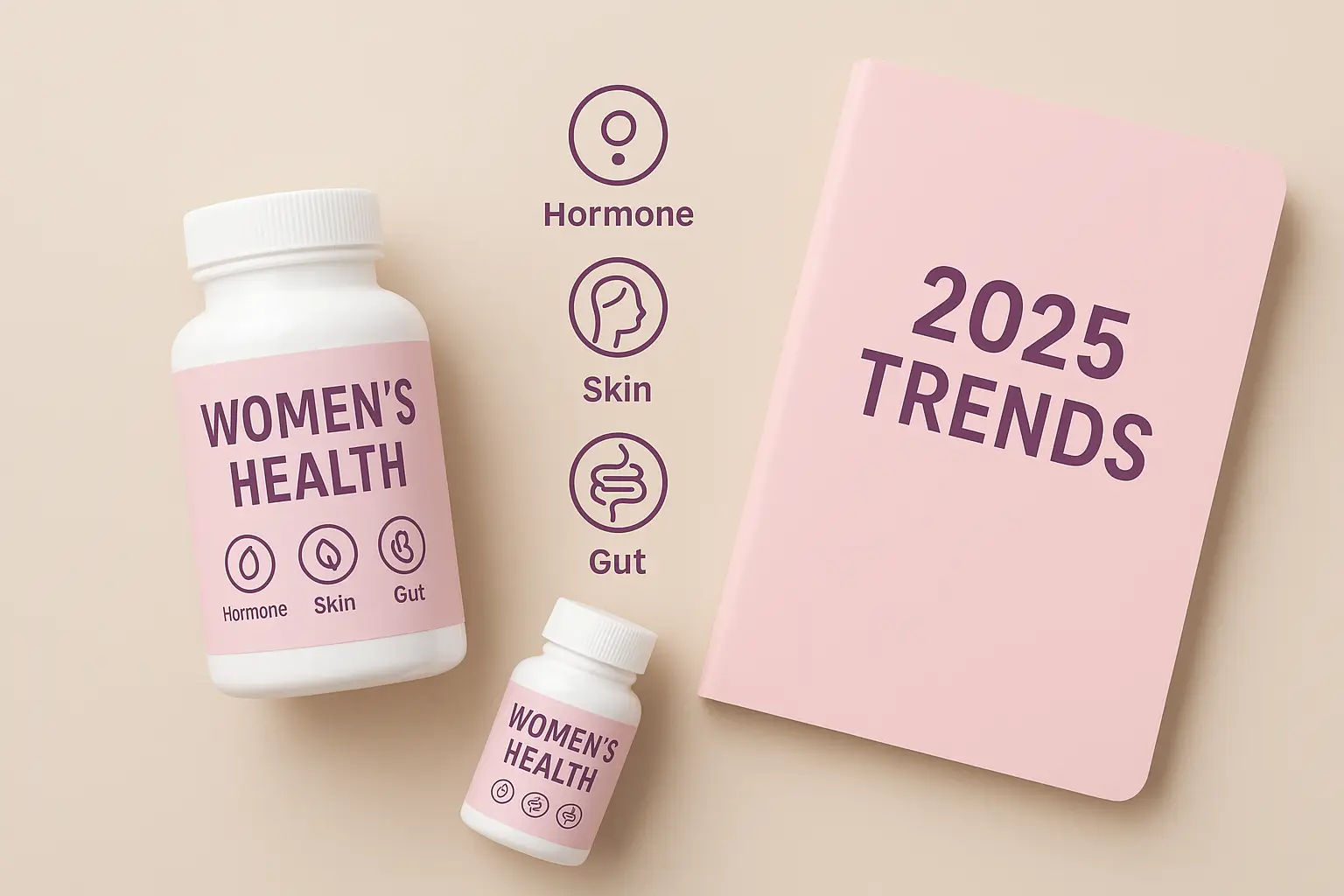
The women’s health supplement market is rapidly expanding in 2025, fuelled by lifestyle shifts, ageing populations, and a surge in preventive wellness. For private label brands, this means strong growth potential across categories like hormonal balance, beauty-from-within, gut health and energy. Brands that deliver specialised, evidence-based formulas for women unlock major opportunities in a once-overlooked market.
The question isn’t if brands should enter this sector—it’s how. To succeed, you must understand why women’s health supplements are booming, what segments are leading, and how private label manufacturers and brand owners can capitalise. The next sections break it all down.
1. Why the Demand for Women’s Health Supplements Is Rising?
There are several structural factors driving the surge in women’s health supplements. Women are living longer, working longer, and managing more stress—and they want solutions for more than just basic nutrition. Concurrently, wellness has shifted from “treatment” to “prevention”, and women are front and centre of that change.
Demographics, lifestyle pressures and preventive wellness trends are combining to push women’s health supplements into high-growth territory.
Some of the key drivers include:
-
Ageing populations and longer lifespans ➝ higher demand for menopause, bone, joint, cognitive support.
-
Lifestyle shifts: more women in the workforce, increased stress, disrupted sleep, gut issues.
-
Preventive self-care focus: women are increasingly choosing supplements before problems arise.
-
Personalised nutrition: women want formulas tailored to their stage of life, gender, hormonal status.
-
Growth of e-commerce & global access: reaching women in emerging markets as well as mature ones.
* The women’s health supplement market is projected to grow at a CAGR of 11.6% and reach over USD 140 billion by 2029.
* Vitamins & minerals alone will account for more than 40% of the 2025 women’s health supplement market.
2. What Life-Stage Segments Are Driving Growth?
Women’s lives follow distinct phases: fertility, pregnancy, postpartum, perimenopause, menopause, and beyond. Each stage comes with unique nutritional and health needs. A one-size-fits-all supplement won’t satisfy a 28-year-old florist and a 55-year-old executive in the same way.
Life-stage segmentation allows brands to design targeted solutions—fertility, hormone support, menopause, beauty-from-within—opening differentiated niches.
| Life Stage | Key Health Concerns | Supplement Opportunity |
|---|---|---|
| Fertility / Pre-pregnancy | Hormonal balance, folate, ovulation | Fertility support, prenatal blends |
| Pregnancy / Postpartum | Nutrient demands, brain development, mood | DHA/EPA, iron, mood adaptogens |
| Perimenopause | Hormonal shifts, sleep, mood, skin | Phytoestrgens, adaptogens, bone support |
| Menopause & Beyond | Bone loss, metabolic slowdown, cognition | Collagen, vitamin D/K, brain support |
Emerging segments like sexual health, sleep and mood for women are gaining traction.
* Supplements tailored for menopausal women are growing faster than general multivitamins in many markets.
* Over 46% of new women’s supplement launches target mood/brain health claims.
3. What Product Categories Are Most in Demand Among Women?
Within the women’s health segment, certain categories are particularly hot: hormonal support, bone and joint health, gut & gut-brain axis, skin/hair/beauty-from-within, and energy/mood. Formulations that combine multiple benefits are especially attractive.
Hormone balance, beauty-from-within, gut health and mood support stand out as top opportunities for women’s supplement brands.
-
Hormonal & reproductive health – including PMS relief, fertility, menopause support.
-
Bone & joint health – vitamins D/K, calcium, collagen become women-specific due to post-menopausal risk.
-
Beauty from within – skin, hair, nails via collagen, biotin, antioxidants.
-
Gut & mood health – women more likely to experience IBS, mood disorders; probiotics, adaptogens are relevant.
-
Energy & vitality – formulations that appeal to active, multitasking women.
Brands that overlay delivery innovation (gummies, sachets, drinkables) with targeted claims stand out.
* Women’s health supplements now account for nearly one-fifth of all new supplement launches globally.
* Beauty-from-within claims dominate the women’s health sub-category in 2025.
4. How Private Label Brands Can Seize the Opportunity?
For brand owners and OEM/ODM manufacturers like you, the women’s health segment offers clear pathways to growth: differentiated formulas, targeted messaging, higher perceived value, and premium pricing. But success requires strategic positioning and execution.
Private label success in women’s health depends on niche positioning, formula relevance, clean labels, and differentiated branding—not just re-branding generic formulas.
Key steps:
-
Define your niche: Pick a life stage or health need (e.g., perimenopause stress support) rather than “women’s multivitamin”.
-
Partner with experienced OEM/ODM: Ensure your manufacturer offers women-specific formulations, low MOQ, private label flexibility, regulatory support.
-
Focus on clean, transparent claims: Women’s health shoppers are discerning; they want efficacy, traceability, and authenticity.
-
Innovative formats: Gummies, drink packets, sachets appeal more than simple pills.
-
Value-added positioning: Bundles, subscription models, personalised regimens.
-
Global sourcing & certification readiness: If exporting to SE Asia or Europe, you’ll need compliance (e.g., EU-nutraceutical regulations, ASEAN).
-
Brand story & marketing: Use life-stage language, expert endorsement, digital marketing geared to female consumers.
* Private label brands offering targeted women’s health blends report faster shelf-turn and higher repeat purchase rates than generic multivitamins.
* Brands that invest in women-specific ingredient innovation can command 20-30% higher margin than standard vitamin SKUs.
5. What Formulation & Format Trends Should You Leverage?
The female consumer demands not just efficacy—but experience. Format, delivery, flavor, and brand feel matter almost as much as the ingredient list. Staying on trend is key.
Gummies, drinkables, sachets, floral flavours, clean-label, plant-based formats—these are all drivers of preference among women supplement buyers in 2025.
-
Gummies & chewables are popular among younger consumers and women looking for convenience.
-
Dual-function formats: e.g., sleep support + hormone balance; collagen + beauty; gut health + mood.
-
Plant-based and vegan-friendly: aligns with values of younger female consumers.
-
Personalisation & subscription models: mix-to-order women’s health stacks.
-
Global trend watching: Asia-Pacific and Middle East show strong growth in women’s health supplement demand.
* Non-pill formats now make up more than 65% of new female supplement launches.
* Women’s health supplement consumption via e-commerce grew by over 30% year-on-year in several key markets.
6. What Compliance, Certification & Differentiation Steps Matter?
Entering the women’s health supplement space requires more than just a formula. Certification, claims substantiation, global compliance, and differentiation are critical to long-term success.
Ensure your private label women’s health supplements meet regulatory standards, use clinically backed ingredients, and deliver clear, credible claims to build trust and brand loyalty.
-
Certifications: GMP, NSF, ISO, Halal/Kosher if targeting global markets.
-
Clinical & science-backing: Trials or peer-reviewed data help support claims like “hormonal balance”, “menopause support”, “beauty from within”.
-
Claims accuracy: Beware regulatory restrictions—avoid implied drug claims.
-
Global market compliance: If exporting to EU, Australia, ASEAN, check local rules on women’s health supplements.
-
Differentiation: Unique ingredients (e.g., botanicals for female hormonal balance), packaging, branding that speaks to women’s values and life-stage.
-
Traceability & transparency: Women’s health consumers expect authenticity and ethical sourcing.
* In markets like Europe and North America, women’s health supplements that carry certification and clinical backing achieve 2× higher trust ratings among female buyers.
* Global markets such as Asia-Pacific are expected to contribute over 40% of incremental growth in women’s health supplements through 2030.
Conclusion
Women’s health supplements represent one of the most powerful growth opportunities in wellness today. With strong market momentum, under-served niches, and high willingness to purchase among female consumers, private label brands that execute smartly can capture premium positioning and brand loyalty. But success hinges on focus—pick life-stage, offer differentiated formulations, match consumer values around transparency and self-care, and partner with an OEM/ODM that understands your vision. With the right strategy, U can turn this booming trend into a sustainable brand asset.
Ready to launch a women’s health supplement line that stands out? At SD Health Biotech, we specialise in OEM/ODM solutions tailored for women’s wellness—from hormone balance blends and beauty-from-within formulas to menopause support and gut-brain health stacks. With our in-house formulation team, low MOQ options, full certification support, and global export readiness, U can bring your women’s health brand to market faster and smarter. Let’s build the future of women’s wellness together.