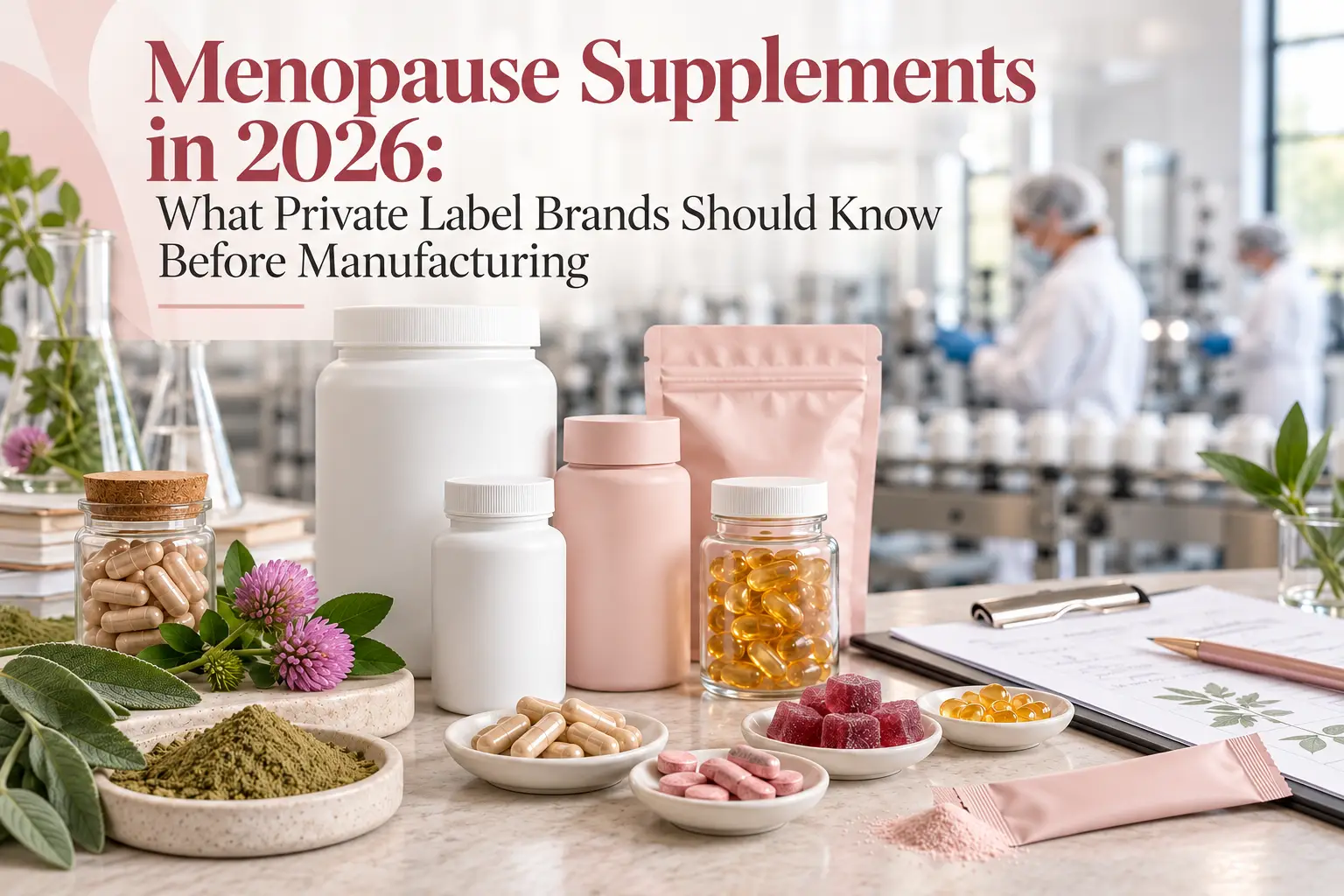

Developing a menopause supplement can look like a promising opportunity for supplement brands. The category is growing, consumers are paying more attention to women’s health, and there are many possible ingredients to choose from. But this also creates a problem. A product can quickly become overloaded with vitamins, minerals, botanicals, phytoestrogens, adaptogens, and other actives without a clear reason for including each one. The result may be difficult to manufacture, expensive to produce, hard to position, or impossible to fit into the intended dosage form. In gummies, active loading and taste can become limiting factors. In capsules, the number of capsules per serving may become too high. In tablets, mineral-heavy formulas may create oversized tablets. Claims and regulatory requirements add another layer of complexity.
Private label brands developing menopause supplements in 2026 should begin with a clear product position rather than a long ingredient list. The formula, dosage, dosage form, serving size, claims, testing requirements, packaging, target market, and manufacturing feasibility should be evaluated together. Common commercial ingredients include vitamin B6, magnesium, zinc, vitamin D, calcium, sage, red clover, soy-derived phytoestrogens, ashwagandha, and other botanicals. However, market popularity should not be confused with proven effectiveness.
The commercial opportunity is significant, but the category is far from standardized. A 2026 analysis led by UCL identified 201 menopause supplements in the UK market and found substantial differences in ingredients, doses, and prices. Herbs appeared in 80.1% of products, vitamins in 76.6%, and phytoestrogens in 74.1%, yet no single ingredient or ingredient category appeared in every product.
This creates an important opportunity for private label brands.
Instead of asking:
“Which ingredients can we add?”
a better question is:
“What product are we trying to create, who is it for, and can the formula deliver that positioning in a commercially practical way?”
The following guide explains how supplement brands can approach menopause product development from formulation through commercial manufacturing.
Why Are Menopause Supplements Becoming a Growing Opportunity for Brands?

Women’s health is becoming more segmented.
Instead of offering one general multivitamin for all adult women, supplement brands are increasingly developing products for specific life stages and wellness goals.
These can include:
- Menstrual health
- Fertility support
- Perimenopause
- Menopause
- Postmenopause
- Bone health
- Sleep and relaxation
- Healthy aging
- Midlife nutrition
- Hormonal wellness
This creates opportunities for brands to build more focused product lines.
Menopause supplements are becoming a larger opportunity because women’s wellness is moving toward more personalized, life-stage-specific products. At the same time, consumers are increasingly discussing needs such as hormonal balance, sleep, mood, bone health, cognition, metabolism, and healthy aging rather than treating menopause as one single product category.
UCL researchers noted in September 2026 that the menopause supplement market is growing rapidly and cited projections of approximately $25 billion globally by 2030. Their analysis also found a highly fragmented commercial market, suggesting that there is still significant room for differentiation.
Why Is Consumer Language Changing?
One important development is how women describe their needs.
A 2026 analysis of women's wellness conversations reported that discussion around “menopause support” fell while discussion around “hormonal balance” increased 233% in the dataset examined.
This does not mean consumers are no longer interested in menopause products.
It suggests that some consumers may prefer broader language around how they want to feel.
That can include:
- Hormonal Balance
- Women 40+
- Midlife Wellness
- Healthy Aging for Women
- Daily Women's Wellness
- Perimenopause Support
- Sleep & Calm
- Bone Health
- Energy & Vitality
For private label brands, this matters because positioning influences almost every later decision.
A product positioned as:
Midlife Daily Wellness
may require a very different formula from:
Bone Health for Women 50+
or:
Nighttime Menopause Support
Should Brands Target Perimenopause Too?
For many brands, this deserves consideration.
The consumer journey does not suddenly begin when menopause is complete.
A broader product line might include:
| Product Concept | Potential Audience |
|---|---|
| Perimenopause Support | Women entering the menopause transition |
| Hormonal Wellness 40+ | Broader midlife consumer |
| Menopause Daily Support | Menopause-specific positioning |
| Bone Health 50+ | Postmenopausal / healthy aging market |
| Nighttime Women's Wellness | Sleep and relaxation positioning |
| Women’s Healthy Aging | Broader longevity positioning |
The right approach depends on the brand.
A specialist menopause brand may benefit from very specific positioning.
A broader women's wellness company may prefer to build several products around different life stages.
Is the Market Already Too Crowded?
It is competitive, but it is not standardized.
The 2026 UK study found 201 different menopause supplements, with wide differences in formulation and pricing.
That means brands can still differentiate through:
- Better product positioning
- More rational formulas
- Standardized ingredients
- Appropriate dosages
- Improved dosage forms
- Better consumer experience
- Transparent testing
- Stronger documentation
- Premium packaging
- Clearer claims
Adding more ingredients is not necessarily the best way to compete.
A formula that consumers can understand may be stronger than a product with 20 ingredients present in very small amounts.
Which Ingredients Are Commonly Used in Menopause Supplements?

There is no universal menopause supplement formula.
Current commercial products use a wide range of vitamins, minerals, botanical extracts, phytoestrogens, probiotics, oils, amino acids, and other functional ingredients.
A 2026 study examining 201 menopause supplements found herbs in 80.1%, vitamins in 76.6%, and phytoestrogens in 74.1% of the products reviewed. Vitamin B6 appeared in 69.2%, zinc in 48.8%, magnesium in 47.3%, sage in 42.8%, red clover in 38.8%, and ashwagandha in 30.4%.
Private label brands should distinguish between ingredients that are commercially popular, ingredients with established nutritional functions, and ingredients supported for the exact intended claim. The fact that an ingredient frequently appears in menopause supplements does not automatically prove that it will deliver a specific menopause-related benefit.
Which Vitamins and Minerals Are Common?
Common formulation candidates include:
- Vitamin B6
- Vitamin B12
- Folate
- Vitamin D
- Vitamin E
- Vitamin K
- Magnesium
- Calcium
- Zinc
The right selection depends on the product concept.
For example, a bone-health-oriented product could emphasize a different combination than a formula positioned around general midlife wellness.
The British Menopause Society's current osteoporosis guidance notes the importance of adequate dietary calcium and supplemental vitamin D as part of osteoporosis management, while also noting that calcium and vitamin D supplementation alone has not been proven to reduce fractures.
This illustrates why brands should be careful with wording.
An ingredient can have an established nutritional role without supporting every menopause-related marketing claim.
Which Botanical Ingredients Are Common?
The commercial market includes botanicals such as:
- Sage
- Red clover
- Ashwagandha
- Maca
- Black cohosh
- Soy-derived ingredients
- Flaxseed-derived ingredients
- Rhodiola
- Shatavari
- Fenugreek
Botanical formulas require careful raw material specifications.
For each botanical, a manufacturer may need to confirm:
- Botanical species
- Plant part
- Extract ratio
- Extraction solvent
- Standardization
- Active marker
- Raw material source
- Daily dose
- Heavy metals
- Microbiology
- Pesticides where appropriate
- Residual solvents where applicable
Two ingredients with the same common plant name are not automatically equivalent.
Why Is Standardization Important?
Consider black cohosh.
A label that simply states:
Black Cohosh Extract
does not provide the complete technical information needed for formulation.
Black cohosh preparations can differ in chemical composition depending on the material and extraction method. NIH also notes that most studies have examined short-term use and that reports of liver injury have been associated with black cohosh, although a causal relationship has not been established.
A professional specification might therefore need to define:
Botanical species + plant part + extraction method + extract ratio + marker compound + dosage.
This is particularly important when brands want to use research associated with a specific standardized extract.
What About Phytoestrogens?
Phytoestrogens appear frequently in commercial menopause formulas.
Common examples include:
- Red clover
- Soy isoflavones
- Flax-derived lignans
The 2026 study found red clover in 38.8% of the menopause products reviewed and soy derivatives in 28.4%.
From a formulation perspective, brands should consider:
- Standardization
- Effective daily amount
- Ingredient source
- Allergen implications
- Target consumer
- Label warnings
- Target-market regulation
A formula should not simply combine several phytoestrogen ingredients because they appear on competitor labels.
Each ingredient should have a defined reason for inclusion.
Are Probiotics and Other Newer Ingredients Entering the Category?
Yes.
The same 2026 analysis found probiotic bacteria, collagen, inositol, CoQ10, amino acids, and other nontraditional ingredients in a smaller proportion of products.
This reflects a broader commercial movement toward concepts involving:
- Gut health
- Healthy aging
- Metabolism
- Beauty
- Cognition
- Muscle health
- Stress management
This can create opportunities for new product concepts.
However, product development should still begin with the positioning rather than assembling unrelated trending ingredients.
Should You Use the Maximum Number of Ingredients Possible?
Usually not.
Every additional ingredient affects the project.
It may change:
- Raw material cost
- Capsule fill volume
- Tablet size
- Gummy taste
- Gummy texture
- Powder flavor
- Testing complexity
- Stability
- Ingredient sourcing
- Finished-product cost
- Regulatory review
A focused eight-ingredient product may be commercially stronger than an 18-ingredient formula if the first product delivers meaningful doses and clearer positioning.
How Should Brands Build a Menopause Supplement Formula?

The formula should begin with the product concept.
It should not begin with a competitor label.
One of the most common mistakes in private label supplement development is creating a long ingredient list first and only later trying to decide what the product should be marketed for.
This reverses the development process.
A stronger menopause supplement development process starts with the target consumer and product positioning, defines the role and intended amount of each ingredient, calculates the total daily active load, and then chooses the dosage form. Formula feasibility should be reviewed before samples, packaging, or marketing claims are finalized.
A practical development sequence is:
Target Consumer → Product Positioning → Key Ingredients → Daily Dose → Dosage Form → Feasibility → Sample → Testing → Packaging → Commercial Production
Which Product Positioning Should You Choose?
Possible directions include:
| Product Positioning | Possible Formula Direction | Main Manufacturing Consideration |
|---|---|---|
| Midlife Daily Wellness | Vitamins + minerals + selected botanicals | Formula complexity |
| Hormonal Wellness | Micronutrients + selected botanical extracts | Claims and evidence |
| Sleep & Calm | Magnesium + selected relaxation ingredients | Daily dosage and serving size |
| Bone Health | Calcium + vitamin D + vitamin K + magnesium | High mineral loading |
| Energy & Vitality | B vitamins + minerals + selected actives | Positioning and dose |
| Healthy Aging | Micronutrients + antioxidants + selected bioactives | Differentiation |
| Botanical Menopause Formula | Standardized botanical extracts | Raw material specification |
| Gut & Midlife Wellness | Probiotics/prebiotics + supporting nutrients | Stability |
These are product-development directions, not fixed formulas.
The actual ingredient selection depends on the intended market, evidence, regulatory requirements, dosage, safety, and dosage form.
Why Should Every Ingredient Have a Defined Role?
Before adding an ingredient, ask:
Why is this ingredient included?
Possible reasons may include:
- Supports the core positioning
- Provides an authorized or appropriate nutritional claim
- Offers a differentiated branded ingredient
- Supports a secondary consumer need
- Helps complete a broader multinutrient formula
If the only reason is:
“Competitors use it.”
the ingredient may need further evaluation.
Too many ingredients can result in under-dosing.
For example, if a brand wants:
- Magnesium
- Calcium
- Ashwagandha
- Maca
- Red clover
- Black cohosh
- Vitamin D
- Vitamin K
- Zinc
- B vitamins
- Collagen
- Probiotics
all inside two small capsules per day, the physical volume alone may make the concept unrealistic.
How Should Brands Think About Daily Dosage?
The manufacturer should calculate the total active weight early.
Important questions include:
- How many milligrams are required per day?
- How many capsules will this require?
- How large will the tablet become?
- Can the ingredients physically fit into the gummy?
- Will the powder serving become too large?
- Does the serving still make commercial sense?
This is especially important for:
- Magnesium
- Calcium
- Collagen
- Fiber
- Protein
- Amino acids
- High-dose botanical powders
These ingredients can consume substantial physical space.
Why Does Cost Per Daily Serving Matter?
Bottle price alone can be misleading.
Suppose Product A costs less per bottle but requires four capsules per day.
Product B costs slightly more per bottle but provides the intended serving in two capsules.
The correct commercial comparison is often:
Cost per effective daily serving
rather than simply:
Cost per bottle
Brands should therefore evaluate:
- Cost per unit
- Units per serving
- Servings per bottle
- Packaging cost
- Testing cost
- Freight
- Retail target
- Expected gross margin
Should You Use Branded Ingredients?
Branded ingredients can be useful when the commercial strategy supports them.
Possible advantages include:
- Defined specifications
- Existing research
- Supplier documentation
- Marketing differentiation
- Ingredient recognition
Possible disadvantages include:
- Higher cost
- Higher MOQ
- Longer sourcing time
- Territory restrictions
- Trademark requirements
- Marketing rules
Confirm availability before completing the label artwork.
Should You Develop One Formula or Multiple SKUs?
For some brands, separating the concept can create a cleaner product line.
For example:
Day Formula
- Daily nutritional support
- Energy-related positioning
- General midlife wellness
Night Formula
- Magnesium
- Relaxation-oriented ingredients
- Evening-use positioning
This may be commercially clearer than trying to fit every ingredient into one product.
However, it also means:
- Two formulas
- Two production runs
- Two MOQs
- More packaging
- More testing
- More inventory
The commercial benefit must justify the additional complexity.
Which Dosage Form Is Best for a Menopause Supplement?

There is no single dosage form that is best for all menopause supplements.
The correct format depends on the formula.
A gummy may be attractive from a marketing perspective, but it may not accommodate a high mineral dose.
A capsule can hide unpleasant flavors, but the finished serving may require several capsules.
A tablet may carry a relatively large amount of powder, but swallowability becomes important.
Powders provide more physical space, but flavor becomes part of product development.
Capsules are often suitable for botanical-heavy menopause formulas, tablets can work well for higher-load vitamin and mineral formulas, gummies are attractive for consumer-friendly lower-load formulas, powders can support larger daily servings, and softgels are generally more appropriate for oils and fat-soluble ingredients. The formula should determine the dosage form rather than forcing the formula into a format selected only for marketing reasons.
When Should You Choose Capsules?
Capsules are widely used for:
- Botanical extracts
- Vitamins
- Moderate mineral doses
- Amino acids
- Powdered functional ingredients
Potential advantages include:
- Taste masking
- Formula flexibility
- Faster development
- Familiar consumer format
- HPMC or gelatin shell options
The main limitation is volume.
If the formula contains several high-dose ingredients, the serving may become:
3 capsules per day
4 capsules per day
or more.
This can affect consumer convenience.
When Are Tablets More Suitable?
Tablets can be useful for:
- Calcium
- Magnesium
- Multivitamin/mineral formulas
- Higher dry ingredient loads
Brands can also consider:
- Coated tablets
- Chewable tablets
- Multi-layer tablets
- Effervescent tablets
However, a technically manufacturable tablet is not automatically consumer-friendly.
Tablet dimensions should be considered during development.
Very large tablets may create poor consumer experience even if manufacturing is technically possible.
Can Menopause Supplements Be Made as Gummies?
Yes.
Gummies can be particularly attractive for women's wellness brands because they provide:
- Consumer-friendly format
- Flavor differentiation
- Color customization
- Shape customization
- Lifestyle-oriented positioning
But gummy formulation introduces additional restrictions.
The manufacturer must consider:
- Active loading
- Gelling system
- Taste
- Heat sensitivity
- pH
- Moisture
- Texture
- Stability
- Sugar system
- Coating
High levels of magnesium or botanical extracts can be challenging.
A capsule formula cannot simply be transferred into a gummy at the same dosage.
Should You Choose Pectin or Gelatin Gummies?
For many women's wellness brands, pectin is commercially attractive because it supports vegan or plant-based positioning.
However, the choice should also consider:
- Ingredient compatibility
- Desired texture
- Acidity
- Processing conditions
- Stability
- Target market
Gelatin provides a different texture and production system.
Neither material is automatically better for every formula.
When Do Powders Make More Sense?
Powders provide more formulation space.
They can be useful for concepts involving:
- Magnesium
- Collagen
- Protein
- Fiber
- Electrolytes
- Amino acids
- Larger nutritional servings
Possible packaging formats include:
- Jars
- Stick packs
- Sachets
Powders also allow brands to create a daily drink ritual.
But the consumer tastes almost everything.
That makes:
- Flavor masking
- Sweetener selection
- Solubility
- Mouthfeel
much more important.
When Are Softgels Appropriate?
Softgels can work well for:
- Oils
- Fat-soluble vitamins
- Lipid-based ingredients
- Certain botanical oils
For example, a formula centered around oils and vitamins D, E, or K may be technically appropriate for softgels.
A formula dominated by high-dose minerals and botanical powders usually points toward a different dosage form.
How Should Brands Compare the Options?
| Dosage Form | Main Advantage | Main Limitation | Often Suitable For |
|---|---|---|---|
| Capsules | Flexible and good taste masking | Limited fill volume | Botanicals and moderate-dose formulas |
| Tablets | Higher dry ingredient load | Tablet size | Minerals and multivitamin formulas |
| Gummies | Strong consumer appeal | Active loading and taste | Lifestyle-oriented formulas |
| Powders | High serving capacity | Flavor and solubility | High-dose nutrition |
| Softgels | Good for oils | Limited dry powder use | Lipid-based formulas |
The ideal dosage form is the one that balances:
technical feasibility + consumer experience + commercial positioning.
What Should Brands Know About Claims, Testing, and Regulatory Compliance?

Claims should be discussed before commercial production.
This is particularly important for menopause products because brands can easily move from general wellness language into treatment or disease-related claims.
The formula may be a dietary supplement.
The marketing language should not automatically make it sound like a pharmaceutical treatment.
Before manufacturing a menopause supplement, brands should define the target country, review the intended claims, confirm ingredient and dosage requirements, establish finished-product testing, review warning statements, and prepare the documentation required for import, retail, and regulatory compliance. Requirements can differ significantly between markets.
In the United States, FDA distinguishes health claims from structure/function claims. Structure/function claims describe the role of a nutrient or ingredient in maintaining normal body structure or function, while disease-risk health claims operate under a different regulatory framework.
In the European Union, Regulation (EC) No 1924/2006 establishes the framework for nutrition and health claims, which must be clear, accurate, and scientifically supported.
Which Claims Require Particular Attention?
Brands should be careful with statements such as:
- Treats menopause
- Stops hot flashes
- Prevents osteoporosis
- Corrects hormone deficiency
- Replaces hormone therapy
- Treats anxiety
- Prevents depression
These statements can create regulatory issues depending on the market.
More general wording may include concepts such as:
- Supports normal energy metabolism
- Supports bone health
- Supports normal psychological function
- Supports general well-being
But even these claims should be checked against the exact formula, dose, ingredient, and destination-market regulations.
Is “Hormonal Balance” Automatically a Safe Claim?
No.
It may be commercially popular, but popularity does not determine regulatory compliance.
The words used on:
- Front label
- Product page
- Amazon listing
- Social media
- Advertising
should be reviewed together.
Brands should not assume that changing:
“Menopause Support”
to:
“Hormonal Balance”
automatically removes all claim risk.
Which Finished-Product Tests May Be Required?
Testing depends on the formula and target market.
Common areas include:
- Active ingredient potency
- Microbiology
- Heavy metals
- Finished-product weight
- Appearance
- Disintegration where applicable
- Moisture
- Water activity for gummies where appropriate
- Ingredient-specific contaminants
- Stability
Botanical-heavy formulas may require additional attention.
Which Raw Material Controls Matter?
For vitamins and minerals, manufacturers may review:
- Identity
- Assay
- Purity
- Heavy metals
- Microbiology
For botanical extracts, specifications may also include:
- Species
- Plant part
- Extract ratio
- Standardized marker
- Pesticides
- Residual solvents
- Origin
For probiotics, additional factors may include:
- Strain identification
- CFU target
- Shelf-life potency
- Storage conditions
Different ingredients create different testing requirements.
Which Documents Should Brands Request?
Depending on the destination market, common documents may include:
- Finished-product specification
- Formula specification
- Ingredient list
- Certificate of Analysis
- Raw material specifications
- Raw material COAs
- Microbiological testing
- Heavy metal testing
- Allergen statement
- Non-GMO statement
- Halal documentation where applicable
- Kosher documentation where applicable
- Packaging specification
- Stability information
- Manufacturing flow chart
- Certificate of origin
- Free sale certificate where applicable
- Commercial invoice
- Packing list
- Export documents
Not every market requires every document.
Confirm requirements with the importer or regulatory consultant before production begins.
Why Should Stability Be Discussed Early?
A product can pass initial sample evaluation and still change later.
Potential issues include:
Capsules
- Moisture
- Shell changes
- Powder clumping
Tablets
- Hardness
- Disintegration
- Coating changes
Gummies
- Sticking
- Sweating
- Hardening
- Softening
- Color changes
- Flavor changes
Powders
- Caking
- Moisture absorption
- Flavor deterioration
Stability becomes especially important when a formula contains:
- Hygroscopic ingredients
- Botanicals
- Probiotics
- Heat-sensitive ingredients
- High active loads
Why Does Packaging Matter?
Packaging is part of product protection.
Possible options include:
- HDPE bottles
- PET bottles
- Glass bottles
- Jars
- Pouches
- Stick packs
- Sachets
- Blister packs
The correct choice depends on:
- Moisture sensitivity
- Light sensitivity
- Oxygen exposure
- Product format
- Serving size
- Shipping conditions
- Market positioning
Packaging should not be selected only for appearance.
How Can Private Label Brands Make a Menopause Supplement Market-Ready?

A technically possible formula is only one part of a commercial product.
Before production begins, the brand also needs to confirm consumer positioning, sample acceptance, claims, packaging, testing, documentation, MOQ, cost, lead time, and logistics.
This is where many projects become delayed.
The brand may approve the formula but not the packaging.
The sample may be ready, but the claim needs revision.
The label may be complete, but the importer requests additional documentation.
The formula may look good on paper but create an impractical serving size.
A private label menopause supplement becomes market-ready when product positioning, formula feasibility, dosage form, serving size, sample approval, testing, claims, packaging, documentation, commercial quantity, production schedule, and logistics have been reviewed as one complete project.
What Should You Send to the Manufacturer First?
A clear product brief improves development efficiency.
Include:
- Target country
- Target consumer
- Product positioning
- Key ingredients
- Target doses
- Preferred dosage form
- Serving size
- Dietary requirements
- Estimated order quantity
- Packaging preference
- Required testing
- Required certifications
- Target price if available
- Target launch date
If you do not have a finished formula, that is not necessarily a problem.
Instead, explain:
What kind of product you want to create.
A capable manufacturer can then evaluate whether the concept is technically realistic.
What Should Be Confirmed Before Sampling?
Before the first sample, confirm:
- Core formula direction
- Important active ingredients
- Approximate dosage
- Dosage form
- Serving size
- Flavor where applicable
- Dietary requirements
- Target market
This reduces unnecessary sample rounds.
What Should You Check During Sample Approval?
The answer depends on dosage form.
For capsules:
- Capsule size
- Color
- Odor
- Appearance
- Capsules per serving
For tablets:
- Size
- Shape
- Coating
- Swallowability
- Appearance
For gummies:
- Flavor
- Sweetness
- Texture
- Color
- Shape
- Coating
- Odor
For powders:
- Flavor
- Sweetness
- Solubility
- Mouthfeel
- Mixing performance
Do not evaluate only whether the correct ingredients were added.
The consumer experience also matters.
Stock Formula or Custom Formula?
Both approaches can work.
A stock formula may be suitable when:
- You want to launch faster
- You want fewer R&D rounds
- Your development budget is limited
- Differentiation will come mainly from branding
A custom formula may be better when:
- You need unique positioning
- You have specific ingredient requirements
- You require defined active doses
- You want branded ingredients
- You want stronger product differentiation
The right model depends on the commercial strategy.
Should You Choose the Lowest MOQ?
Not automatically.
Low MOQ is valuable because it reduces initial inventory risk.
But brands should also evaluate:
- Formula quality
- Ingredient quality
- Testing
- Documentation
- Sample process
- Packaging
- Communication
- Lead time
- Repeat-order capacity
- Future pricing at larger volumes
A manufacturer suitable for the first 500 or 1,000 bottles may not automatically be the best long-term manufacturing partner.
Should You Choose the Lowest Price?
Price matters.
But quotations should be compared on the same basis.
One quotation may include:
- Formula
- Bottle
- Cap
- Label
- Testing
- Packaging labor
Another quotation may include only the finished capsules.
Before comparing prices, confirm:
What exactly is included?
Also consider:
cost per serving, not only cost per bottle.
What Warning Signs Should Brands Watch For?
Be cautious when a manufacturer:
- Accepts every requested formula without technical review
- Does not ask about the target market
- Cannot explain dosage limitations
- Cannot explain ingredient specifications
- Does not discuss sample approval
- Provides vague testing information
- Cannot provide relevant quality documents
- Does not clarify packaging specifications
- Makes unrealistic health claims
- Cannot identify the actual production facility
- Provides unclear lead times
A responsible manufacturer may sometimes say:
“This dose will not fit.”
or:
“This ingredient may affect the gummy texture.”
or:
“This claim should be reviewed.”
That is not necessarily a weakness.
It can indicate that the supplier is considering the commercial product rather than simply accepting the order.
What Does a Good Private Label Manufacturing Process Look Like?
A typical project may follow:
01 — Product Brief
Define market, consumer, format, ingredients, positioning, quantity, and packaging.
↓
02 — Formula Evaluation
Review ingredients, dosage, feasibility, cost, and dosage-form limitations.
↓
03 — Sample Development
Prepare samples and optimize taste, texture, appearance, or dosage form.
↓
04 — Sample Approval
Brand confirms the final product.
↓
05 — Packaging & Label
Finalize bottle, pouch, label, carton, and artwork.
↓
06 — Testing & Documentation
Confirm testing plan and target-market documentation.
↓
07 — Commercial Production
Schedule ingredients, manufacturing, filling, and packaging.
↓
08 — Quality Release
Complete finished-product inspection and applicable testing.
↓
09 — Export & Delivery
Prepare shipping documents and logistics.
This process helps prevent formulation, packaging, regulatory, and production decisions from being managed separately.
Frequently Asked Questions
What Is a Private Label Menopause Supplement?
A private label menopause supplement is manufactured by a supplement manufacturer and sold under another company's brand.
Depending on the project, brands may choose an existing formula or develop a customized product.
Private label services can include:
- Formula development
- Raw material sourcing
- Sampling
- Manufacturing
- Testing
- Bottling
- Labeling
- Packaging
- Documentation
- Export support
What Ingredients Are Most Common in Menopause Supplements?
A 2026 study of 201 UK products found herbs, vitamins, and phytoestrogens were the most common ingredient categories. Vitamin B6, zinc, magnesium, sage, red clover, and ashwagandha were among frequently observed individual ingredients.
However, frequency of use should not be interpreted as proof of efficacy.
Are Menopause Gummies a Good Product Opportunity?
They can be.
Gummies are attractive for consumer-friendly women's wellness positioning.
However, active loading, taste, heat sensitivity, moisture, texture, and stability need to be evaluated.
Mineral-heavy formulas can be particularly challenging.
Are Capsules Better Than Gummies for Menopause Supplements?
It depends on the formula.
Capsules generally offer greater flexibility for botanical extracts and ingredients with unpleasant flavors.
Gummies provide stronger consumer experience but usually have tighter loading restrictions.
Neither format is universally better.
Can You Manufacture a High-Magnesium Menopause Gummy?
Possibly, but the project needs technical evaluation.
Magnesium can create challenges involving:
- Active loading
- Taste
- texture
- Gummy size
- Serving size
The required elemental magnesium amount and magnesium source should be considered separately.
Can a Menopause Supplement Be Sugar-Free?
Yes, particularly in gummy or powder formats.
However, sugar-free systems influence:
- Sweetness
- Texture
- Stability
- Consumer tolerance
- Cost
The sweetener system should be developed together with the overall formulation.
What Is the Typical MOQ for Private Label Menopause Supplements?
There is no universal MOQ.
MOQ depends on:
- Dosage form
- Formula
- Ingredient MOQ
- Packaging
- Testing
- Customization
- Manufacturer
Stock formulas generally offer greater MOQ flexibility than fully customized formulas.
How Long Does Development Take?
The timeline depends on the project.
A stock formula with standard packaging can move faster.
A customized formula requiring:
- New ingredient sourcing
- Multiple sample rounds
- Flavor development
- Custom packaging
- Stability work
- Special testing
will generally require more development.
Brands should therefore share the target launch date at the beginning of the project.
What Should I Ask a Menopause Supplement Manufacturer?
Ask about:
- Formulation capability
- Dosage-form experience
- Ingredient sourcing
- MOQ
- Sample development
- Testing
- Certifications
- Packaging
- Documentation
- Lead time
- Export experience
- Production capacity
Most importantly, ask whether the proposed formula is technically realistic.
A manufacturer that explains potential limitations before production can help reduce problems later.
Conclusion
The menopause supplement market offers significant opportunities for private label brands, but it is also becoming increasingly complex.
There is no standard menopause formula. Current products use very different combinations of vitamins, minerals, botanicals, phytoestrogens, probiotics, and other ingredients, while evidence varies substantially between ingredients and intended benefits.
Successful product development should therefore begin with a clear consumer and positioning strategy.
Define what the product is intended to be. Select ingredients that support that concept. Confirm realistic dosages. Choose a dosage form capable of delivering them. Review claims, testing, packaging, and target-market requirements before commercial production.
The strongest product is not necessarily the one with the longest ingredient list.
It is the product where formula, dosage, consumer experience, quality, claims, manufacturing feasibility, and commercial strategy work together.
For brands developing private label menopause supplements, hormonal wellness products, or women’s health supplements, Shandong Health Biotech supports custom formulation, sampling, capsules, tablets, gummies, softgels, powders, private label packaging, quality testing, documentation, and international export support.
Share your target market, product positioning, preferred ingredients, dosage form, packaging, and estimated order quantity, and the project can be evaluated from formulation feasibility through commercial manufacturing.