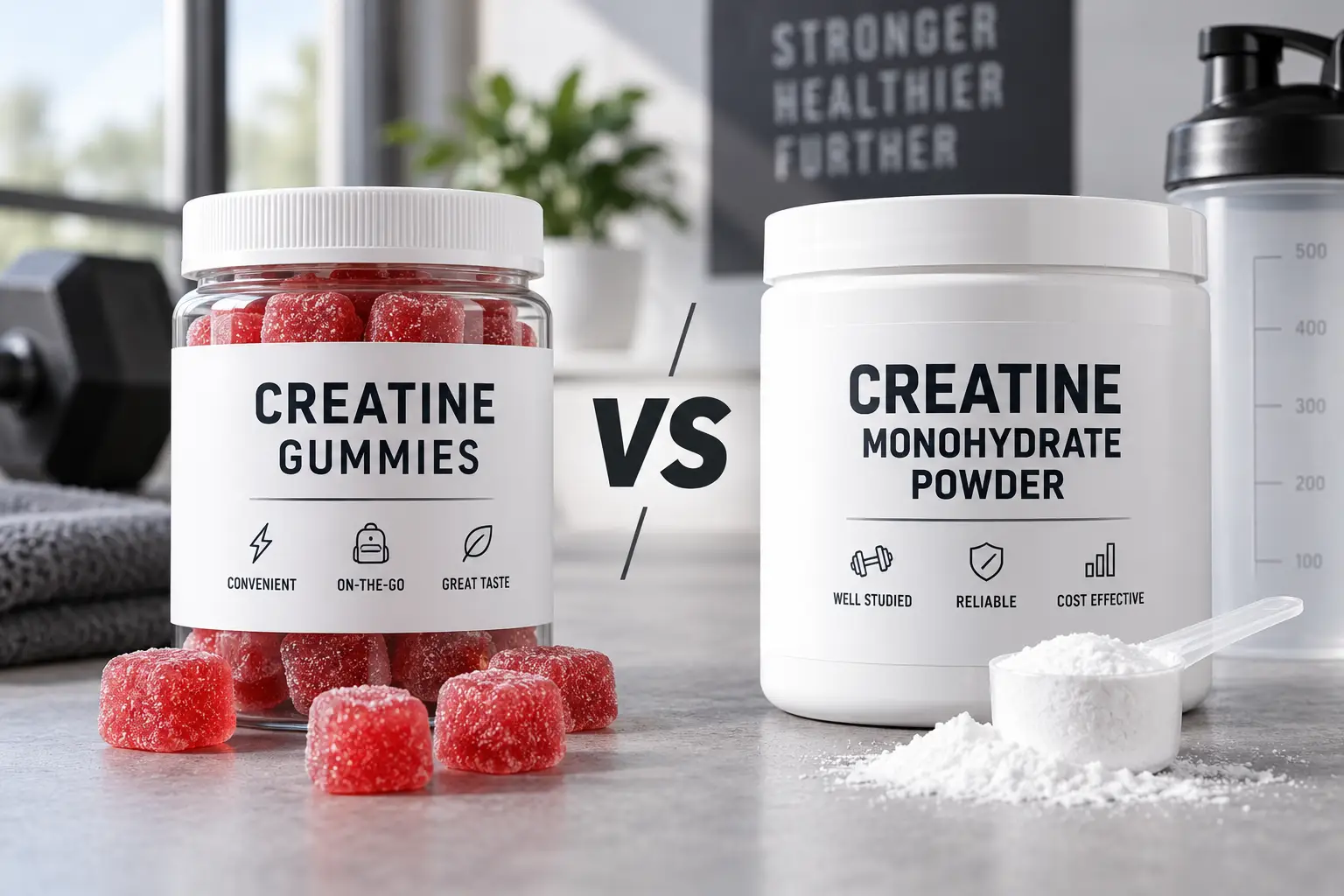

Creatine used to be one of the simplest products in sports nutrition. A consumer bought a tub of white powder, measured a scoop, mixed it with water, and drank it every day.
Creatine gummies changed that experience. They are easier to carry and require no shaker or measuring scoop. But convenience has also created a new problem. A gummy can look attractive and still provide too little creatine, poor stability, or a serving size that does not match the amount commonly used in creatine research.
For consumers, this makes product selection harder. For supplement brands, it creates an even bigger question: how can you tell whether a creatine gummy is actually well designed?
Creatine gummies can work when they provide an appropriate amount of creatine monohydrate and maintain that amount throughout the product's shelf life. The gummy format does not change the basic function of creatine. What matters more is the form of creatine, the amount per serving, product stability, manufacturing control, and finished-product testing. Creatine monohydrate remains the most studied form of creatine, and common supplementation protocols often use about 3–5 grams per day.
The real question is therefore not simply whether creatine works. That has already been studied extensively. The more useful question is whether a gummy can reliably deliver creatine in a practical serving while maintaining its quality during manufacturing and storage.
That is where dosage, formulation, stability, and manufacturing quality become important.
Do Creatine Gummies Work?
Creatine gummies can deliver creatine in the same general way that powders, capsules, and other oral formats do. The active ingredient still needs to reach the digestive system and become available for absorption.
The gummy itself is mainly a delivery system.
This means a gummy does not automatically make creatine more effective. It also does not automatically make creatine less effective. The important question is whether the finished product provides the amount stated on its label.
Creatine monohydrate has a long history of research in sports nutrition. Studies have linked creatine supplementation with increased muscle creatine stores and improvements in certain forms of high-intensity exercise performance.
Research directly involving creatine gummies is newer.
This does not mean gummy products should be treated as unproven. It means brands need to separate the scientific evidence behind creatine itself from the quality of a specific finished gummy product.
Different creatine gummies can contain different amounts of creatine. They can also use different gummy bases, moisture levels, manufacturing processes, packaging systems, and storage conditions.
These differences can affect the final product.
Quick Answer
Yes, creatine gummies can work if the finished product delivers an appropriate amount of creatine monohydrate and maintains that amount during storage. The gummy is mainly a delivery format. Dose, stability, formulation quality, and testing matter more than whether creatine comes in a powder or gummy.

What Does the Research Actually Tell Us?
Most creatine research has historically focused on creatine monohydrate rather than the gummy format itself.
That distinction matters.
Consumers sometimes see a new delivery format and assume it changes the function of the ingredient. In most cases, that is not the right way to evaluate the product.
The main active ingredient is still creatine.
A properly manufactured gummy can act as another way to consume creatine monohydrate.
However, brands should avoid making claims such as "gummies work better than powder" unless they have strong evidence to support that statement.
The more reasonable position is that gummies can offer a different user experience while still delivering the same core ingredient.
Why Does Consistency Matter?
Creatine is not usually taken because consumers expect to feel an immediate effect after one serving.
Creatine supplementation works partly by increasing muscle creatine stores over time.
For this reason, regular intake matters.
A convenient format may help some consumers use the product more consistently. Gummies can be taken without water, mixing, or measuring. They can also be easier to carry to work, the gym, or while traveling.
However, convenience cannot compensate for a weak formula.
A gummy still needs to provide a meaningful amount of creatine.
| Factor | Why It Matters |
|---|---|
| Creatine form | Creatine monohydrate has the strongest research base |
| Amount per serving | The product should provide a meaningful daily amount |
| Serving size | Too many gummies can reduce convenience |
| Stability | Creatine content should remain controlled during shelf life |
| Finished-product testing | Testing helps verify actual creatine content |
| Consumer consistency | Regular intake is important for creatine supplementation |
Claim 1: Creatine monohydrate remains one of the most widely studied forms of creatine in sports nutrition.
Claim 2: A gummy format can provide creatine monohydrate, but the effectiveness of the final product still depends on dose, stability, and manufacturing quality.
Why Is Creatine Monohydrate Used in Creatine Gummies?
Creatine is available in several forms, but creatine monohydrate remains the standard reference point for most supplement development.
This is not simply because the ingredient is familiar.
It is mainly because creatine monohydrate has a large body of research behind it.
Other forms of creatine have been marketed with claims related to solubility, absorption, or improved performance. However, better solubility does not automatically mean better physiological results.
For supplement brands, this matters.
A new creatine product needs more than a modern flavor and attractive packaging. The active ingredient also needs to make sense to consumers who already understand the category.
Creatine monohydrate has strong recognition in sports nutrition.
Consumers often search for it directly. Retailers and distributors also understand what the ingredient is.
This can make creatine monohydrate gummies easier to position than products based on less familiar creatine forms.
The challenge is not only choosing the ingredient.
The manufacturer also needs to make that ingredient work inside a gummy system.
A gummy contains moisture. It may also contain acids, sweeteners, flavors, gelling agents, and other ingredients. This creates formulation questions that do not exist in the same way with simple dry creatine powder.
Quick Answer
Creatine monohydrate is commonly used in creatine gummies because it has the strongest research base, high consumer recognition, and a long history of use in sports nutrition. Other creatine forms exist, but they have not consistently shown clear advantages over creatine monohydrate.

Why Does Ingredient Form Matter to a Brand?
The ingredient form affects several parts of product development.
It affects how consumers understand the product.
It affects the claims a brand may want to make.
It can also affect how easy it is to support marketing statements with existing research.
A familiar ingredient usually requires less consumer education.
For example, a product labeled as creatine monohydrate gummies immediately tells experienced fitness consumers what type of creatine they are receiving.
That can make product communication simpler.
Does Better Solubility Mean Better Creatine?
Not necessarily.
Creatine monohydrate has limited solubility in water. This has encouraged companies to develop alternative creatine forms.
However, greater solubility alone does not prove that another form produces better muscle uptake or better performance.
The total formulation still matters more.
| Development Question | Practical Consideration |
|---|---|
| Which creatine form has the strongest research base? | Creatine monohydrate |
| Do consumers recognize the ingredient? | Usually yes |
| Does higher solubility guarantee better results? | No |
| Is gummy formulation the same as powder formulation? | No |
| Does finished-product stability require attention? | Yes |
Claim 1: Creatine monohydrate remains the reference form used in much of the research on creatine supplementation.
Claim 2: Better ingredient solubility does not automatically mean better performance or better product effectiveness.
How Much Creatine Should Creatine Gummies Provide?
Dosage is one of the most important questions in creatine gummy formulation.
A product may display "creatine" prominently on the front of the bottle. However, consumers still need to check how much creatine is provided in one gummy and in one full serving.
Those numbers are not always the same.
Many creatine supplementation protocols use amounts measured in grams rather than a few hundred milligrams.
A common daily maintenance range is around 3–5 grams of creatine.
This creates an important formulation challenge for gummies.
A manufacturer needs to fit enough creatine into each piece while maintaining acceptable texture, flavor, appearance, and manufacturing performance.
If each gummy contains only a small amount, the consumer may need to eat many gummies every day.
That can reduce convenience.
It can also increase the amount of sweeteners, flavors, gummy base, and other ingredients consumed with each daily serving.
This is why creatine content per gummy deserves as much attention as the total amount shown on the front of the package.
Quick Answer
Many creatine supplementation protocols use around 3–5 grams of creatine monohydrate per day. For creatine gummies, brands should evaluate both the amount per gummy and the amount in the full daily serving. A high gummy count can reduce convenience even if the final daily dose looks reasonable.

Why Does the Amount Per Gummy Matter?
Consider a creatine gummy that contains 1,500 mg of creatine monohydrate per piece.
Two gummies would provide:
1,500 mg × 2 = 3,000 mg, or 3 g
Three gummies would provide:
1,500 mg × 3 = 4,500 mg, or 4.5 g
This structure gives a brand practical serving options.
It also keeps the daily number of gummies relatively manageable.
A serving of 3–4.5 grams also falls within the range commonly used in many creatine supplementation protocols.
The final serving instructions should still match the finished formulation, target market, product positioning, and applicable labeling requirements.
Why Not Put 5 Grams Into One Gummy?
A gummy is not an unlimited delivery system.
A very high active load can affect gummy size, texture, flavor, processing, and consumer experience.
A manufacturer therefore needs to balance several factors.
| Formulation Factor | What the Brand Needs to Balance |
|---|---|
| Creatine per gummy | Enough to create a practical serving |
| Gummy size | Comfortable to chew |
| Number of gummies | Easy daily use |
| Texture | Stable and pleasant |
| Flavor | Able to mask the active ingredient |
| Stability | Maintain target potency |
| Cost | Suitable for the target retail price |
A technically possible formulation is not always a commercially strong product.
The best formulation is usually the one that balances meaningful active content with a serving size that consumers can understand and use consistently.
Claim 1: Around 3–5 grams per day is a common maintenance range used in creatine supplementation.
Claim 2: A 1,500 mg-per-gummy formulation can provide 3 grams in two gummies or 4.5 grams in three gummies, which creates a practical daily serving structure.
Creatine Gummies vs. Powder: Which Is Better?
Creatine powder and creatine gummies can provide the same core ingredient, but they solve different consumer problems.
Powder remains the simplest format.
It can provide several grams of creatine in one scoop. It also allows users to adjust the amount easily.
Creatine monohydrate powder is also relatively straightforward from a formulation perspective because the ingredient is stored in a dry state.
Gummies offer a different advantage.
They remove the scoop, shaker, mixing step, and loose powder.
A consumer can put a bottle in a gym bag, office drawer, or travel bag and take a measured number of pieces.
This convenience can make gummies attractive to consumers who dislike powder or regularly forget to prepare a drink.
The trade-off is that gummies create more formulation complexity.
A gummy contains more than creatine.
The manufacturer also needs to manage the gummy base, flavor, sweetener system, acids, moisture, processing temperature, and finished texture.
Brands should therefore avoid asking which format is universally better.
A more useful question is which format better fits the target consumer, price position, and product strategy.
Quick Answer
Creatine powder is usually simpler, more dose-flexible, and easier to formulate at high amounts. Creatine gummies offer greater convenience and a more consumer-friendly experience. If both formats provide a verified amount of creatine monohydrate, the main differences are convenience, serving format, formulation complexity, price, and stability.

Where Does Powder Have an Advantage?
Dry creatine monohydrate has strong stability.
Powder can also provide a 3–5 gram serving without requiring several separate pieces.
For cost-focused consumers, this can make powder attractive.
Powder products may also have lower manufacturing costs because the formulation is simpler.
Where Do Gummies Have an Advantage?
Gummies make the consumption process easier.
There is no measuring scoop.
There is no powder residue.
There is no need to find water immediately.
Gummies can also create more opportunities for flavor, packaging, and brand differentiation.
This matters in a mature sports nutrition category.
Two creatine powders may look very similar on a shelf.
Gummies give brands more room to differentiate through shape, flavor, bottle design, sugar strategy, serving size, and positioning.
| Factor | Creatine Gummies | Creatine Powder |
|---|---|---|
| Convenience | High | Requires mixing |
| Dose flexibility | Moderate | High |
| Active load per serving | Limited by gummy design | Easy to increase |
| Flavor options | High | High |
| Formulation complexity | Higher | Lower |
| Stability | More formulation dependent | Strong in dry form |
| Portability | High | Moderate |
| Product differentiation | High | Moderate |
| Consumer experience | Chewable and convenient | Traditional sports nutrition format |
The choice is therefore not purely scientific.
It is also commercial.
A value-focused sports nutrition brand may prefer powder.
A lifestyle or convenience-focused brand may see more opportunity in gummies.
Some brands may also carry both formats for different consumer groups.
Claim 1: Dry creatine monohydrate offers strong stability and allows several grams to be delivered easily in one serving.
Claim 2: Gummies offer stronger convenience and product differentiation, but they require more careful formulation and manufacturing control.
What Affects Creatine Gummy Stability and Quality?
Stability is one of the most important issues in creatine gummy development.
Creatine monohydrate behaves differently as a dry powder than it does when exposed to moisture.
In dry form, creatine monohydrate is relatively stable.
When water is present, creatine can gradually convert into creatinine. The rate of this process can be influenced by factors such as pH, temperature, moisture, and storage time.
This does not mean creatine cannot be used in gummies.
It means manufacturers need to understand the ingredient rather than treating it like a standard flavor or vitamin addition.
A gummy is a complex food matrix.
Its moisture level, acid system, cooking process, cooling process, active addition stage, and storage environment can all affect the finished product.
The amount of creatine added during production is therefore only one part of the quality discussion.
A brand should also ask how much creatine remains after manufacturing.
Then it should consider how much remains during the product's shelf life.
This is especially important for products that may spend months moving through manufacturing, international shipping, warehouses, distributors, retailers, and finally the consumer's home.
Quick Answer
Creatine gummy stability depends on more than the amount of creatine added during manufacturing. Moisture, pH, temperature, processing conditions, packaging, and storage time can affect the finished product. For this reason, finished-product testing and stability planning are important parts of creatine gummy development.

Why Are Moisture and pH Important?
Creatine is less stable after it enters a moisture-containing environment than when it remains in a dry powder.
This is important because gummies naturally contain moisture.
Gummy products also commonly use acids to control flavor and texture.
The manufacturer therefore needs to control the complete system.
Temperature also matters.
Processing conditions that work for one gummy formulation may not be ideal for another active ingredient.
This is why formulation design and production experience matter.
Why Is Finished-Product Testing Important?
Raw material testing answers one question:
Was the incoming creatine ingredient acceptable before manufacturing?
Finished-product testing answers another question:
How much creatine is actually present after the product has been manufactured?
For creatine gummies, the second question can be especially important.
A strong quality program may consider several stages.
| Quality Stage | Main Question |
|---|---|
| Raw material verification | Is the incoming creatine within specification? |
| In-process control | Is the manufacturing process staying within target conditions? |
| Finished-product assay | Does the gummy contain the expected creatine amount? |
| Microbiological testing | Does the finished gummy meet safety specifications? |
| Stability evaluation | Does the product maintain specifications during storage? |
| Packaging review | Does the packaging help protect the gummy? |
Brands should not assume that an attractive gummy automatically represents a technically strong formulation.
Texture and flavor are visible to consumers.
Potency and stability usually are not.
This makes analytical testing valuable.
Claim 1: Creatine monohydrate is more stable in dry form than in moisture-containing environments.
Claim 2: Finished-product testing is important because the amount of creatine added during production does not by itself confirm the amount present in the finished gummy throughout its shelf life.
What Should Supplement Brands Check Before Sourcing Creatine Gummies?
A creatine gummy project should not begin with flavor or bottle color.
Those decisions matter, but they should not come first.
The first questions should focus on the product itself.
Brands should understand which form of creatine is being used, how much is present per gummy, how many gummies make one serving, and how the manufacturer controls finished-product quality.
The supplier should also be able to explain the manufacturing format clearly.
This is especially important for private-label buyers.
A ready-made formula can shorten development time, but a buyer still needs to understand what is being purchased.
The same principle applies to custom formulas.
Adding more ingredients does not automatically create a better product.
Every additional active can change flavor, texture, production performance, cost, or stability.
A strong sourcing decision therefore combines formulation, manufacturing, commercial positioning, documentation, and regulatory planning.
Price is still important.
However, the lowest price per bottle does not always create the lowest cost per useful serving.
A product with a low creatine amount per gummy may require consumers to take many gummies every day.
That can affect product reviews, repeat purchases, packaging size, and cost per daily serving.
Quick Answer
Before sourcing creatine gummies, supplement brands should check the creatine form, amount per gummy, daily serving size, finished-product testing, stability strategy, manufacturing standards, packaging, documentation, MOQ, and labeling requirements. Price matters, but a low unit price has limited value if the product cannot support the intended dose or quality position.

What Should You Ask a Creatine Gummy Manufacturer?
A buyer does not need to become a formulation scientist.
But the buyer should ask enough questions to understand the product.
| Question | Why It Matters |
|---|---|
| What form of creatine is used? | Helps assess research support and positioning |
| How much creatine is in each gummy? | Determines the practical serving size |
| How many gummies are required daily? | Affects convenience and cost per serving |
| Is creatine tested in the finished gummy? | Helps verify actual potency |
| Has stability been considered? | Helps assess shelf-life planning |
| What gummy base is used? | Affects positioning and market fit |
| What packaging is recommended? | Helps protect product quality |
| What documentation is available? | Important for registration and import |
| What is the MOQ? | Determines launch investment |
| Can the label and packaging be customized? | Important for private-label projects |
| What is the production lead time? | Helps with inventory planning |
| Can samples be provided first? | Helps brands evaluate taste and texture |
Should You Choose Ready Stock or Custom Manufacturing?
The answer depends on the brand stage.
A startup or distributor that wants to test demand may prefer an existing formula.
This can reduce development work and shorten the route to market.
A mature brand may need more differentiation.
That can mean changes to flavor, gummy base, serving size, supporting ingredients, packaging, or formula positioning.
However, customization should solve a real commercial problem.
It should not be added only to make the ingredient list longer.
For brands entering the creatine gummy category quickly, a ready-stock formula can offer another advantage.
The product can be evaluated before the buyer invests in a completely new formulation.
For example, a ready-stock formulation that provides 1,500 mg of creatine monohydrate per gummy allows a brand to consider a two-gummy serving that provides 3 grams or a three-gummy serving that provides 4.5 grams.
This gives the product a clear dosage structure while keeping the daily number of gummies manageable.
The final serving instructions and claims should always match the product specification, target market, testing results, and applicable regulations.
Claim 1: Creatine content per gummy, finished-product potency, serving size, stability, and documentation are important sourcing criteria for B2B buyers.
Claim 2: Ready-stock formulas can help brands shorten development time, while custom manufacturing may be more suitable when the brand needs stronger differentiation.
Conclusion
Creatine gummies are not simply candy with a sports nutrition ingredient added.
A strong product needs to deliver a useful amount of creatine, provide a practical serving size, maintain acceptable quality during storage, and match the positioning promised on the label.
Creatine monohydrate remains the most established form because it has a large body of research behind it.
However, the delivery format still matters from a product development perspective.
Gummies offer convenience and stronger opportunities for product differentiation. At the same time, they create additional formulation and stability challenges compared with dry creatine powder.
Consumers should look beyond the word "creatine" on the front of the bottle.
They should check the amount per gummy and the amount in the full serving.
Supplement brands should go further.
They should also evaluate finished-product testing, stability, manufacturing controls, packaging, serving structure, documentation, and supplier experience.
The best creatine gummy is therefore not simply the gummy with the highest number on the label.
It is the product that balances a meaningful creatine amount, practical daily use, stable manufacturing, and a clear market position.
For brands that want to enter the creatine gummy category without developing a formula from zero, SD Health Biotech offers creatine monohydrate gummies containing 1,500 mg of creatine monohydrate per gummy. You can develop your project with private-label packaging, OEM/ODM support, label customization, and scalable manufacturing for different market needs.