Starting your own nutritional supplement business sounds straightforward until you discover that the real challenge isn't picking ingredients—it's navigating a complex chain of regulatory requirements, supply-chain decisions, and market-entry logistics that most first-time founders never see coming. The gap between "I have a product idea" and "I have a product on shelves" is wider than most online guides admit.
To start a nutritional supplement business, you need to define your target market first, then work backward through regulatory compliance, formulation feasibility, manufacturing partnership selection, packaging, testing, and distribution logistics. The process is non-linear and market-dependent—skipping any link in the chain can invalidate months of work and thousands in capital.
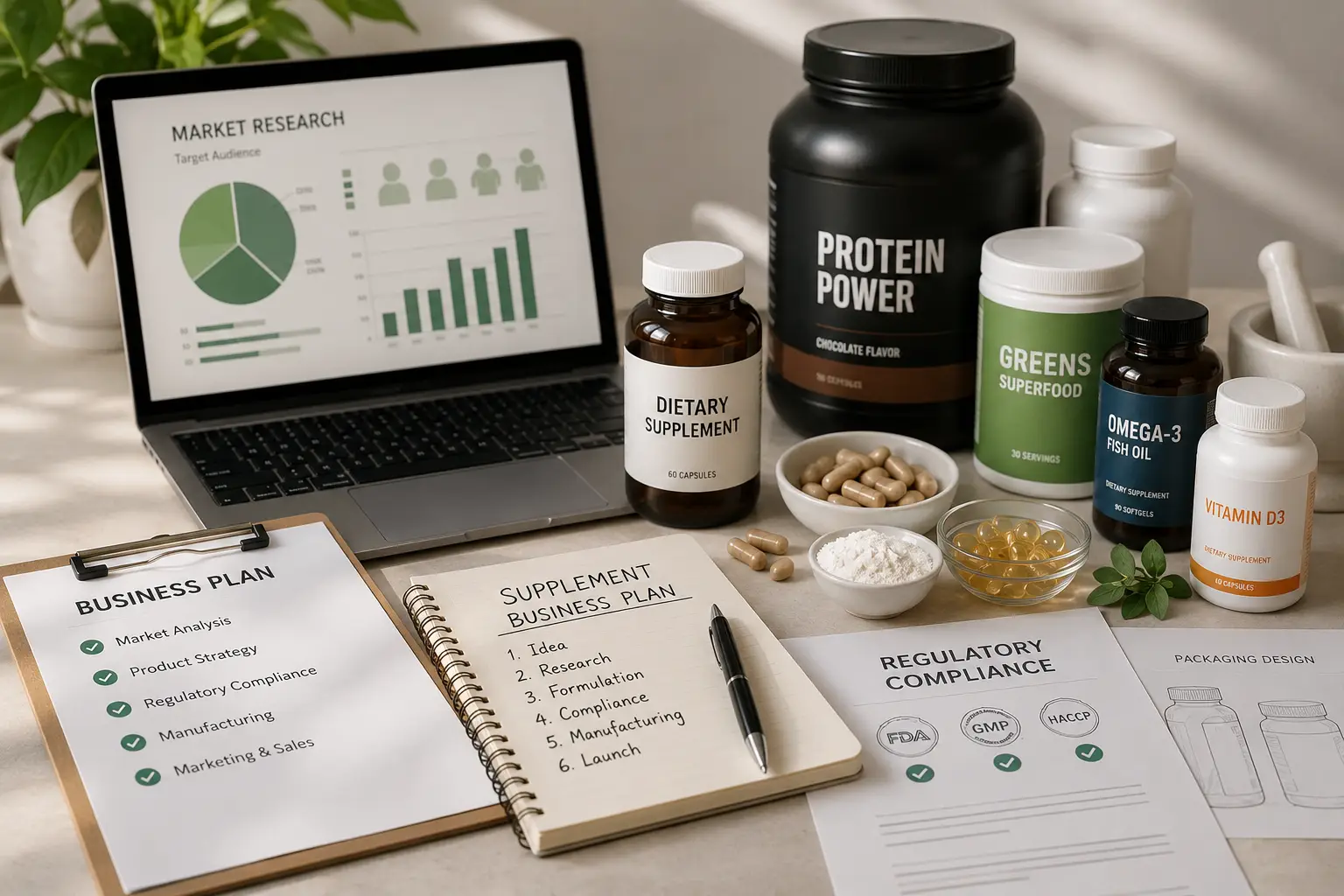
I've spent years on the manufacturing side of this industry, guiding first-time brand owners from their initial inquiry through to market launch. The patterns I see—where people get stuck, where budgets blow up, where timelines collapse—are remarkably consistent. Let me walk you through what actually matters, in the order it actually matters.
Why does your target market determine everything else?
Most founders start with a product idea. They've found a trending ingredient, or they want to sell the supplement they personally use. But in our experience, the single most consequential early decision isn't what you sell—it's where you sell it.
Your target market dictates which ingredients are permitted, what label claims you can make, which certifications your manufacturer needs, how your product must be tested, and what registration documents you'll need before a single bottle crosses the border. Choose your market first; everything else follows.

Why market selection matters more than product selection
Every country—and sometimes regions within countries—maintains its own regulatory framework for dietary supplements1. The differences are not minor. They are fundamental.
Consider these variations we encounter regularly when working with clients across different markets:
| Factor | Example: Southeast Asia | Example: North America | Example: Middle East |
|---|---|---|---|
| Product classification | May be classified as food, health food, or pharmaceutical depending on claims | Dietary supplement (distinct category) | Often requires pre-market registration |
| Permitted ingredients | Positive lists vary by country | Relatively broad, but NDI notifications may apply2 | Restricted lists, Halal certification often required3 |
| Label language | Local language mandatory in many markets | English (+ French in Canada) | Arabic required in most GCC countries |
| Registration timeline | Weeks to months depending on country | No pre-market approval for most supplements (US)4 | Can take 3–12 months |
| Required testing | Country-specific parameters | Third-party testing recommended, not always mandated pre-sale | Government lab testing may be required |
I've seen founders invest in a full production run—formula developed, packaging printed, product manufactured—only to discover that a key ingredient is restricted in their destination market. That's not a setback; that's a write-off.
What to decide before touching product development
Before you contact any manufacturer, answer these questions:
- Which country or countries will you sell in first? Start with one. Expansion comes later.
- What distribution channel? E-commerce, retail pharmacy, direct sales, and professional channels each carry different regulatory and packaging implications.
- Who is your end consumer? Age group, health concern, price sensitivity—these shape dosage form, serving size, and positioning.
- Do you have access to local regulatory counsel? If not, budget for it. This is not optional.
In our experience working with clients targeting the Philippines, for example, the product registration process through FDA Philippines requires specific documentation—Certificate of Product Registration, laboratory analysis from accredited labs, GMP certificates from the manufacturer5—that must be prepared before production, not after. Knowing this upfront saves months.
What does starting a supplement business actually cost?
Budget planning is where I see the most painful miscalculations. First-time founders often anchor on unit manufacturing cost—"How much per bottle?"—without accounting for the full capital chain required to get product to market.
The true startup cost for a nutritional supplement business extends far beyond manufacturing. You must budget for formulation development, regulatory consultation, third-party testing, minimum order quantities, packaging design and tooling, international freight, import duties, warehousing, and marketing. These collectively represent your real startup capital—not the per-unit price.

The hidden cost layers most founders miss
Let me break this into categories. These are illustrative ranges based on what we observe across our client base—your actual numbers will vary by market, product complexity, and volume.
Pre-production costs
- Regulatory consultation: Varies significantly by market. In some countries, a regulatory affairs consultant charges per product registration. In others, you may need ongoing retainer support.
- Formulation development: If you're working with a manufacturer's R&D team, this may be included or charged separately depending on complexity and exclusivity requirements.
- Stability testing: Required by many markets to establish shelf life claims. Typically takes 3–6 months for accelerated studies6.
- Third-party laboratory testing: Heavy metals, microbiology, potency verification, allergen testing—the panel depends on your market's requirements.
Production costs
- Minimum order quantities (MOQs): This is where many first-time founders hit reality. MOQs exist because production line changeover, quality control setup, and raw material procurement have fixed costs regardless of batch size. For capsules or tablets, MOQs from established manufacturers often start in the range of 50,000–100,000 units per SKU7. Smaller runs may be possible but at significantly higher per-unit cost.
- Packaging tooling: Custom molds for bottles, blister pack tooling, or specialized printing plates carry one-time setup costs.
- Raw materials: Some premium ingredients (branded extracts, patented forms) have their own MOQs from the ingredient supplier, which cascade into your production planning.
Post-production costs
- International freight: Container shipping, air freight for samples, customs clearance fees.
- Import duties and taxes: Country-specific, product-category-specific.
- Warehousing and fulfillment: Particularly relevant for e-commerce models.
- Marketing and brand building: The most variable—and often underestimated—category.
A realistic budgeting framework
Rather than quoting a single number, I recommend clients build a spreadsheet with these line items and get actual quotes for each. The total will vary enormously based on:
- Number of SKUs at launch (start with fewer than you think)
- Dosage form complexity (gummies cost more than capsules in tooling and formulation)
- Target market registration fees
- Volume tier pricing
The founders who succeed are those who treat this as a proper business investment with detailed financial planning—not a side project they can bootstrap with minimal capital.
Why can't I just find a formula online and manufacture it?
This is one of the most common starting points I see. A founder finds a competitor's supplement facts panel, or a formula from a research paper, and asks: "Can you make this?" The short answer is: maybe. The honest answer is: a formula found online is not a commercially viable formulation.
A commercially viable supplement formulation must satisfy five simultaneous constraints: regulatory permissibility in your target market, ingredient sourcing feasibility at commercial scale, manufacturing compatibility with available production equipment, stability across the product's intended shelf life, and alignment with the claims you're legally permitted to make. An ingredient list alone satisfies none of these.

The five feasibility gates every formula must pass
1. Regulatory permissibility
Not every ingredient is permitted in every market. Not every dosage is permitted even where the ingredient is allowed. Some ingredients require specific source declarations. Some require Novel Food applications in certain jurisdictions8. Your formula must be screened against your target market's positive/negative lists before any further work begins.
2. Sourcing feasibility
A research paper may use a specific extract standardized to a specific percentage that no commercial ingredient supplier produces at scale. Or the ingredient exists but only from a single supplier with 12-month lead times. Or the cost per kilogram makes your retail price uncompetitive. We regularly work with clients to identify equivalent alternatives that achieve similar functional positioning with commercially available materials.
3. Manufacturing compatibility
Some ingredient combinations create problems on production lines:
- Hygroscopic materials that absorb moisture and gum up tableting machines9
- Ingredients with strong odors or flavors that limit dosage form options
- Oil-soluble and water-soluble ingredients that can't be combined in a single capsule format
- Incompatible ingredients that degrade each other in the same formula
4. Stability
Will your formula maintain potency and safety throughout its shelf life? Probiotics degrade. Certain vitamins oxidize. Some botanical extracts interact with each other over time. Stability testing isn't a bureaucratic formality—it protects your brand reputation and your consumers10.
5. Claim alignment
What you want to say on your label and what you're permitted to say are often very different. Your formula should be designed to support the specific claims your target market allows—structure/function claims, health claims, or therapeutic claims each carry different evidence requirements11 and ingredient implications.
What a good formulation development process looks like
In practice, formulation is iterative. Here's what the process typically involves when we work with a new client:
- Brief: Client provides target market, desired positioning, target consumer, preferred dosage form, and rough price point.
- Draft formula: Our R&D team proposes one or more formulations meeting those constraints.
- Review: Client and their regulatory consultant review for market compliance.
- Sourcing confirmation: We verify ingredient availability, lead times, and cost.
- Pilot production: Small-scale trial run to confirm manufacturability.
- Stability initiation: Samples placed on stability testing.
- Revision: Adjustments based on pilot results (taste for gummies, dissolution for tablets, etc.).
This process takes time. Rushing it leads to products that can't be registered, can't be manufactured consistently, or can't support their label claims.
How do I choose and manage a manufacturing partner?
Selecting a manufacturer is not a price comparison exercise. It's a partnership decision that will determine your speed to market, your product quality, your regulatory compliance, and your ability to scale. I'll be transparent: I work on the manufacturing side. But I'll share what I've observed separates smooth projects from painful ones.
Choosing a supplement manufacturer requires evaluating their certifications, production capabilities, communication responsiveness, regulatory support capacity, and willingness to work with your specific volume tier. Managing that relationship effectively requires you to arrive prepared—with your target market defined, dosage form selected, volume forecast ready, and regulatory pathway identified—before your first conversation.

What to evaluate in a manufacturing partner
| Criteria | Why It Matters | Questions to Ask |
|---|---|---|
| Certifications (GMP, ISO, HACCP, Halal, etc.) | Required for market access and product registration | Which certifications do you hold? Can you provide copies? |
| Production capabilities | Not all factories handle all dosage forms | What formats do you produce? What are your line capacities? |
| MOQ flexibility | Critical for first-time launchers | What are your MOQs per SKU? Are pilot runs available? |
| Regulatory support | Reduces your burden significantly | Do you provide COA, GMP certificates, stability data in the format my market requires? |
| Communication | Possibly the most underestimated factor | Who is my primary contact? What is your typical response time? |
| Export experience | Relevant for international shipping | Have you shipped to my target market before? Do you handle export documentation? |
The information you should prepare before contacting any factory
This is where I see the biggest efficiency gap. Founders who arrive prepared get faster quotes, more accurate timelines, and better service. Founders who send a message saying "I want to start a supplement brand, what can you do?" receive generic responses because the factory cannot help without specifics.
Prepare this before your first inquiry:
- Target market(s): Country where product will be sold
- Dosage form preference: Capsules, softgels, tablets, gummies, powder, liquid
- Product concept: General category (multivitamin, joint health, weight management, etc.)
- Monthly/annual volume forecast: Even a rough estimate helps
- Regulatory pathway: Do you know what's required for registration? Have you consulted a regulatory specialist?
- Timeline: When do you need product ready?
- Budget range: Helps the manufacturer propose appropriate solutions
Managing the ongoing relationship
Once you've selected a partner, the relationship requires active management. In our experience, the most common friction points are:
- Documentation requests: Product registration often requires specific documents in specific formats. Discuss this early—not after production is complete.
- Revision cycles: Formula adjustments, packaging design changes, and label revisions all take time. Build buffer into your timeline.
- Quality expectations: Define your quality parameters upfront. What testing do you require? What are your acceptable limits? Put this in writing.
- Communication cadence: Establish regular check-ins, especially during production. Silence is not a sign that everything is fine.
I've observed that clients who treat manufacturing as a transaction ("make this, ship it") have worse outcomes than those who treat it as a collaboration. The factory knows things you don't—about ingredient behavior, production constraints, common pitfalls. Use that knowledge.
What does the actual timeline look like from idea to product?
New supplement brand founders almost universally underestimate timelines. The desire to move fast is understandable—but rushing creates expensive mistakes.
A realistic timeline from initial concept to first shipment of finished product typically ranges from 4 to 12 months12, depending on formulation complexity, regulatory requirements in your target market, packaging customization, and production scheduling. Markets requiring pre-market registration can add additional months before you can legally sell.

Typical phases and their durations
These ranges reflect what we observe across projects. Your specific timeline will depend on your market, product complexity, and how prepared you are at each stage.
| Phase | Typical Duration | Key Dependencies |
|---|---|---|
| Market research & regulatory assessment | 2–6 weeks | Access to regulatory counsel, market clarity |
| Formulation development | 3–8 weeks | Ingredient availability, revision cycles |
| Packaging & label design | 2–6 weeks | Design complexity, regulatory review of claims |
| Pilot production & testing | 2–4 weeks | Factory scheduling, test turnaround |
| Stability testing (accelerated) | 3–6 months | Can run parallel to other steps |
| Full production | 3–6 weeks | MOQ size, raw material lead times |
| Quality control & documentation | 1–2 weeks | Testing panel scope |
| Shipping & customs clearance | 2–6 weeks | Destination country, shipping method |
| Product registration (if required) | 1–12 months | Market-specific, often runs parallel |
Where delays actually happen
In our experience, the most common timeline killers are:
- Waiting for regulatory clarity: Founders who haven't consulted a local regulatory specialist often stall at this stage because they don't know what's required.
- Packaging revisions: Label claim language goes through multiple revisions when regulatory review happens after design is "finished."
- Ingredient lead times: Some specialty ingredients have 8–12 week lead times from suppliers.
- Indecision: Founders changing their mind about dosage form, target audience, or formula direction mid-process effectively restart the clock.
The most efficient projects I've seen are those where the founder did their regulatory homework first, arrived at the manufacturer with clear parameters, and made decisions decisively when presented with options.
Frequently Asked Questions
Do I need a specific license or certification to sell supplements?
Requirements vary dramatically by country. Some markets require a business license with specific food or health product categories. Others require product-by-product registration. Some require both. Consult a regulatory affairs professional in your target market before assuming you know what's needed—this is not an area where generic internet advice is reliable.
How much money do I need to start a supplement brand?
There is no universal answer. Capital requirements depend on your number of SKUs, dosage form complexity, target market registration costs, order volume, and marketing strategy. However, this is a capital-intensive business with significant upfront costs before any revenue. Expect to invest substantially more than just the manufacturing cost per unit.
Can I start with a very small order to test the market?
Some manufacturers offer pilot runs or lower MOQs at higher per-unit pricing. This can be a reasonable way to validate market demand before committing to full-scale production. However, per-unit economics at small scale may not reflect your actual margins at commercial volumes—factor this into your test strategy.
How do I protect my formula from being copied?
Discuss confidentiality agreements (NDAs) with your manufacturing partner before sharing propri
"A Comparison of Current Regulatory Frameworks for ... - PMC", https://pmc.ncbi.nlm.nih.gov/articles/PMC8326690/. The World Health Organization and comparative regulatory analyses document substantial international variation in how dietary supplements are classified and regulated, with some countries treating them as foods, others as specialized health products, and others requiring pharmaceutical-level registration, creating a fragmented global regulatory landscape. Evidence role: general_support; source type: institution. Supports: There is no harmonized global regulatory framework for dietary supplements, with significant variation in how countries classify, regulate, and control these products.. Scope note: While harmonization efforts exist (e.g., Codex Alimentarius guidelines), implementation varies significantly at the national level. ↩
"New Dietary Ingredient (NDI) Notification Process", https://www.fda.gov/food/dietary-supplements/new-dietary-ingredient-ndi-notification-process. The FDA requires a 75-day pre-market notification for any dietary supplement containing a new dietary ingredient (NDI)—defined as an ingredient not marketed in the United States before October 15, 1994—under Section 8 of DSHEA. Evidence role: mechanism; source type: government. Supports: Manufacturers must submit a New Dietary Ingredient notification to the FDA at least 75 days before marketing a supplement containing an ingredient not marketed in the US before October 15, 1994.. ↩
"Global Halal Certification Requirements and Regulation ...", https://www.chemlinked.com/featured/global-halal-certification. The Saudi Food and Drug Authority (SFDA) and UAE regulatory bodies require that imported food products, including dietary supplements, comply with Halal standards, with certification from an accredited Halal certification body typically required as part of product registration documentation. Evidence role: general_support; source type: government. Supports: Gulf Cooperation Council countries generally require or strongly prefer Halal certification for food and health products, with specific requirements varying by country.. Scope note: Specific Halal certification requirements and accepted certifying bodies vary among GCC member states and may be updated periodically. ↩
"New Dietary Ingredient (NDI) Notification Process", https://www.fda.gov/food/dietary-supplements/new-dietary-ingredient-ndi-notification-process. The U.S. Food and Drug Administration confirms that under DSHEA (1994), manufacturers and distributors of dietary supplements are not required to obtain FDA approval before marketing their products, though they are responsible for ensuring safety and accurate labeling. Evidence role: definition; source type: government. Supports: Under the Dietary Supplement Health and Education Act of 1994 (DSHEA), dietary supplements do not require FDA pre-market review or approval before being marketed in the United States, unlike pharmaceutical drugs.. ↩
"Certificate of Product Registration - FDA eServices Portal", https://eservices.fda.gov.ph/applications/certificate_product_registration. The Philippine Food and Drug Administration mandates that health supplements obtain a Certificate of Product Registration prior to marketing, with application requirements including product laboratory analysis from FDA-recognized laboratories and a valid Certificate of Good Manufacturing Practice from the manufacturing facility. Evidence role: general_support; source type: government. Supports: The Philippine FDA requires a Certificate of Product Registration (CPR) and supporting documentation including laboratory analysis and manufacturer GMP certification for health supplements to be legally marketed in the Philippines.. Scope note: Specific documentary requirements may be updated periodically through FDA Philippines administrative orders; applicants should verify current requirements. ↩
"TRS 1010 - Annex 10: WHO guidelines on stability testing ...", https://www.who.int/publications/m/item/trs1010-annex10. ICH Guideline Q1A(R2) specifies that accelerated stability studies should be conducted at 40°C ± 2°C / 75% RH ± 5% RH for a minimum of 6 months, with data used to evaluate the effect of short-term excursions and to support tentative shelf life determinations when long-term data are not yet available. Evidence role: mechanism; source type: institution. Supports: Accelerated stability studies, conducted under elevated temperature and humidity conditions, typically run for 6 months under ICH guidelines to predict product shelf life.. Scope note: ICH guidelines are designed for pharmaceuticals; dietary supplement manufacturers may adapt these protocols, and some markets accept shorter accelerated study durations for food-category products. ↩
"21 CFR Part 111 -- Current Good Manufacturing Practice in ...", https://www.ecfr.gov/current/title-21/chapter-I/subchapter-B/part-111. Industry sources indicate that contract manufacturers of dietary supplements commonly set minimum order quantities ranging from tens of thousands to hundreds of thousands of units per SKU, driven by production line changeover costs, quality assurance protocols, and raw material supplier minimums. Evidence role: general_support; source type: other. Supports: Contract supplement manufacturers typically impose minimum order quantities that reflect fixed costs of production line setup, quality control, and raw material procurement, with MOQs varying by dosage form and manufacturer scale.. Scope note: MOQs vary significantly by manufacturer size, geographic location, dosage form, and whether the manufacturer specializes in startup brands or large-scale production. ↩
"Extracts Rich in Nutrients as Novel Food Ingredients to Be Used ... - PMC", https://pmc.ncbi.nlm.nih.gov/articles/PMC9370228/. Under EU Regulation 2015/2283, food ingredients—including those intended for dietary supplements—that lack a significant history of consumption within the EU prior to May 15, 1997, are classified as novel foods and must undergo a safety assessment by EFSA and receive European Commission authorization before being placed on the market. Evidence role: definition; source type: government. Supports: In the European Union, ingredients without a significant history of consumption prior to May 1997 are classified as novel foods under Regulation (EU) 2015/2283 and require pre-market authorization before use in food supplements.. Scope note: Novel Food regulations are specific to the EU and certain other jurisdictions that have adopted similar frameworks; not all markets use this classification system. ↩
"Formulation Strategies to Improve the Stability and Handling of Oral Solid ...", https://pmc.ncbi.nlm.nih.gov/articles/PMC9611293/. Pharmaceutical manufacturing literature documents that hygroscopic active ingredients and excipients absorb moisture from the environment, leading to poor powder flow, tablet sticking to punch faces, and inconsistent tablet weight and hardness during compression, necessitating humidity-controlled manufacturing environments or moisture-protective formulation strategies. Evidence role: mechanism; source type: paper. Supports: Hygroscopic ingredients absorb atmospheric moisture, which can cause sticking, picking, and flow problems during tablet compression, requiring environmental controls or formulation adjustments.. Scope note: Most published research focuses on pharmaceutical tablet manufacturing; supplement-specific data may differ due to different ingredient profiles and quality standards. ↩
"Stability of nutrients in complex liquid and powder food matrices - PMC", https://pmc.ncbi.nlm.nih.gov/articles/PMC12158562/. Research published in the Journal of AOAC International and guidance from ICH (International Council for Harmonisation) confirm that active pharmaceutical and nutraceutical ingredients undergo degradation during storage, with factors including temperature, humidity, and ingredient interactions affecting potency over the product's shelf life. Evidence role: mechanism; source type: research. Supports: Active ingredients in dietary supplements, particularly probiotics and certain vitamins, undergo measurable degradation during storage, making stability testing essential for accurate potency labeling.. Scope note: ICH guidelines are primarily designed for pharmaceuticals but are widely adopted as best practice in the supplement industry. ↩
"Structure/Function Claims", https://www.fda.gov/food/nutrition-food-labeling-and-critical-foods/structurefunction-claims. The FDA distinguishes between structure/function claims, which describe the role of a nutrient in maintaining normal body structure or function and require substantiation but not pre-approval, and health claims, which characterize a relationship between a substance and disease risk reduction and require either significant scientific agreement or qualifying language under an authorized or qualified health claim framework. Evidence role: definition; source type: government. Supports: US regulatory framework distinguishes between structure/function claims (which require manufacturer substantiation but no FDA pre-approval), qualified health claims, and authorized health claims, each with escalating evidence requirements.. Scope note: This classification applies specifically to the US market; other jurisdictions such as the EU (under EFSA) and individual Asian markets maintain different claim categorization systems. ↩
"A Global Overview of Dietary Supplements: Regulation ... - PMC", https://pmc.ncbi.nlm.nih.gov/articles/PMC10421343/. Industry analyses and contract manufacturing organizations report that new supplement product development timelines typically range from 4 to 18 months depending on formulation complexity, regulatory requirements of the target market, ingredient lead times, and whether pre-market registration is required. Evidence role: general_support; source type: other. Supports: The product development cycle for new dietary supplements, from concept through manufacturing and regulatory clearance to market entry, typically spans several months to over a year depending on complexity and market requirements.. Scope note: Timelines are highly variable and depend on factors including manufacturer capacity, regulatory jurisdiction, and brand owner preparedness; no single authoritative source provides a universal benchmark. ↩